3 ways SAIT’s School of Health and Public Safety uses simulation technology to train for the future
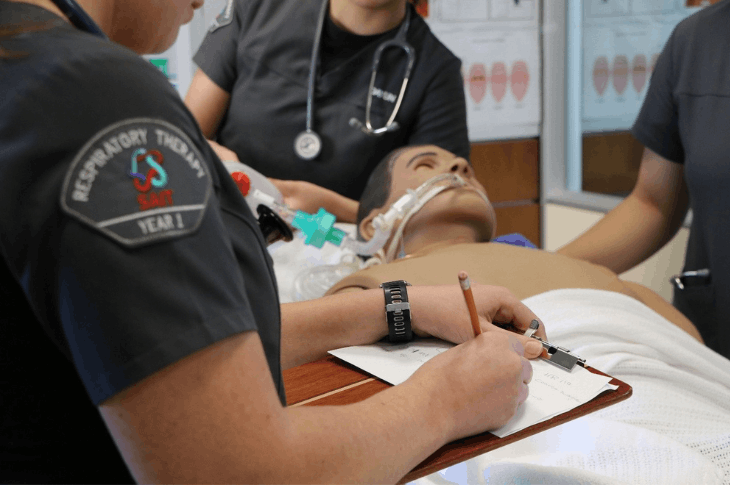
When it comes to getting hands-on in the classroom, there isn’t a one-size-fits-all approach at SAIT. That’s why students in SAIT’s School of Health and Public Safety (HPS) are using all kinds of technology to prepare for their future careers.
See how augmented reality, simulations and virtual reality help students’ lab-time mirror real-world workplaces such as hospitals, clinics and ambulances with simulations so lifelike some even breathe.
Turning the classroom into a medical clinic with virtual reality
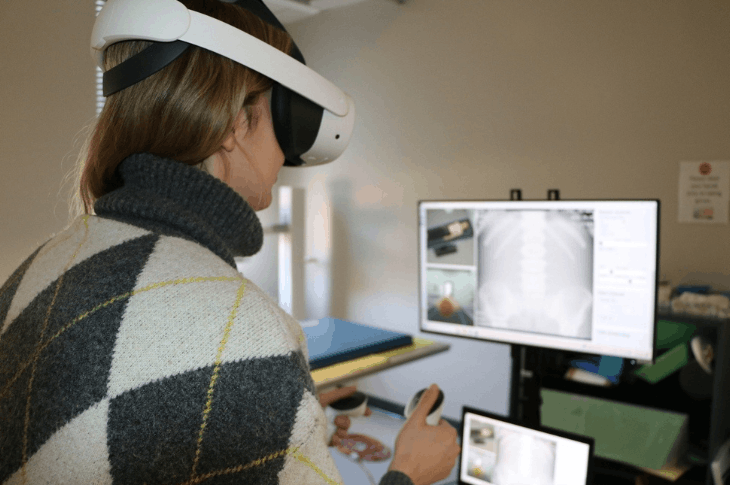
Virtual reality (VR) is being used to do incredible things by creating immersive, 3D environments through headsets.
At SAIT, when Medical Office Assistants and Unit Clerk students put those VR goggles on and the physical world disappears, they find themselves in a very different space: a clinic with patients, their families and other staff. .
The students interact with the patients, improving their communication skills, and ability to handle difficult situations in healthcare settings. It allows students to have an immersive experience and a safe space to make mistakes and learn from them.
But it’s not just practical — shifting to a virtual environment can also be the safest way to learn for some programs.
“One of the challenges of radiography education is having limited access to the x-ray rooms, and the inability to take images while practicing because of the radiation dose,” says Catherine Theng, an instructor with HPS.
To keep our Medical Radiologic Technology students safe while also learning how to perform essential tasks, they use VR simulation.
“This simulator allows students to practice positioning patients for different x-ray exams, while also allowing them to take the exposure and assess the resulting images for quality and accuracy.”
High-fidelity simulations in respiratory therapy
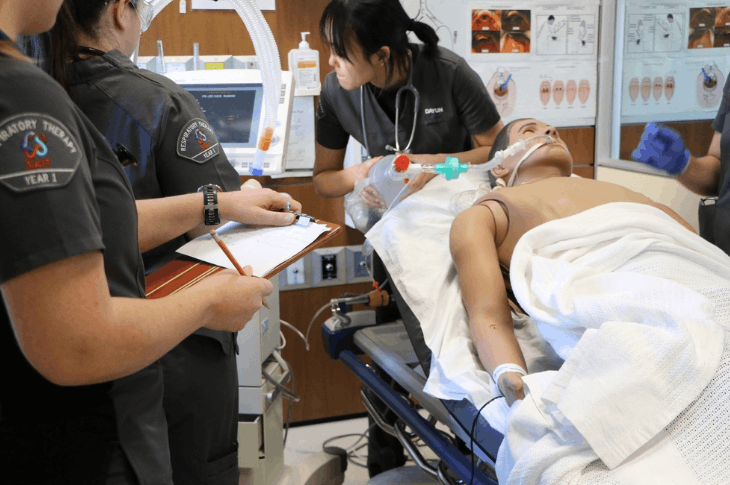
In HPS labs, simulators respond like living, breathing patients. They look like people. They blink. Their blood pressure goes up and down. Their chests rise and fall with “breath.”
In our Respiratory Therapy program, students work with these high-tech manikins before making the switch to real patients during their practicum placements.
Erin Choquette, an instructor with HPS, explains: “We teach intubation and ventilation on these manikins. They’re very specialized and their lungs function with the same stretch and volume as a human’s lungs. It allows us to have a lot of precision and simulations that really reflect the clinical environment.”
Respiratory therapy students have a weekly encounter with these manikins, where they put their classroom learnings to practice and prepare for the clinical environment. While the simulation takes place, instructors and learners participate in rapid cycle deliberative practice — meaning feedback is provided in real time, allowing students to repeat tasks or scenarios immediately after receiving corrections.
Bringing the optometry how-to manual straight to your fingertips
Complex optometry equipment isn’t something you can learn with just a click of a button. But it is something you can learn with help from a tap on a screen.
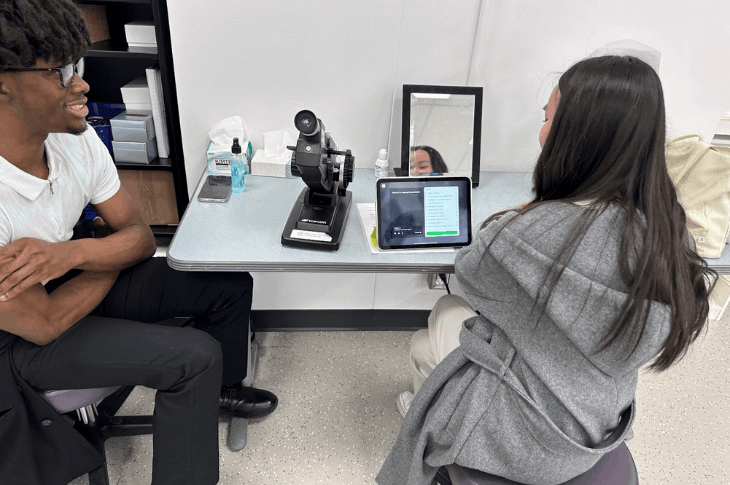
Using an iPad-based augmented reality app, SAIT’s Optician students explore various tools used in professional licensing exams.
An example is the lensometer — a device used to measure prescriptions and locate the optical centre (necessary, especially if you have progressive lenses, where the prescription changes based on the direction you’re looking in) — which students must be competent with to be certified by the National Alliance of Canadian Optician Regulator.
Students will use an iPad to scan the device, and the screen will label the device. To learn more about the functions of each component — like one of the lensometer’s many knobs — students can click the screen. When they do, a detailed description of the part’s function and how to use it will appear, alongside tutorial images and videos made by School of Health and Public Safety instructor Jennifer Hussein.
“It allows the students to get more hands-on and one-on-one with the tools,” she shares.
The future of simulation
Simulation is just one of the ways HPS students are trained and prepared for their future roles.
“In the simulation world, a word we use a lot of the time is ‘scaffolding,’” says Jawad Ali Hashim, Research and Simulation Lead, School of Health and Public Safety. “Scaffolding means preparing students with the basic knowledge, understanding and skills they need, building them up toward competence that can be transferred into a simulation, ultimately real life practice.”
We’re always looking for new ways to enhance accessibility and introduce flexible, hands-on training to students. These are just some of many initiatives using simulations in SAIT’s programs, with more to come.

Oki, Âba wathtech, Danit'ada, Tawnshi, Hello.
SAIT is located on the traditional territories of the Niitsitapi (Blackfoot) and the people of Treaty 7 which includes the Siksika, the Piikani, the Kainai, the Tsuut’ina and the Îyârhe Nakoda of Bearspaw, Chiniki and Goodstoney.
We are situated in an area the Blackfoot tribes traditionally called Moh’kinsstis, where the Bow River meets the Elbow River. We now call it the city of Calgary, which is also home to the Métis Nation of Alberta.