
Why take notes?
Taking notes during classes:
- helps keep you from getting distracted
- engages your mind (and prevents you from falling asleep)
- helps you clarify concepts and understand the content
- helps you collect and organize information before studying
- builds confidence in the material and reduces overall stress.
This video teaches a six-step system to efficiently extract information from textbooks, take better notes, and retain knowledge in the long term. Master strategies for effective note-taking and maximizing learning in class.
Three stages of note-taking
There are usually three main stages when note-taking in your classes:
Before class (prep)
For a minimum of five to 10 minutes, briefly review your previous notes and get a sense of what's coming up. This gives you a focus even before you enter the classroom.
- Review the last class
- Preview new material
- Read (or skim) assigned readings
- Arrive on time
- Sit where you can see and hear easily
- Have all supplies ready
During class
Participate and take notes. Focus on capturing main ideas using point form and abbreviations. If you miss something, mark it with a question mark or leave extra space in your notes to address later.
- Label your notes (date, topic, course)
- Record main ideas
- Use point form
- Use abbreviations and symbols
- Leave space
- Consider format
After class
For a minimum of 15 to 20 minutes, review the notes you took in class.
This is a key step that helps with comprehension and sets the stage before studying. Clean up and organize your notes, filling in any gaps using resources such as your textbook. You can also begin to create study notes for yourself during this stage.
- Compare with peers to check accuracy
- Review and edit
- Fill in any gaps
- Summarize
- Edit, clean-up, colour code
- Check your textbook
- Revisit within 24 hours
Note-taking formats
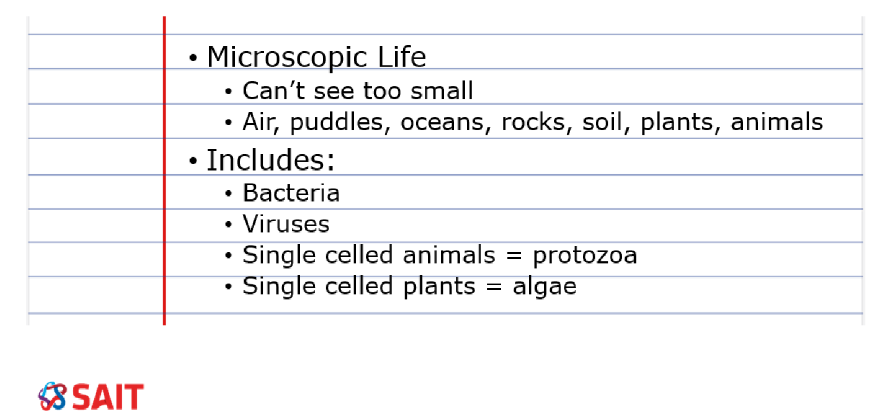
Traditional formats, or the outlining method, is one of the main note-taking systems used. It tends to be simple and straightforward.
You write your title, then add related information in point form underneath.
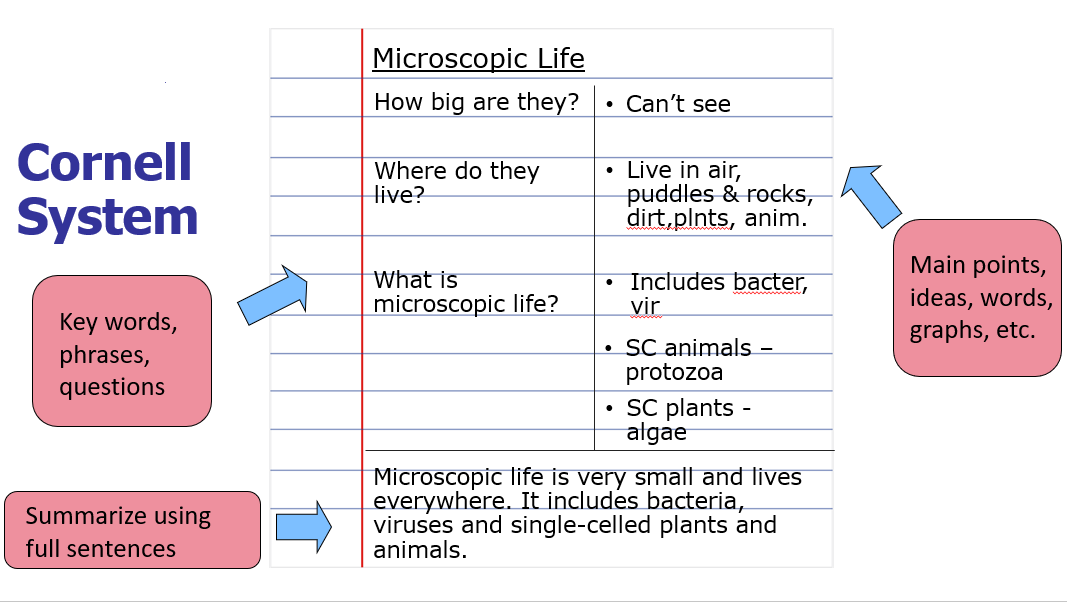
A popular technique in schools, the Cornell system combines traditional note-taking during class with adding keywords, phrases or questions when reviewing notes after class.
It also involves summarizing each page of your notes in full sentences.
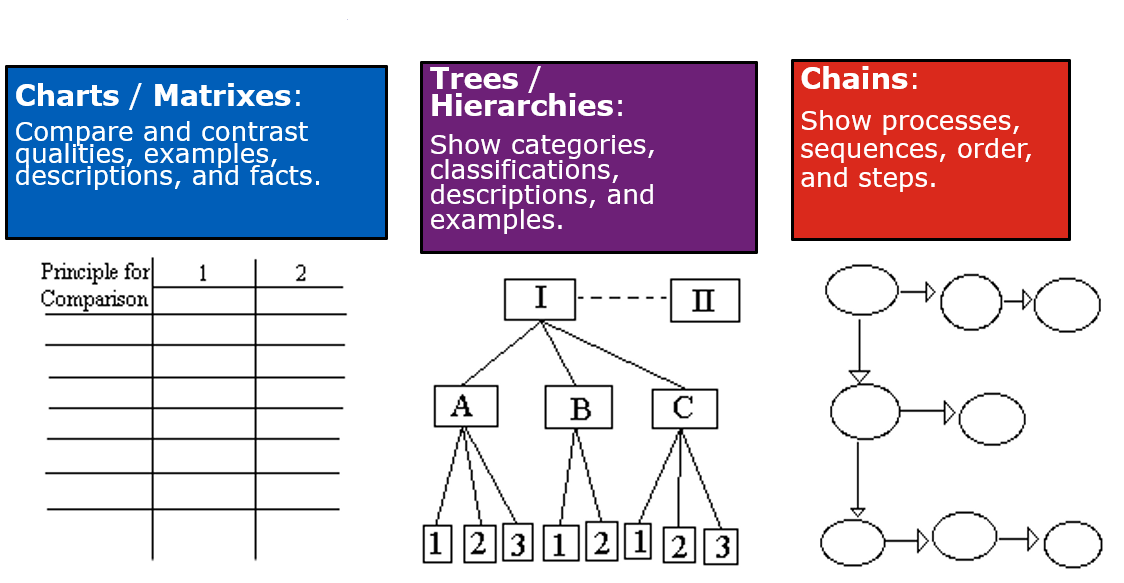
Concept mapping is specific to the material you are learning. If you are covering processes, you might try taking notes using a flow chart.
If you are covering several terms that appear quite similar, you might try a comparison-contrast chart to help distinguish the concepts.
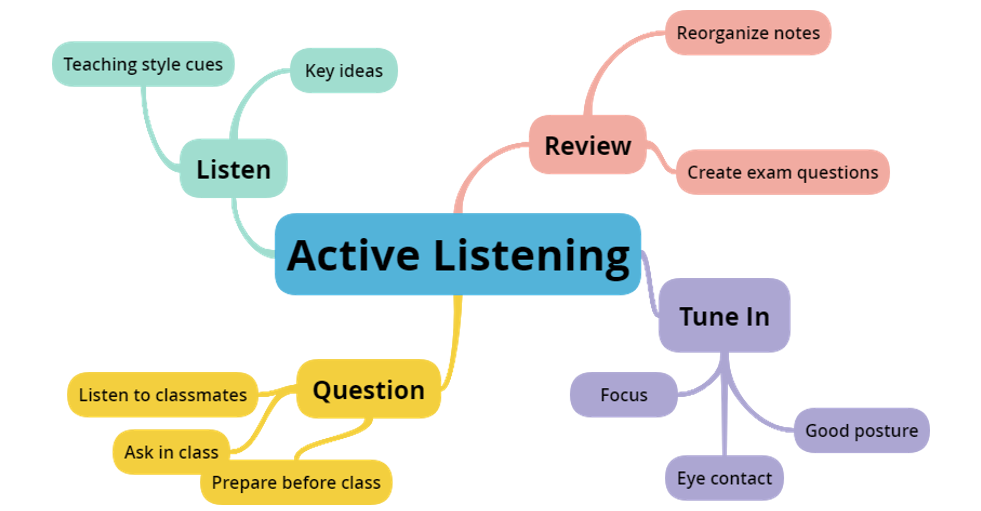
Mind mapping is quite similar to chains or flow charts.
You simply start with a main topic in the middle of your page and then branch out to groups of related ideas.
Should you handwrite or type?
Whether you handwrite or type your notes depends on your preference, and both approaches can be effective.
Handwritten notes
- Easier to create diagrams and illustrations
- Sometimes better for visual learners
- Provides more focus for those prone to digital distraction
- Can be better for conceptual information
Digital notes
- Faster and easier to take a higher volume of notes
- Easier to edit and reorganize
- Can be backed up, shared and searched
- Can be better for factual information
Download our handout
Find more tips on how to write quickly using short-hand, a checklist on listening and note-taking and templates for various note-taking styles.
Contact us
Learning Skills Services
Lamb Learner Success Centre, MC221, Stan Grad Centre
- Phone
- 403.284.7050
- llsc@sait.ca

Oki, Âba wathtech, Danit'ada, Tawnshi, Hello.
SAIT is located on the traditional territories of the Niitsitapi (Blackfoot) and the people of Treaty 7 which includes the Siksika, the Piikani, the Kainai, the Tsuut’ina and the Îyârhe Nakoda of Bearspaw, Chiniki and Goodstoney.
We are situated in an area the Blackfoot tribes traditionally called Moh’kinsstis, where the Bow River meets the Elbow River. We now call it the city of Calgary, which is also home to the Métis Nation of Alberta.