
The difference between active and passive learning
We are all passively taking in information all the time. Our brains know that much of it is unimportant.
So we forget it.
To retain the information that matters, we need to signal to our minds that the material we are learning in class is important, rather than simply allowing information to pass over us and expecting it to stick. In other words, we need to practice active study skills.
We share some strategies to help you make your study sessions more active.
This video is designed to help you activate your study skills by turning learning into a seamless daily routine rather than a source of stress. You'll discover how to enhance your memory using proven techniques to retain information, providing you with the tools to learn more effectively and feel better prepared for any challenge.
The learning cycle
Remember, learning takes time! Doing a small amount every day is more effective than doing a lot on one day.
A lot of learning happens outside the classroom.
Five questions to help you study
Whether you're studying for a final exam or are just looking to brush up before a quiz, you should really evaluate how you're studying.
First off, where exactly are you studying? There are great spots whether you are on or off campus.
On campus:
Studying on campus can be great if you take advantage of spaces that limit distractions, including:
- private desks
- secluded corners
- group study areas
- bookable rooms in the library.
Off-campus:
Studying off campus is the norm for most students. It's important to create a dedicated space for yourself that's quiet, has a comfortable temperature, offers good lighting, and has few distractions.
Don't cram!
Space out your study sessions over the day, week and term. Long sessions aren't good for concentration and retaining knowledge.
Create a realistic plan for what you wish to achieve, so you can determine exactly how much time to allocate day by day. Taking time to study every day is the best-case scenario, and it is possible for you.
If you try to study every piece of information your instructor has given you, you'll be stressed out quickly.
Try crafting your own study material to help you identify and focus on the most important parts.
How do you know what information is important? Look for:
- the hints your instructor gives you in class
- what's outlined study guides
- material on practice exams
- the content in Brightspace
- learning outcomes listed in your course outline.
How you study will affect how well you remember information.
More active studying methods will often work better. Just reading or listening to a lecture is less active than practicing test questions and teaching others.
In general, if you want some information to stick: hear it, read it, write it, and remember it.
Do a little of each every day.
Recall practice a study method where you attempt to recall specific test information without looking at any study resources.
When challenging yourself to recall information without any aids, you'll quickly see how well you know the subject.
You can use flashcards, an online tool (if available), practice tests or even cover your notes with your hands.
Understanding Learning outcomes
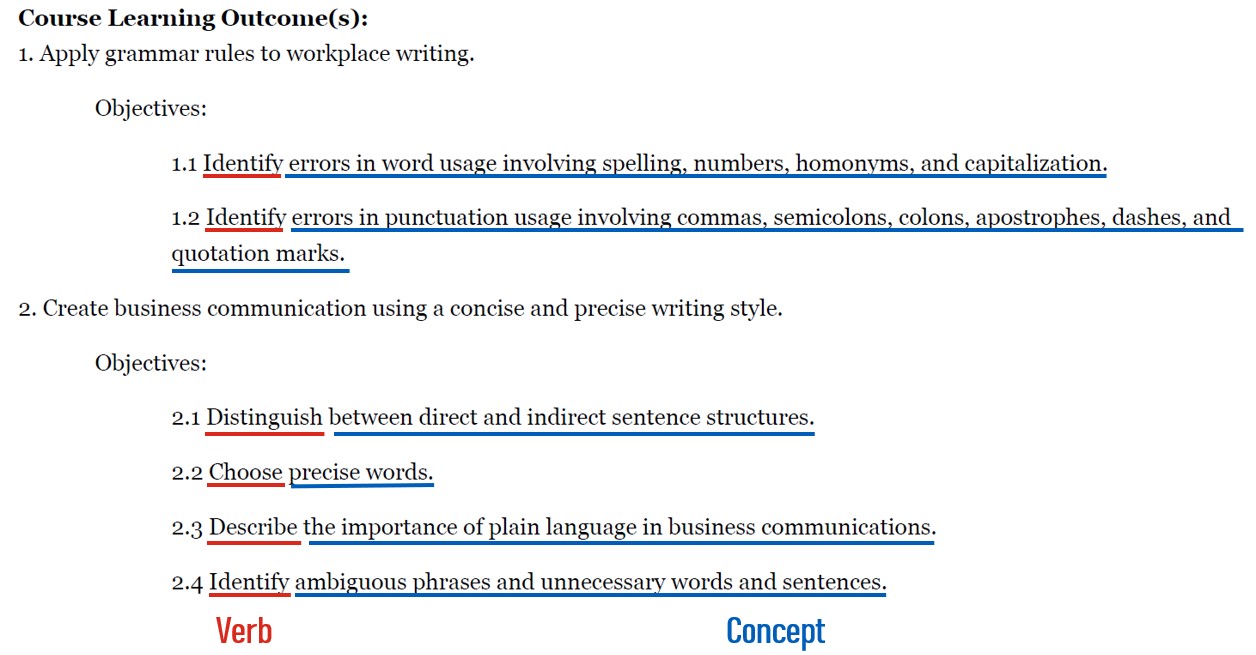
Learning outcomes include an action word (underlined in red) that describes exactly what you need to be able to do with the information.
The concepts/skills you need to demonstrate are underlined in blue. Use your course objectives to create practice questions.
Contact us
Learning Skills Services
Lamb Learner Success Centre, MC221, Stan Grad Centre
- Phone
- 403.284.7050
- llsc@sait.ca
Oki, Âba wathtech, Danit'ada, Tawnshi, Hello.
SAIT is located on the traditional territories of the Niitsitapi (Blackfoot) and the people of Treaty 7 which includes the Siksika, the Piikani, the Kainai, the Tsuut’ina and the Îyârhe Nakoda of Bearspaw, Chiniki and Goodstoney.
We are situated in an area the Blackfoot tribes traditionally called Moh’kinsstis, where the Bow River meets the Elbow River. We now call it the city of Calgary, which is also home to the Métis Nation of Alberta.