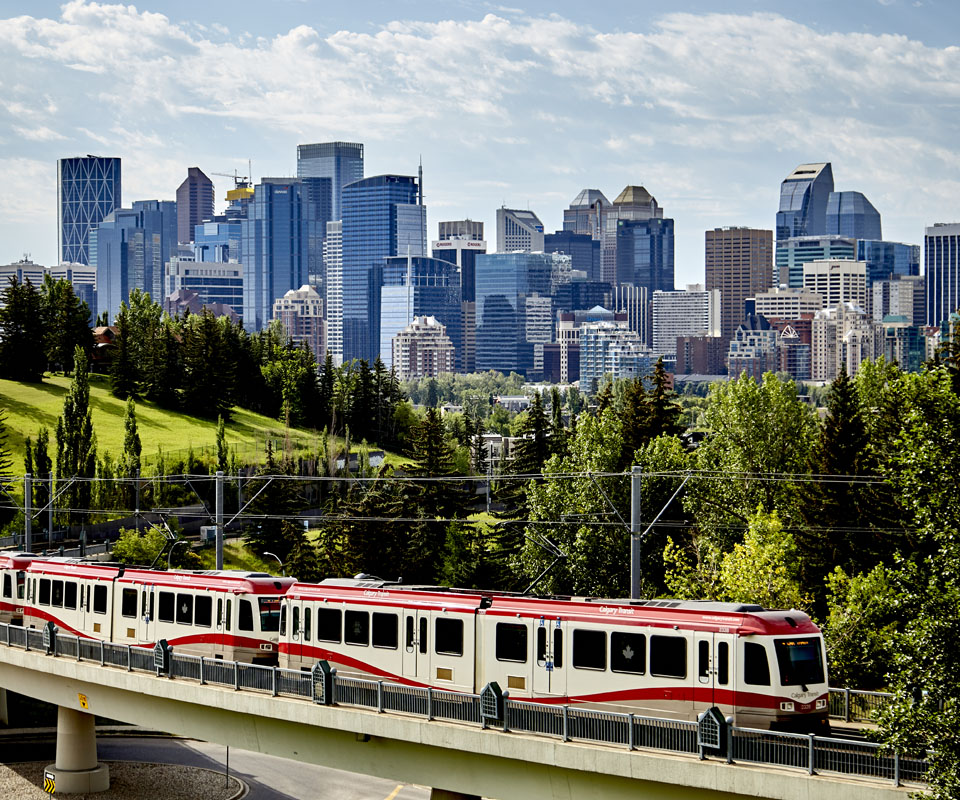
Explore SAIT’s sustainable campus
Facility design guidelines
SAIT’s Facilities Management team administers guidelines for the planning, design, construction and maintenance of SAIT facilities and buildings. The Facility Design Guidelines and Workplace Standards document sets the minimum requirements and aspirational measures for new construction and renovations, including sustainability standards.
Buildings and grounds
Green Building Technology Access Centre
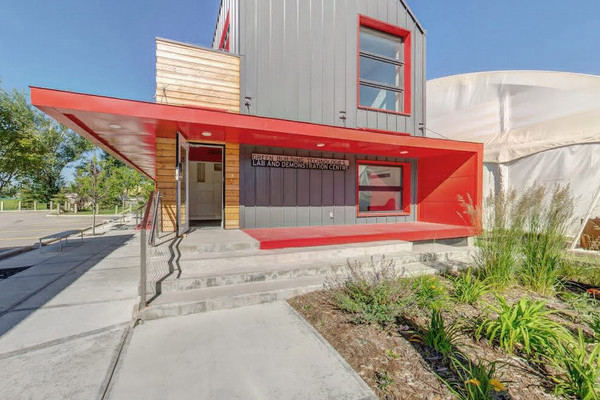
As Calgary's first commercial net-zero building, the Green Building Technology Access Centre (GBTAC) integrates construction, green technologies and renewable energy. The demonstration centre includes a solar lab, rainwater harvesting technology, passive heating and charging ports for electric cars. The centre is part of SAIT’s Applied Research and Innovation Services Hub.
Aldred Centre
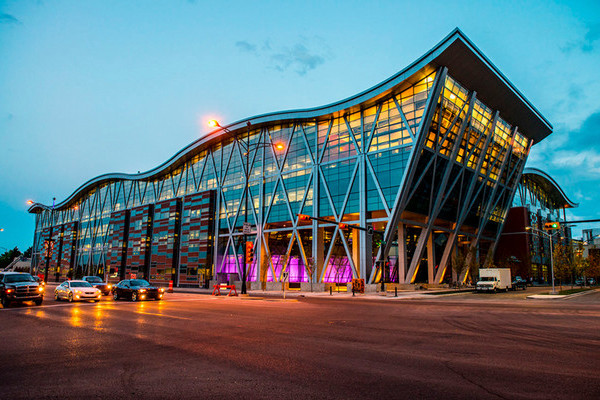
The Aldred Centre is one of three buildings that make up SAIT's Trades and Technology Complex. The unique wavy roof and air handlers reflect and redistribute heat helping to reduce the amount of energy used to heat the building. Exterior gutters collect rainwater, which is redistributed into the stormwater system during dry weather.
Facilities Management collaborates across campus to integrate sustainability into daily life through a variety of programs, including utility reduction initiatives, mechanical upgrades and green cleaning.
Taylor Family Campus Centre redevelopment project
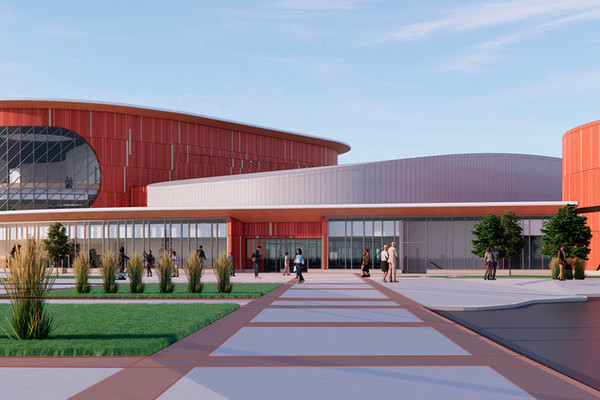
The Taylor Family Campus Centre will open in late 2027. The design program for the new building centres on student-focused spaces supporting health and well-being, campus athletics and recreation, and campus life, as well as teaching and learning. The design prioritizes improved pedestrian access to the building, universal accessibility and sustainable design principles.
Water management on campus
Facilities Management is committed to identifying water conservation opportunities and implementing a long-term conservation program. Water management initiatives on campus include scheduled irrigation, water bottle filling stations, a green cleaning program that conserves energy and water and a snow melting pilot program.
Indigenous plant species biome
Created in honour of SAIT’s Centennial anniversary in 2016, this 11,000-square-foot garden is located on the slope of the hill adjacent to the P6 Parking Garage. The garden is a diverse meadow of drought-tolerant, pollinator-friendly plants — all native to Alberta’s foothills biome. ALUS Canada helped select and also contributed some of the plant species important for the ecosystem, including Alberta wild roses and sweetgrass. Contact sustainability@sait.ca to learn more about the garden and get involved.
Sustainable transportation
Bike lockers and racks
SAIT’s main campus is nearby several bike pathways and located on the 10th street bike lane. Bike racks are located across campus and secure bike lockers can be rented on level 3 of the P6 parkade. Contact residence@sait.ca to rent a bike locker.
If you bike to campus, don’t forget to lock it up. Choose a good lock and use it correctly.
Tap into transit
Eligible students have unlimited access to Calgary Transit services through the UPass. The UPass fee is charged per term and is included in tuition and fees for most full-time programs at SAIT. You can use your UPass directly on your mobile device through the My Fare app. Jump aboard the CTrain or check out the bus routes that service SAIT.
Eligible SAIT employees have access to an employee transit benefit. Learn more on SAITNOW.
Electric Vehicle charging stations
Searching for an EV charger? There are two EV charging stations located in the P3 parking lot. Please note, there is a fee for entering the lot.
SAIT’s commuter stats
The Office of Sustainability conducted a campus commuter survey of students in 2024 and employees in 2025. Insights from those surveys are included below.
While our community relies heavily on traditional transit, there is an appetite for greener alternatives to reduce our collective carbon footprint.
The transit foundation
- Public transportation is the most utilized method to reduce carbon footprints among students. Currently, 71% of domestic students and 82% of international students rely on public transit.
Active alternatives
- To reduce transportation-related carbon footprint, employees currently utilize telecommuting (46%), walking or biking (44%), and public transit (42%).
The preference gap
- There is a notable gap between actual and preferred transportation methods for both students and employees. While most employees drive to campus, many would prefer a more sustainable method if given the choice and availability.
- Currently, only 3% of employees typically commute by bike.
- Biking is also rare among students, with 1% of domestic students and 0% of international students utilizing it as their typical method.
- Overall, 81% of employees and 89% of domestic students report never biking to campus.
- Commuting methods change with weather. When the weather warms up, biking adoption among employees who change their commute increases to 25% in the spring and 26% in the summer.
- The big 3: The top barriers preventing our community from biking more often are the long distance of commutes, navigating unsafe general traffic, and unpredictable weather.
- The rider experience: For those who do brave the ride, challenges remain upon arrival. Regular cyclists on campus note insufficient safe bike storage, a lack of designated bike lanes, and a lack of showers on campus are their biggest daily hurdles.
- Multi-Modal Commuting: Integrating biking with public transit is difficult; 92% of students who take their bike on the CTrain or bus find it challenging during rush hours.
- Improving infrastructure for biking and walking would motivate 30% of employees, 39% of domestic students, and 42% of international students to use more sustainable transportation.
- Investing in shared, secure bike storage is considered highly important across the board, favored by 80% of employees, 80% of domestic students, and 93% of international students.
- Similarly, individual bike lockers are a priority investment for 74% of employees, 74% of domestic students, and 91% of international students.
- Discounts or subsidies for public transportation remain the top overall motivator to encourage the use of sustainable transportation among all groups.
5,179 students were invited to participate in SAIT’s 2024 Student Sustainable Commuter Survey; 795 responses were received (15% response rate). 3,163 employees were invited to participate in SAIT’s 2025 Employee Sustainable Commuter Surveys; 696 responses were received (22% response rate).
Contact
Office of Sustainability
- sustainability@sait.ca

Oki, Âba wathtech, Danit'ada, Tawnshi, Hello.
SAIT is located on the traditional territories of the Niitsitapi (Blackfoot) and the people of Treaty 7 which includes the Siksika, the Piikani, the Kainai, the Tsuut’ina and the Îyârhe Nakoda of Bearspaw, Chiniki and Goodstoney.
We are situated in an area the Blackfoot tribes traditionally called Moh’kinsstis, where the Bow River meets the Elbow River. We now call it the city of Calgary, which is also home to the Métis Nation of Alberta.