Cisco Chair award details
Cisco Chair funding enables the experimentation, application and implementation of technology into learning and teaching. The award can fund various projects at different amounts, as determined by the project proposals and decision-making process.
Award funding will be allocated to projects directly aligned to strategic priorities within the school/department. In addition, the project proposals must demonstrate impact on students, connection to other initiatives and projects across SAIT, and the enabling processes and structures that will support project success.
The total value of the award is $125,000 annually. All permanent, full-time SAIT faculty or employees whose work directly contributes to teaching and learning activities are eligible to apply for the award.
Applications open in December 2026.
2026/27 Cisco Chair award recipients
 Colin Pattison, MacPhail School of Energy
Funding will further develop SAIT’s environmental DNA (eDNA) Research Lab, turning research into training resources for programs such as Environmental Technology and Integrated Water Management.
The proposal aims to advance scholarly activity, support curriculum development and give students hands-on experience applying biotechnology, artificial intelligence, machine learning, nanotechnology and bioinformatics to real-world industry challenges.
 Janice Mills, School of Health and Public Safety
Funding will support the design, development, testing and integration of a high-fidelity echocardiography training simulator using 3D heart models, allowing students to practice pathology-based scanning before entering practicum.
Compatible with commercial ultrasound machines, the simulator will enable instructors to standardize practice across learners, target specific competencies and create repeatable learning experiences, improving practicum readiness.
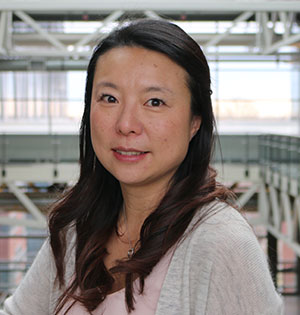
 Jojo Hsu-O’Connor and Sarah Scott, Academic Services
Funding will support a project to integrate VR and AI into communication skills training, providing students with a safe, immersive and scalable environment to practice communication tasks.
Through VR-based simulations, students will engage in realistic mock interviews, client meetings, presentations and public speaking scenarios that mirror real workplace contexts. These environments allow students to practice without the fear of judgment, reducing performance anxiety and encouraging repeated practice.
 Rami Haddad, School of Business
Funding will build on a pilot using VR and AI-supported simulation software in the School of Business.
The simulation leverages AI-driven scenarios featuring interactive characters that respond dynamically to user input, creating a tailored experience unique to each learner in a psychologically safe environment.
The project will implement AI-supported simulations within course contexts as an asynchronous learning activity and is designed to evaluate learning value (e.g., confidence and readiness), instructional feasibility, and operational viability, as well as the effectiveness of AI-generated feedback in shaping learner reflection and informing instructor-guided learning.
Cisco Chairs 2019-present
- 2026/27: Colin Pattison, MacPhail School of Energy
- 2026/27: Janice Mills, School of Health and Public Safety
- 2026/27: Jojo Hsu-O’Connor and Sarah Scott, Academic Services
- 2026/27: Rami Haddad, School of Business
- 2025/26: John Giray, ISchool of Business
- 2025/26: Erin Choquette, School of Health and Public Safety
- 2025/26: Catherine Theng, School of Health and Public Safety
- 2025/26: Nathan Biswanger, School of Health and Public Safety
- 2024/25: Blake Kanewischer, School of Business
- 2024/25: Jenni Hussein, School of Health and Public Safety
- 2024/25: Jojo Hsu-O’Connor and Sarah Scott, Academic Services
- 2024/25: Charissa Lee, School of Business
- 2022/23: Matt Karns, Centre for Academic Development and Innovation
- 2022/23: Kat Hassard, School of Construction
- 2019/20: Nikolay Bukharin, School of Manufacturing and Automation
- 2019/20: William Hu, School for Advanced Digital Technologies
- 2019/20: Steve Janz, School of Business
- 2019/20: Jacqueline Lydon, School of Business
- 2019/20: Yoni Porat, School of Business
- 2019/20: Heramb Vadalkar, School of Business

Oki, Âba wathtech, Danit'ada, Tawnshi, Hello.
SAIT is located on the traditional territories of the Niitsitapi (Blackfoot) and the people of Treaty 7 which includes the Siksika, the Piikani, the Kainai, the Tsuut’ina and the Îyârhe Nakoda of Bearspaw, Chiniki and Goodstoney.
We are situated in an area the Blackfoot tribes traditionally called Moh’kinsstis, where the Bow River meets the Elbow River. We now call it the city of Calgary, which is also home to the Métis Nation of Alberta.