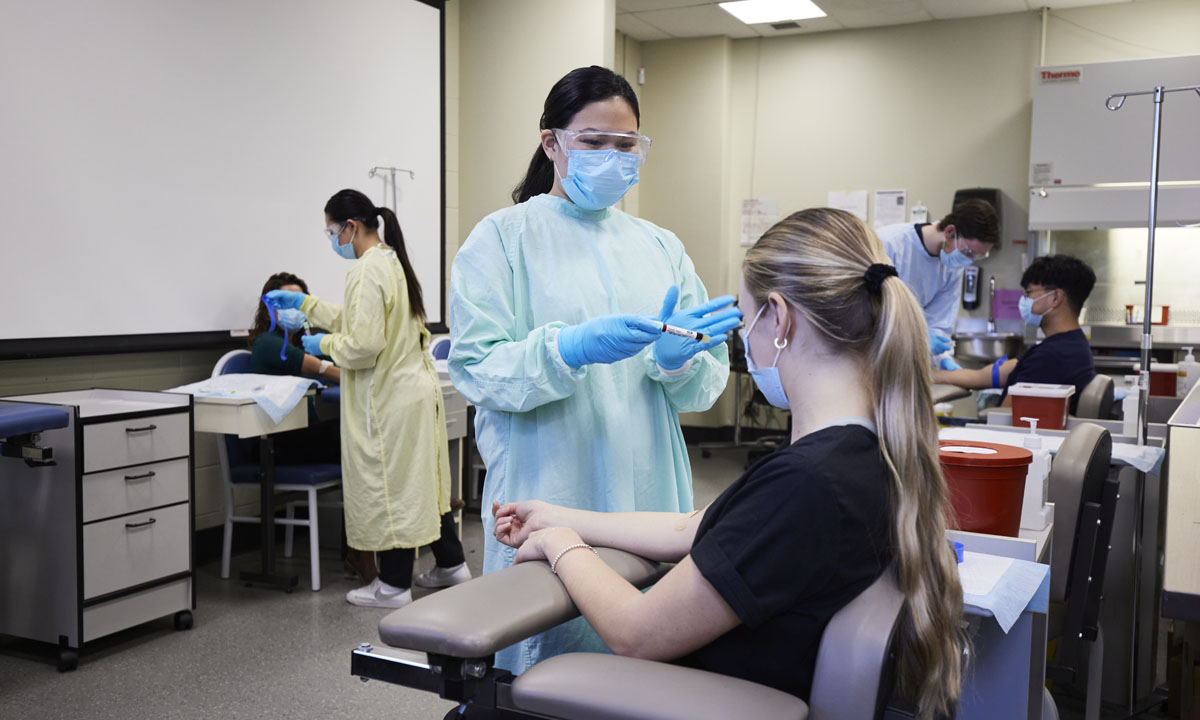
Patient-centered healthcare education
An essential ingredient to high quality healthcare is actively including the voice of patients, families and caregivers to improve quality, safety and health outcomes. There is a growing movement within the Canadian public to be involved in decisions about how healthcare services are designed and delivered.
SAIT values the creation of these partnerships for students and academic learning. These collaborations can improve competencies in patient relations, decision making and care planning.
Our Patient Partnership program is connected to the following programs available through our School of Health and Public Safety:
Perspectives from one of our valued patient partners
My health journey from my late teens to now has been very eventful. My many interactions with health services in Alberta have provided me with a wealth of insights not readily available to the average citizen. Over the last 3 years as a Patient Partner at SAIT, I have had the opportunity to pass along my life’s health experiences in Alberta to RT students. What’s really made my day is the positive feedback from those students regarding their perceived value of my volunteering work. It’s been a “win/win” process and that’s why I plan to continue volunteering with SAIT.
Reg Gerlitz
Opportunities for involvement
As a patient partner, you can actively engage with the instructors, students and staff at SAIT and participate in-person or virtually:
- sharing your healthcare experiences
- developing educational materials
- delivering feedback to students
- reviewing curriculum, processes and policies
- participating in working groups and advisory committees
- designing, advising and planning of new projects
- volunteering for lab activities
- participating in simulations
For questions or to request information about the opportunities, please contact hps.info@sait.ca.
Volunteer opportunities
We're looking for:
- Volunteers who are > 18 weeks pregnant
- Must have had their "detailed" 18–22-week ultrasound completed
- Must know the results of their ultrasound
- Must be willing to sign a standard SAIT volunteer patient waiver
Please note: No results will be given to participants as this is not a diagnostic exam.
What to expect: Volunteers can expect to be scanned by rotating groups of 2-4 students during a two-hour time slot. During this time, SAIT lab instructors will be supervising and providing guidance. An instructor may also scan for a short while to provide an instructional demo for the students. Volunteers are welcome to bring one guest to accompany them.
Volunteer perks: Besides the joy of contributing to students' learning, volunteers will be able to interact with the students and watch while their baby is being scanned. We will also provide some keepsake photos as a souvenir for those who bring a USB drive for upload.
If you meet the criteria above and are interested in volunteering but December timing does not work for you, please reach out to jennifer.chaudhary@sait.ca about potential for other volunteer opportunities.
We're looking for:
- Female pelvis volunteers who have known pelvic abnormalities/variants, such as fibroids, ovarian cysts/masses.
- Must not currently be pregnant.
- Must have had a prior pelvic ultrasound completed.
- Must know the results of their ultrasound.
- Must be willing to sign a standard SAIT volunteer patient waiver.
Please note: No results will be given to participants as this is not a diagnostic exam.
What to expect: Volunteers can expect to be scanned by rotating groups of students during a two-hour time slot. During this time, SAIT lab instructors will be supervising and providing guidance. An instructor may also scan for a short while to provide an instructional demo for the students.
Contact Jennifer Chaudhary for more information.
The SAIT Respiratory Therapy program is working on engaging patients from the community to create a partnership. We have created a program which brings patients from non-acute care settings into the labs at SAIT. This will allow students to have exposure to patients who can share information about not only their disease process, but how it has impacted their lives.
The year 1 Respiratory Therapy program students will be gathering a brief patient history as well as performing a clinical assessment incorporating basic vital signs such as Heart rate, Blood pressure, Oxygen Saturation and listening to a patients' breath sounds.
What to expect: Each patient volunteer can expect to be assessed approximately 4 times in a 2-hour time frame. After the assessments have been concluded, the larger group will convene for a panel discussion with the patient volunteers. The volunteers will be asked questions about their experiences in the healthcare system. The time commitment is approximately 4 hours in total. A light lunch and parking will be provided.
Next steps
If you want to participate in the program, complete the interest form. Our program coordinator will contact you to discuss various opportunities and address your questions.
Services at Dental Clinic
Dental Assisting students offer dental services at our on-campus clinic from January to May and September to December each year and preventative dentistry throughout the year.
Visitor information
If you're required to visit our campus for participation, the campus map, transit and parking resources can assist you.
Contact us
Have questions? We're here to help!
School of Health and Public Safety
Senator Burns Building, SAIT Main Campus
- hps.info@sait.ca
-
Monday - Friday | 9 am - 4pm

Oki, Âba wathtech, Danit'ada, Tawnshi, Hello.
SAIT is located on the traditional territories of the Niitsitapi (Blackfoot) and the people of Treaty 7 which includes the Siksika, the Piikani, the Kainai, the Tsuut’ina and the Îyârhe Nakoda of Bearspaw, Chiniki and Goodstoney.
We are situated in an area the Blackfoot tribes traditionally called Moh’kinsstis, where the Bow River meets the Elbow River. We now call it the city of Calgary, which is also home to the Métis Nation of Alberta.