
Benefits of planning papers
There are many benefits to planning your papers before you begin.
Writing a group paper? Download the Group Work Checklist (PDF). It provides a great guide to planning and organizing your group papers, presentations, or projects.
Reading and understanding instructions
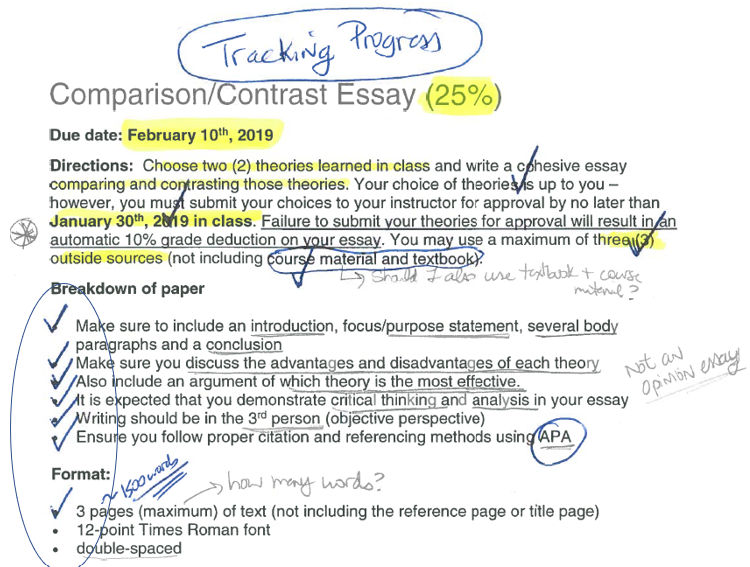
In preparation for assignments and papers, it's essential to thoroughly understand your instructions and follow them closely. We recommend you practice:
- reading instructions EARLY (the same day you receive them) for every assignment/paper you receive by setting aside 10-15 minutes to review instructions
- scheduling this task into your phone, planner, or agenda.
This prevents last-minute reading, misunderstanding instructions, adding incorrect information to papers, or forgetting essential details, which can lead to lower grades.
Active reading strategies
We recommend you practice paying close attention to your instructions by:
- reading the instructions section by section
- underline or highlight key information (for example, deadlines)
- rewrite or make additional notes in margins
- ask your instructor questions ASAP if you don't understand something
- checkmark or cross off information you have added to your assignment as you work through it.

Try the Written Kitten website as a progress tracker. It tracks how many words you've written and provides a pop-up of a cute animal picture every time you hit your goal.
Planning your assignment
Whether planning a paper, a presentation, or any other large task, follow a few simple steps:
- Break down the assignment into smaller, manageable steps.
- Assign mini-deadlines for each step.
Example plan for a small paper
| Steps | Mini-deadlines |
|---|---|
| Read instructions | Jan. 9th |
| Choose topic | Jan. 10th |
| Brainstorm ideas | Jan. 12th |
| Create outline | Jan. 13th |
| Start writing | Jan. 14th |
| Finish draft | Jan. 17th |
| Edit draft | Jan. 18th |
| Submit | Jan. 20th |
Online planning calculators
Planning calculators can do a big chunk of the work for you.
Calculators like the two below allow you to fill out the information required, and the tool will provide you with a general guideline of steps and suggested deadline dates.
Remember to use these calculators as a starting point. Your assignment is unique, so you may need to adjust the steps to fit your assignment/paper as needed.
The Pomodoro timer is an excellent tool for writing. It encourages short work sessions (25 minutes), making it a great tool to help you get started on your writing and avoid procrastination.
Contact us at
Writing Services
Lamb Learner Success Centre, MC221, Stan Grad Centre, SAIT Main Campus
- Phone
- 403.284.7050
- llsc@sait.ca

Oki, Âba wathtech, Danit'ada, Tawnshi, Hello.
SAIT is located on the traditional territories of the Niitsitapi (Blackfoot) and the people of Treaty 7 which includes the Siksika, the Piikani, the Kainai, the Tsuut’ina and the Îyârhe Nakoda of Bearspaw, Chiniki and Goodstoney.
We are situated in an area the Blackfoot tribes traditionally called Moh’kinsstis, where the Bow River meets the Elbow River. We now call it the city of Calgary, which is also home to the Métis Nation of Alberta.