
Independent clauses
Independent clauses are complete sentences. They have:
- subject(s)
- verb(s)
- a complete idea.
For example, "Dogs are wonderful pets."
Run-on sentences
Run-on sentences have one or more independent clauses combined, but they often:
- have missing punctuation, or
- incorrect punctuation.
For example, "Emily brought her dog a lot of food the dog ate all of it."
In this example, punctuation is missing. We have two complete sentences, but they are not effectively separated or combined.
The first step to correcting basic run-on sentences is to identify the simple sentences (independent clauses) and separate them. In the example above, the two simple sentences are:
- "Emily bought her dog a lot of food."
- "The dog ate all of it."
Now that we've identified the two simple sentences, we can apply three different correction techniques.
| Add a period | "Emily bought her dog a lot of food. The dog ate all of it." | We recommend adding periods if you struggle to write compound or complex sentences. Writing short, simple and clear sentences can be a great way to get your ideas across. |
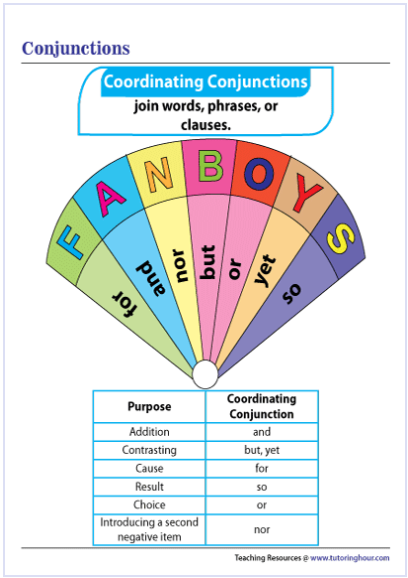
| Add a FANBOY and comma | "Emily bought her dog a lot of food, and the dog ate all of it." | FANBOYS are coordinating conjunctions that join words, phrases or clauses. |
| Add a semi-colon | "Emily bought her dog a lot of food; the dog ate all of it." | The semi-colon should be used sparingly. Only a few times in a paper. Semi-colons are meant to extend the first sentence by separating two complete sentences with closely related ideas. |
Sentence fragments
Sentence fragments are incomplete sentences and cannot stand on their own. Fragments are missing one or more of the following:
- subject(s)
- verb(s)
- don't express a complete thought.
Dependent clause fragments
There are many types of fragments, but dependent clause fragments are the most common. These fragments DO have a subject and verb, but don't express a complete thought.
Examples:
- "Because he works hard."
- "When you finish exercising."
Notice how none of the examples express a complete idea, and that you're left with questions? These sentences have an opening word (dependent clause marker), a subject and verbs, but don't have a complete thought.
Find more independent and dependent clause examples from Purdue University.
To correct a dependent clause fragment, first identify the fragment.
For example, "Although I enjoy spending time with friends. I usually prefer staying at home."
Once you've identified the fragment, we can apply three different correction techniques.
| Attach the fragment to an independent clause with a comma | "Although I enjoy spending time with friends, I usually prefer staying at home." | We always add a comma if the fragment comes first in the sentence. There's now a natural pause after the dependent clause. Combining a dependent clause with an independent clause creates a complex sentence. |
| Attach a fragment to an independent clause without a comma | "I usually prefer staying home although I enjoy spending time with friends." | Notice we do not add a comma when the fragment comes last in the sentence. |
| Remove the dependent clause marker | "I enjoy spending time with friends. I usually prefer staying at home." | Notice how removing although creates a complete sentence (the dependent clause now becomes an independent clause). We now have two complete, simple sentences with periods. |
Supporting resources
Sentence structure
Handouts courtesy Seneca College.
Contact us at
Writing Services
Lamb Learner Success Centre, MC221, Stan Grad Centre, SAIT Main Campus
- Phone
- 403.284.7050
- llsc@sait.ca
Oki, Âba wathtech, Danit'ada, Tawnshi, Hello.
SAIT is located on the traditional territories of the Niitsitapi (Blackfoot) and the people of Treaty 7 which includes the Siksika, the Piikani, the Kainai, the Tsuut’ina and the Îyârhe Nakoda of Bearspaw, Chiniki and Goodstoney.
We are situated in an area the Blackfoot tribes traditionally called Moh’kinsstis, where the Bow River meets the Elbow River. We now call it the city of Calgary, which is also home to the Métis Nation of Alberta.