5 research projects Labs4 at SAIT is bringing to industry
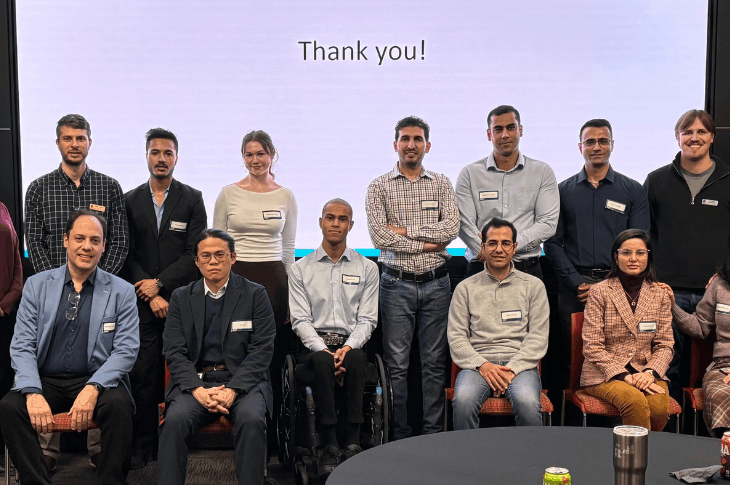
Labs4 is helping students and recent grads turn their early-stage innovations into real-world ventures, products and solutions.
Sounds ambitious — and it is — but the program’s first cohort can tell you how it works.
Labs4 is a Canada-wide network of colleges and universities that supports research or entrepreneurship projects. Student innovators can apply to Labs4 with a proposal for levelling up or advancing their work — and Labs4 provides approved projects with the support needed to advance them towards commercialization.
During the 16-week program, Labs4 connects students with hands-on experience in applied research labs, technical advisors and mentors with industry and business backgrounds who can help them build their networks. In addition, Labs4 provides students with nationally-delivered workshops to help strengthen intellectual property strategy, technical validation and commercialization skills, as well as a stipend — funded by the Natural Sciences and Engineering Research Council of Canada and Mitacs — of $10,000.
Labs4 uses a hub-and-spoke model, with regional hubs delivering programming aligned to each region’s strengths, needs and capacity. Within each hub, the spokes — post-secondary partners — supply resources and expertise to students.
SAIT is the Labs4 Southern Alberta Hub, helping connect students with expertise at SAIT and our spokes: the University of Calgary, Red Deer Polytechnic (RDP), Lethbridge Polytechnic, University of Lethbridge and Olds College.
These are just some of the amazing research projects undertaken by Labs4’s first-ever cohort.
Creating automotive hand controls for drivers with disabilities
Dante Bravi, Automotive Service Technology, SAIT, Class of 2025
SAIT Alumnus Dante worked with RDP on his innovative hand controls for drivers with loss of lower limb function. The device is a ring-shaped accelerator that is placed on the face of the steering wheel. While the current systems require one hand to always be on the accelerator, leaving only one hand for steering, this innovation allows two hands to be on the wheel while operating the accelerator. The system works by sending electrical signals to the vehicle’s electronic control unit based on the position of the ring. This mimics the function of a traditional accelerator pedal, allowing the vehicle to operate in the exact same way.
“My product makes a driving experience as user friendly as possible for users, facilitating an experience similar to driving for people with no physical impairments. This product will make driving less fatiguing, allow two-handed control of the steering wheel and empower drivers.”
To make this project possible, Dante worked with RDP and SAIT’s Applied Research and Innovation Services (ARIS) Hub.
“SAIT assisted in this research by contributing expertise as well as access to equipment. During the project, I worked with SAIT’s technicians, technologists, and CIRAMM’s Principal Investigator Craig Maynard, who provided valuable insight during the ideation phase of the electronic systems.”
Managing wound-care from the comfort of home
Akpeko Gasonoo, CTO and co-founder, PrintedSUN Inc.
Current therapies for diabetic foot ulcers — such as negative pressure devices, hyperbaric oxygen chambers and clinic-based phototherapy — are costly, invasive and conducted only in supervised environments. Sometimes, these barriers lead to slower healing and high probability of recurrence.
Akpeko’s company PrintedSUN is revolutionizing wound care with a wearable printed red-light therapy patch: a flexible, skin-conformal device that delivers therapeutic light safely and consistently at home. This innovation accelerates wound healing and closure while also reducing healthcare costs.
“The Labs4 program has provided us with valuable applied research guidance and access to technical expertise that is helping accelerate our product development. While navigating challenges in materials testing and fabrication, the mentorship from SAIT’s Centre for Innovation and Research in Advanced Manufacturing and Materials and ARIS has been critical in refining our prototype and shaping our commercialization roadmap.”
Quickly detecting bacteria in milk
Tatiana Elsworth, Bachelor of Science (Electrical Engineering) and Bachelor of Commerce, University of Calgary
Milk contamination caused by bacterial pathogens is a widespread and critical issue with consequences in both public health and agri-food systems. Inappropriate or delayed responses to bacterial presence can lead to overuse of antibiotics, contributing to the global threat of antimicrobial resistance.
With technical advising from Kwantlen Polytechnic, Tatiana is developing a novel, low-cost detection chip for rapid bacterial detection in milk. The device is an easy-to-use detection solution that can function outside traditional lab settings and provide results within minutes, telling the user if bacteria is detected and action is required.
“The program has given me a really great sense of direction in the process of turning an idea or prototype into a profitable product, and I've gained a lot of insight on how our technology can be advanced.”
Bringing carbon-capture technology to breweries
Jack Jarvis, PhD., P.Chem.
TurnCO2 uses carbon dioxide (CO₂) recovery to make brewery operations more sustainable. Jack — one of TurnCO2’s founders — is working with technical advisors from the Centre for Energy Research and Clean Unconventional Technology Solutions (CERCUTS) at SAIT to develop a compact, brewery-scale carbon capture system that enables small and mid-sized breweries to recover and reuse the CO₂ released during fermentation.
Through this process, TurnCO2 is advancing toward a pilot-ready unit with automated operation, safety controls and seamless integration into existing brewery infrastructure.
“The Labs4 program has been incredibly valuable, not only in terms of mentorship and networking, but particularly through the workshops. Sessions on customer discovery helped us better define our value proposition and refine our go-to-market strategy, while workshops like AI in business sparked new ideas for automation, data handling and operational efficiency. The program has pushed us to think more like a startup rather than just a technology team.”
Scaling an ambient-condition platform for ammonia, H2S and phosphate removal in wastewater systems
Pirouz Kiani, PhD student (Chemistry), University of Calgary
NanoStrip is a clean-technology company that develops solutions to remove chemicals from water and biogases used in industrial processes — with the goal of helping operators boost renewable natural gas production while reducing treatment costs and emissions.
Alongside technical advisors from CERCUTS, NanoStrip’s Chief Technology Officer Pirouz is developing a system that removes ammonia and hydrogen sulfide from waste streams such as biodigesters and municipal wastewater.
“My experience has been rewarding, working with everyone at SAIT to get my project underway. Everyone has been supportive, from the onboarding team to the technical engineering team, in ensuring we make solid progress during the Labs4 program. We were able to create detailed roadmaps and deliverables for the four months at SAIT and set up a clear path for successful outcomes.”
You can learn more about Labs4 by reaching out to our Southern Alberta Hub contact, Raj Deol.

Oki, Âba wathtech, Danit'ada, Tawnshi, Hello.
SAIT is located on the traditional territories of the Niitsitapi (Blackfoot) and the people of Treaty 7 which includes the Siksika, the Piikani, the Kainai, the Tsuut’ina and the Îyârhe Nakoda of Bearspaw, Chiniki and Goodstoney.
We are situated in an area the Blackfoot tribes traditionally called Moh’kinsstis, where the Bow River meets the Elbow River. We now call it the city of Calgary, which is also home to the Métis Nation of Alberta.