Alberta companies look to workforce training to close critical skills gaps
businesses boost productivity and workplace performance.
Canada’s productivity problem has been debated for years in economic and policy circles, but for many employers, the challenge is no longer theoretical. Technology is reshaping work, experienced workers are retiring and teams are being asked to do more with fewer people.
In Alberta – where energy, construction, manufacturing, aviation and transportation anchor the economy – those pressures translate into critical skills gaps on both the frontline and in management. The challenge is so pronounced that the federal and provincial governments recently launched the Canada-Alberta Productivity Grant, a $39-million, three-year initiative designed to help employers invest in training aimed at improving productivity.
On the ground, organizations are turning to local institutions like Southern Alberta Institute of Technology (SAIT) in Calgary, whose corporate training programs provide applied, workforce-ready skills tailored to the needs of Alberta employers.
“Any time you invest in your people and help them do better, do more and work more collaboratively, you strengthen your company,” says Craig Hess, director of corporate and international training at SAIT. “There’s a domino effect. When people feel more confident in what they do, you get a stronger culture and many other benefits. You invest in one thing and get ten things back.”
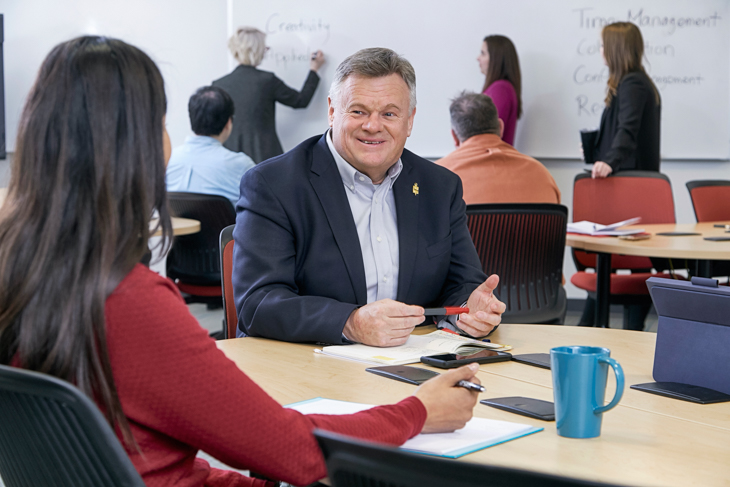
Hess leads a team that works with organizations to upskill and reskill employees using programming from SAIT’s Continuing Education and Professional Studies division, developing training that translates directly into workplace performance.
Today, Hess says organizations are investing in several areas for the future of work: creative and critical thinking, managing ambiguity, leadership capabilities and applying new technologies. By connecting learning to real on-the-job challenges, SAIT creates training that employees can immediately apply to their daily work.
For example, SAIT’s training in artificial intelligence emphasizes using tools already in the workplace and putting them to practical use. “It’s about how you use what’s already there to improve productivity,” Hess says.
As work rapidly shifts, SAIT’s programs adapt just as quickly. Hess explains that continuing education allows SAIT to move faster than traditional credential development, since shorter, non-credit offerings can launch without lengthy approval processes. This process keeps SAIT relevant, agile and aligned with evolving industry needs. “Our product development cycle is about 100 days now, from idea to first registrants in the program,” explains Hess.

gain relevant skills they can immediately apply on the job.
This responsiveness extends into flexible learning formats for today’s busy professionals, with course delivery now including virtual and asynchronous options. “The pace of change is so great now,” says Hess. “Pulling people away from their jobs for three, six or 12 hours isn’t easy. You have to be sure the training is relevant.”
For Lora Bucsis, director of product and learner success at SAIT, rapid workplace shifts are prompting employers to look for clear proof that training has genuinely built skills, particularly as job roles evolve.
“Jobs are changing faster than I’ve ever seen in my 25 years at SAIT,” she says, adding that this shift has pushed greater investment in micro-credentials, which she describes as more than a badge. “For us, the credential is a validation that someone actually has the skills. It’s not just a checkbox.”
In corporate settings, SAIT’s approach begins with defining objectives and designing learning that mirrors work as closely as possible. Facilitators have real-world experience, leading to sessions that feel like engaged conversations rather than slide presentations.
However, effective training requires support beyond the classroom. Bucsis says organizations often face hurdles around buy-in, governance and risk – especially when AI raises concerns about data and ethics. “Training needs to happen at multiple levels if you want to create change,” she says. “Leaders need to be on board as well as the individual contributors.”
Hess communicates a similar point when employers ask about return on investment. Technical competencies can often be assessed quickly. Leadership and people-focused capabilities, he adds, reveal themselves over time as behaviour changes. “The training is the catalyst to that,” he says, helping organizations turn learning into lasting workplace impact.
At a time when productivity, retention and internal mobility are under pressure, that distinction matters. Employers are not only trying to fill roles, but to build the capacity that helps teams perform through constant change.
“We want to become the trusted partner that can get this done,” Bucsis says.
The partner you want. The solutions you need.
We help businesses thrive in a changing world of work. Explore group training options through SAIT Corporate Training and discover talent development solutions for your organization — no matter where in the world — through International Corporate Training and Client Development.
Or, build your individual skill set with courses from SAIT's Centre for Continuing Education and Professional Studies.

Oki, Âba wathtech, Danit'ada, Tawnshi, Hello.
SAIT is located on the traditional territories of the Niitsitapi (Blackfoot) and the people of Treaty 7 which includes the Siksika, the Piikani, the Kainai, the Tsuut’ina and the Îyârhe Nakoda of Bearspaw, Chiniki and Goodstoney.
We are situated in an area the Blackfoot tribes traditionally called Moh’kinsstis, where the Bow River meets the Elbow River. We now call it the city of Calgary, which is also home to the Métis Nation of Alberta.