Cadmus Chair uses 3D to bring plumbing code to life
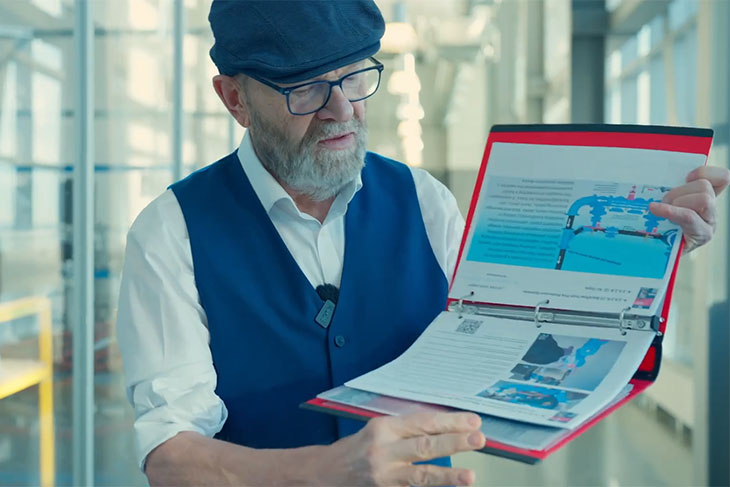
Fred Bretzke has amassed about two million views on YouTube for what he describes as “boring” plumbing videos.
Ten years ago, Bretzke, an instructor in SAIT’s School of Construction, saw an opportunity to inject new life into teaching Plumbing using computer animation. As the 2024/25 Cadmus Trades Teaching Chair, he went a step further — creating a 3D-enhanced supplement to the 2020 National Plumbing Code appendix.
The Cadmus award is designed to foster faculty excellence in skilled trades teaching. Award recipients receive $20,000 in funding and a four-month break from teaching to work on their project.
It's in the code
As the manual of technical requirements for all plumbing design and installation in Canada, the code book is a critical tool in Bretzke’s teaching toolbox.
“Parts of the book haven’t changed much over the years,” says Bretzke. “The figures are just stick drawings — many from 40 to 50 years ago. It’s hard to teach from a drawing like that.”
Securing computer equipment, digital tools and a handful of AI voice programs through his Cadmus budget, Bretzke used his project time (plus some) to create 65 3D animations and eight holograms to help interpret existing code appendix articles from basic installations to detailed plumbing designs.
After uploading everything to YouTube, he combined screenshots and a QR code link to each animation into a handy reference guide in book form.
“Each AI-narrated video is about three minutes,” he says. “I did the design, made the animations, wrote the scripts, managed the narrations and put everything together.”
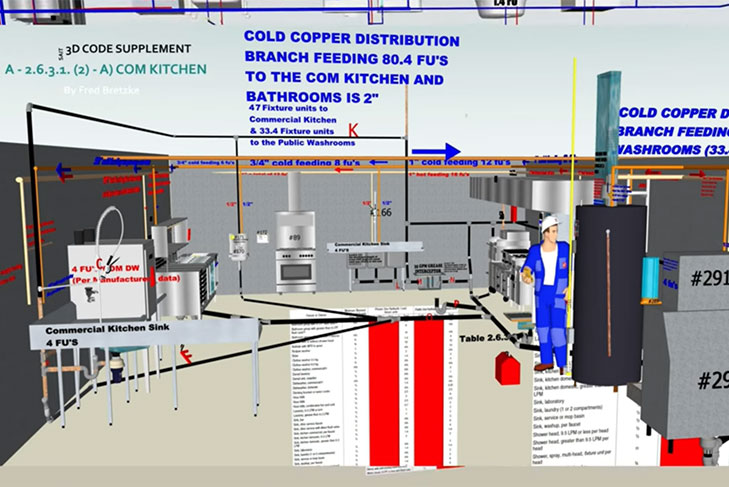
A screenshot of Bretzke’s 3D code supplement animation for A-2.6.3.1.(2)-A pertaining to potable water systems in commercial kitchens.
Made for teaching
The animations are primarily intended as teaching tools for trades instructors.
“When you’re teaching with the videos, the idea is you stop and start as needed,” he says. “I could probably spend three hours teaching to a three-minute video and explaining all the references.”
According to Bretzke, a single animation can cover about 15 pages in an apprentice’s Individual Learning Module — the standardized training materials used in trades and technical courses.
“Trades are very visually oriented,” he says. “Seeing things in 3D helps expedite learning and makes everything more accessible to the student.”
Bretzke even translated the script for a few of the animations into additional languages, including French, Hindi and Mandarin.
When he first started using animations in the classroom, some of his students were hesitant, he admits. But if the tech is easy to use, people will use it, he says.
“I’m teaching my students not to ignore technologies like AI and 3D,” says Bretzke. “I’ve been on construction sites where there’s a 3D artist with no knowledge of the trade working with a plumbing foreman to try and turn a hand drawing into a 3D image. Imagine being a tradesperson who could do both? You’d be a hot commodity.”
SAIT plumbing supplement code appendix combined relief vent.
Made to last
Since completing his Cadmus project, Bretzke has been travelling to conferences and college campuses to share his code book supplement.
“This isn’t SAIT’s plumbing code — it’s the national code. I want every college in Canada to be able to use it.”
He estimates there are about 750 of his books in circulation right now. Since it’s designed to supplement the national code, it could have lasting value beyond the classroom as well, he says.
“There’s a lot you learn in school that you may not touch for five years. If suddenly you have to put in a circuit vent, the book can help refresh your memory.”
He’s also keen to use the momentum from the project to focus on the future.
“Cadmus is really good for a teacher who doesn’t want to be one and done. I officially finished my project a year ago, but I’m not stopping. I’m thinking about what’s next.”
From here to SAIT City
The “what’s next” is an immersive trades teaching project Bretzke calls SAIT City.
“SAIT City contains 14 different commercial and residential buildings all done in 3D. I would love to take the next step and make it interactive,” he says.
“Imagine putting on a VR headset and going into SAIT City. You’ll find your building. The pipe will be laying out front. You’ll have a digital tape measure, drill and saw, and everything will be to scale. You’ll drill holes in the wood, cut the pipe to the correct length and install it — all virtually.”
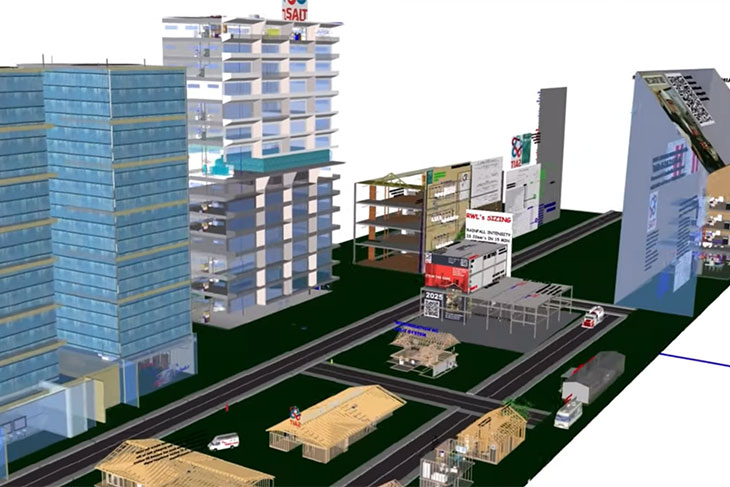
A screenshot of Bretzke’s SAIT City animation.
According to Bretzke, SAIT City could be a first for teaching multiple trades how to install their systems digitally, all in one place, before they tackle the real thing.
It’s a big idea for a man who says he fell into plumbing.
“I didn’t always want to be a plumber — I fell into it at 17, cause the coolest guy at my church was a plumber.
“I was 10 years on the tools,” he says. “Then I wanted to do the business side, so I started a company. But I always wanted to teach.”
Now, he’s been teaching off and on for about 35 years.
“I’ve taught somewhere around 5,000 students. Sometimes someone I taught will come up to me and say I changed their life. I went to the Taylor Family Campus Centre construction site just recently to look around, and some of the crew knew me — I taught them, they even knew about the book. That makes me think, well, maybe I’m doing a good thing here.”
➡️ Find Bretzke’s 3D-enhanced supplement to the 2020 National Plumbing Code appendix at the SAIT Bookstore.


Oki, Âba wathtech, Danit'ada, Tawnshi, Hello.
SAIT is located on the traditional territories of the Niitsitapi (Blackfoot) and the people of Treaty 7 which includes the Siksika, the Piikani, the Kainai, the Tsuut’ina and the Îyârhe Nakoda of Bearspaw, Chiniki and Goodstoney.
We are situated in an area the Blackfoot tribes traditionally called Moh’kinsstis, where the Bow River meets the Elbow River. We now call it the city of Calgary, which is also home to the Métis Nation of Alberta.