Building what Alberta needs most
Alberta’s health-care system had nearly 9,000 unfilled positions as of early 2025. Closing that gap requires more than good intentions — it requires investment.
Manpower Services Alberta recently directed a gift to SAIT in support of its growing health portfolio. The company’s President and CEO, Randy Upright — who also serves as Chair of the Real Futures Campaign Cabinet — sees the investment as a natural expression of Manpower’s commitment to Alberta’s workforce future.
“As AI continues to reshape the workforce, it’s not replacing people — it’s amplifying the need for new skills, new thinking and new ways of learning,” says Upright. “SAIT plays a critical role in transforming not just who we train, but how and what we teach. We are living in a pivotal moment, and SAIT is a leader in that evolution.”
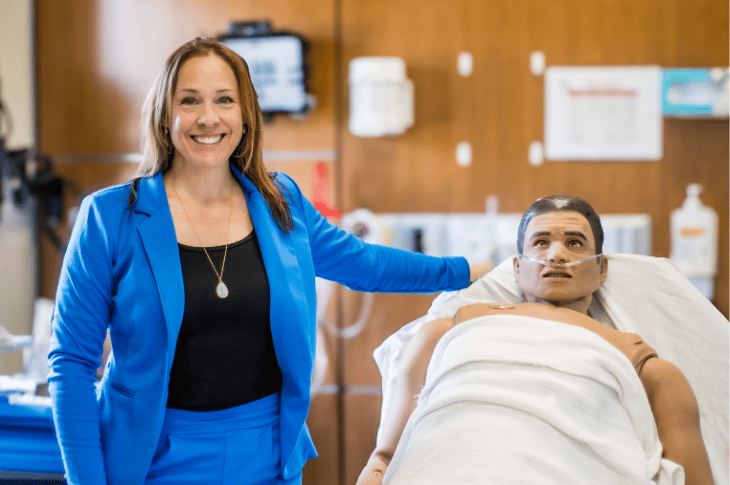
For Sonja Chamberlin, Dean of the School of Health and Public Safety, the Manpower gift matters as much for what it signals as for what it funds.
“We're building an ecosystem that will shape how health care is taught and delivered in this province for generations. Gifts like this one from Manpower are part of that enduring story,” says Chamberlin, who is herself a donor to the Real Futures campaign. “They help us move with ambition rather than just with necessity, and that’s how we build something that lasts.”
One way donor support is helping find innovative health care solutions is outlined by the school’s Supervisor of Quality and Strategic Initiatives, Jennifer Stefura, who is playing a key role in shaping the school’s future state and driving the current transformation.
"When you dig into what goes wrong in patient care, it's almost always a failure of teamwork... hierarchies, someone afraid to speak up, people not understanding each other's roles, communication breaking down as patients move through the system,” says Stefura. “Those are the things that lead to poor outcomes."
That insight reshapes what HPS teaches and, along with the opening of SAIT’s new Taylor Family Campus Centre in 2027, how it will deliver instruction.
“Technical skill has never been enough on its own. It’s the durable skills — communication, collaboration, critical thinking — that determine whether a team delivers good care,” says Stefura.
“And the new technology we’re integrating in the Taylor Family Campus Centre, as well as the spaces we’re building, give us powerful ways to teach those skills.”
The School of Health and Public Safety trains more than 2,100 students annually across 21 programs — from medical laboratory technology and diagnostic imaging to respiratory therapy and vision care. With the Taylor Family Campus Centre set to also extend the school’s instructional and practicum footprints, there has never been a better moment to be part of what’s being built here at SAIT.
Did you know, every gift makes a difference.
Explore how our donors are making real change happen everyday here at SAIT.


Oki, Âba wathtech, Danit'ada, Tawnshi, Hello.
SAIT is located on the traditional territories of the Niitsitapi (Blackfoot) and the people of Treaty 7 which includes the Siksika, the Piikani, the Kainai, the Tsuut’ina and the Îyârhe Nakoda of Bearspaw, Chiniki and Goodstoney.
We are situated in an area the Blackfoot tribes traditionally called Moh’kinsstis, where the Bow River meets the Elbow River. We now call it the city of Calgary, which is also home to the Métis Nation of Alberta.