SAIT and TUS sign international collaborative agreement to shape the future of student success
MEDIA RELEASE
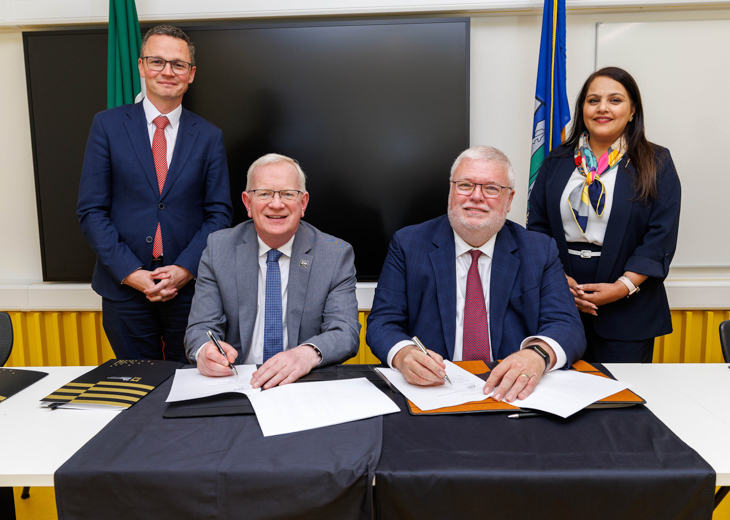
Calgary, AB and Dublin, IRE — As part of a foundational commitment to expanding global partnerships, the Southern Alberta Institute of Technology (SAIT) and Ireland’s Technological University of the Shannon (TUS) have entered a three-year collaborative agreement to foster a cooperative relationship between the two institutions.
Aimed at fulfilling mutual strategic alignment of internationalizing curriculum and the student experience, this exciting initiative will endeavour to develop joint programming, seek opportunities for student and faculty exchanges, share information and best practices and explore research initiatives.
“Solidifying our mutual commitment to collaboration through this new partnership with TUS is significant,” says Dr. David Ross, SAIT President and CEO. “The opportunity to exchange information and develop new and engaging education methods in support of student success will be a welcomed initiative among SAIT faculty and staff.”
With a focus on enhancing faculty development through international projects, the agreement will support exploration into new teaching and learning practices in applied learning through leading-edge technology.
Professor Vincent Cunnane, President of TUS, commented, “Collaboration is the lifeblood of innovation, and we are delighted to commit to this exciting new partnership with SAIT, which will open new opportunities across two continents for staff, students and researchers.”
To further enrich the post-secondary experience, a committee made up of representatives from both institutions will determine learning opportunities for students to gain global perspectives through joint programming and potential education exchanges. Participation for student engagement in research projects, practicums or internships will also be evaluated.
Plans to investigate the viability of collaborative design and delivery of joint programming at SAIT and TUS will be explored. Assessment will be completed through the lens of Alberta’s accreditation requirements, with necessary emphasis on providing a unique educational offering in the province.
Additionally, SAIT’s Applied Research and Innovation Services and the TUS Research Institutes will take a coordinated approach to applied research in their respective areas of expertise and interest. Common areas include green technology and transformation, advanced manufacturing, digitalization, bioeconomy and agriculture.
About SAIT
Established in 1916, SAIT was the first of its kind, publicly funded technical school in North America. As a global leader in applied education, SAIT serves 40,000 students annually. SAIT offers baccalaureate and applied degree programs, diplomas, certificates, apprenticeship programs and more than 550 continuing education and corporate training courses, and specializes in four award-winning areas of applied research. Curriculum and research priorities are developed through industry partnerships to meet workforce needs and build capacity for innovation province-wide. SAIT is recognized by Mediacorp Canada Inc. as one of Alberta’s Top Employers (2026) and by Research Infosource Inc. as fourth among the Top 50 Research Colleges in Canada (2025). QS University Rankings and CEOWORLD magazine awarded SAIT’s School of Hospitality and Tourism top honours in 2026, each ranking the school #1 in its sector in Canada. SAIT’s School of Business was recognized as #2 in Canada on CEOWORLD’s list of Best Business Schools in the World for 2026.
Connect with us: linkedin.com/SAIT | facebook.com/SAIT | instagram.com/SAIT
Media inquiries
Kate Laverdure, Senior Communications Specialist
Stay up to date with SAIT
Visit our Media Centre to access our media kits, expert biographies and most up-to-date news.

Oki, Âba wathtech, Danit'ada, Tawnshi, Hello.
SAIT is located on the traditional territories of the Niitsitapi (Blackfoot) and the people of Treaty 7 which includes the Siksika, the Piikani, the Kainai, the Tsuut’ina and the Îyârhe Nakoda of Bearspaw, Chiniki and Goodstoney.
We are situated in an area the Blackfoot tribes traditionally called Moh’kinsstis, where the Bow River meets the Elbow River. We now call it the city of Calgary, which is also home to the Métis Nation of Alberta.