Overview
Build real-world skills and confidence for a successful career in live media and television with our industry-informed two-year Live Media and Television Production diploma program.
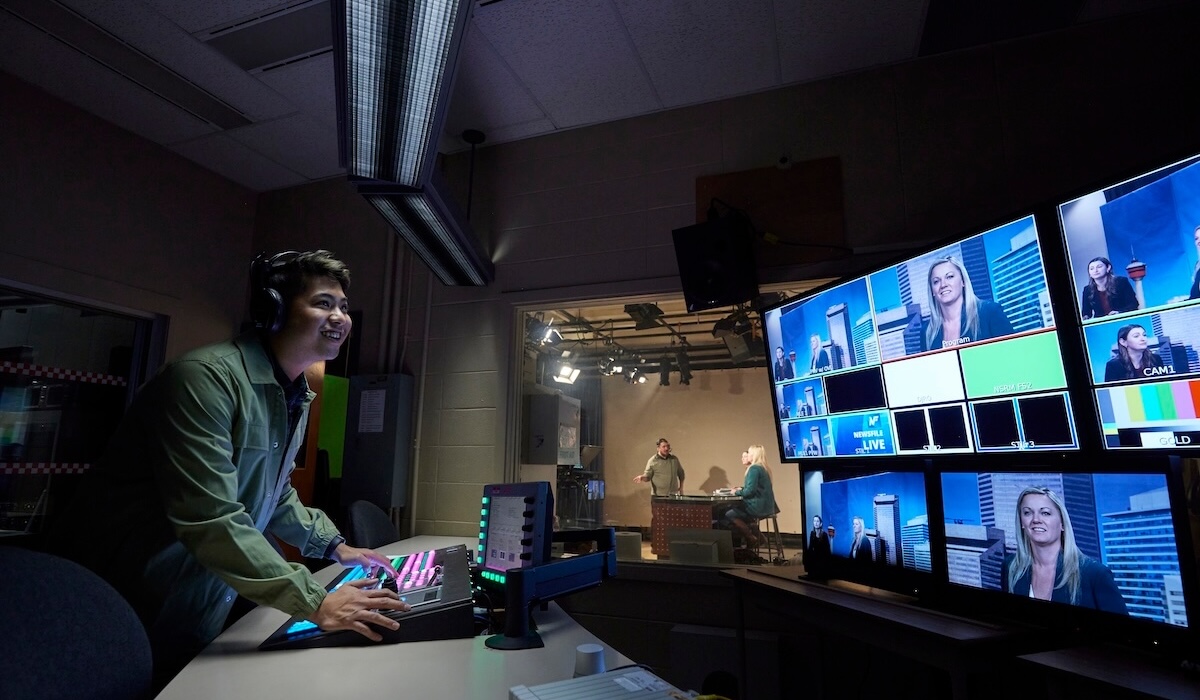
If you thrive in fast-paced environments where every second counts, a career in live media and television could be your perfect fit. From the high-energy buzz of a studio control room to the unpredictable challenges of remote field productions, this program prepares you to handle it all.
You'll gain hands-on experience in:
- creating live broadcast content
- managing on-the-fly decisions
- coordinating complex productions across traditional TV, streaming platforms, and digital media.
This program will help you to succeed as a live media professional in a variety of roles and settings, including as a producer, director, technical operator and content manager in newsrooms, sports broadcasting, entertainment programming, corporate communications, digital streaming and more.
Classes center on hands-on live production experiences in television studies, control room and production scenarios. Learning occurs through real-time production exercises, technical training sessions, creative projects and collaborative teamwork. Course workload will vary from week to week and semester to semester depending on the number of credits and the number of lecture hours scheduled for each course.
Whether you're behind the camera or calling the shots, you'll develop the technical skills and creative instincts needed to bring compelling live content to life, anytime, anywhere.
People in media and television production tend to be investigative, enterprising and social.
You need:
- to be confident on camera
- to be comfortable interviewing people and engaging with audiences
- objectivity and integrity
- to be comfortable reporting or presenting under pressure and tight deadlines
- an aptitude for research and fact-checking
- to remain composed and poised in fast-paced environments
- an accurate memory
- strong problem-solving skills.
You should enjoy working with a variety of people, compiling and presenting information and informing and entertaining others.
Graduates of SAIT's Digital Media Production certificate are eligible to enter this program in year two and complete one additional year of study to earn their diploma.
The courses in the Digital Media Production certificate are the same as those in year one of the Live Media and Television Production diploma.
This program includes an optional work term between the first and second year.
The work placement includes full-time paid employment.
After successfully completing this program, you'll receive a SAIT Live Media and Television Production diploma.
Careers and opportunities
Our graduates may work in the following occupations. Some careers require additional experience and education.
Associated National Occupational Classification (NOC) codes: 50011, 51120, 52112, 52113, 52114, 52119, 53111.
Career planning support
Unsure which career path is for you? Here are some recommended career planning resources to help you decide your future.
You can also head to Alberta alis for lots of information about careers in Alberta, including quizzes and labour market information to help you narrow down a path.
Finally, you can take our online career finder quiz, which can help narrow your options based on your current skills and interests.
Courses
The Live Media and Television Production diploma requires 66 credits (20 courses) to complete.
The program spans two years, with two semesters in each year.
You must take all of the following courses to complete this program.
Digital Media core
| Course | Credits |
|---|---|
|
This hands-on studio course invites students into the collaborative world of audio and visual production, where their stories take shape through technology. Students will capture compelling visuals, design clean and dynamic soundscapes, and experience the full production process from concept to final cut. Along the way, they will learn how to shape mood, build atmosphere, and enhance narrative through sight and sound. Emphasis is placed on creative problem-solving, experimentation, and developing workflows that mirror industry practice. By the end of the course, students will have gained the skills and confidence to transform their own ideas into polished, screen-ready content. |
3 |
|
Success in digital media depends not only on creative talent but also on the ability to collaborate, adapt, and grow through challenge. This course helps students build the personal and professional skills that drive success in high-performance creative environments. Through reflection, teamwork, and real-world scenarios, students will practice effective communication, constructive critique, and problem-solving under pressure. Emphasis is placed on work ethic, adaptability, being coachable, and openness to feedback, preparing students to contribute with confidence and seize opportunities across cinematic, live, and digital media production. |
3 |
|
Students learn the fundamentals of image formation and exposure, safe operation of film and video cameras and lenses, and the setup of location lighting and sound. The course introduces electrical safety for lighting equipment, including power distribution, load planning, and safe rigging practices. In studio sessions and on location, learners plan, shoot, and record short narrative pieces that integrate camera control, lighting design, microphone selection, and clean audio capture. Teams practice visual and sonic storytelling from pre-production through delivery, reflect on results, and refine techniques. By the end of the course, each team delivers portfolio ready short projects that demonstrate technical competence and creative intent. |
3 |
|
Students learn the creative and technical foundations of picture and sound editing. They build fluency with non linear editing concepts, core terminology, and media management workflows, then practice timeline assembly, trimming strategies, continuity, and pacing. Learners apply basic image adjustments, titling, and compositing to support story, and explore the audio signal chain including level, equalization, dynamics, and sync. Through guided labs they integrate dialogue, music, and effects, manage formats and codecs, and export deliverables to specification. By the end, students cut a short piece that demonstrates coherent narrative, clean sync, balanced mix, captions as appropriate, and well organized project files. |
3 |
|
Step into the director's chair and discover the power of performance. This dynamic, hands-on course introduces you to the essential skills of directing and performance, with a creative focus on spoken word, storytelling, pitching, and presentation. Whether you're guiding on-camera talent or collaborating behind the scenes, you'll build confidence in how to communicate ideas clearly, authentically, and persuasively. Through interactive workshops and team-based projects, you'll explore how performance can drive compelling narratives and bring ideas to life. You'll also get a practical introduction to coverage techniques and the visual language of directing, perfect for anyone curious about how stories move from concept to screen. Whether you dream of directing, performing, or producing, this course is your first step into the world of media and storytelling. |
3 |
|
Building on foundational skills, this intermediate course deepens students' understanding of directing and performance within collaborative media environments. Emphasis is placed on expanding visual storytelling, working with actors and crew, and navigating more complex production scenarios. Students will explore casting, script analysis, and set management while refining their ability to shape tone, pacing, and performance through visual language and direction. With a continued focus on clarity, adaptability, and communication, this course prepares students to take greater creative and leadership ownership in both scripted and unscripted production contexts. |
3 |
|
Designed for emerging digital media professionals, this course introduces the essential business skills needed to build a sustainable creative career. With a focus on entrepreneurial practices, students will learn how to navigate the business side of production, from invoicing, timesheets, and taxes to budgeting for both personal and project needs. The course also explores key elements of marketing strategy, client relations, and pitch development, empowering students to present their work confidently and manage creative projects with professionalism and clarity. |
3 |
|
This intermediate course builds on students' writing foundations and challenges them to refine their craft by exploring the interplay between storytelling and strategy. Through a range of creative and commercial writing exercises, students will practice shaping narratives that resonate with diverse audiences, whether the aim is to inspire, inform, or persuade. The course emphasizes adapting tone, purpose, and style across digital platforms, encouraging students to experiment with both authentic storytelling ("writing to tell") and persuasive messaging ("writing to sell"). By the end of the course, students will be equipped to create content that carries both emotional impact and strategic intent, preparing them to write with confidence and versatility in the digital space. Pre-requisites:
|
3 |
|
Marketing Essentials is an introductory course offering you a solid foundation in marketing principles. Working individually and in teams, you will research and discover how marketing decisions are made and identify the components of sustainable marketing programs. Your research, content application and teamwork skills will be developed and reinforced as you progress through the course. Equivalents:
|
3 |
|
Learn to write clear, purposeful content for digital media. This introductory course builds practical skill in structure, storytelling, and concise style across scripts, social posts, web features, and promotional copy. Students adapt tone and voice to fit specific audiences and platforms, plan narrative arcs that hold attention, and craft openings, transitions, and calls to action that earn results. Through short writing sprints and iterative feedback, learners refine ideas, strengthen edits, and align content with project goals and brand standards. By the end, each student assembles a small portfolio that may include a scene script, a social series, a web feature, and a promo one sheet ready for critique. |
3 |
You will select a total of three elective courses (one in semester 3 and two in semester 4).Elective availability varies by semester and is dependent on enrolment. Courses that do not meet minimum registration thresholds may be cancelled or rescheduled.
| Course | Credits |
|---|---|
|
Voice Acting is an advanced course for performers ready to bring stories to life through the power of voice. With a strong emphasis on narrative depth and emotional authenticity, this course challenges students to dive beneath the surface of scripts, uncovering the motivations, arcs, and subtle nuances that make characters truly resonate. Through immersive performance work and critical storytelling analysis, learners will strengthen their ability to interpret text with intention, adapt to diverse genres and tones, and deliver performances that are both technically sound and creatively compelling. This course is ideal for those looking to elevate their voice work and craft performances that leave a lasting impact. |
3 |
|
The Art of the Edit invites advanced learners to step beyond the basics and into the craft of cinematic post-production, where every cut, colour choice, and sound cue shapes the emotional rhythm of a story. Designed for students ready to refine their technical precision and creative instincts, this course explores the editor's role as both technician and storyteller. Through hands-on projects and industry workflows, students will deepen their ability to sculpt narrative, enhance visual impact, and create polished, professional-grade content. Whether you're aiming for the edit suite of a feature film or the fast-paced world of digital media, this course equips you with the skills and confidence to elevate your post-production work to an art form. Pre-requisites:
|
3 |
|
This course further advances your screenwriting and pitching skillset. Original creative works will be developed into outlines, treatments, first drafts, and production ready drafts. You will develop scripts from adapted sources and story edit previously existing work. Pre-requisites:
|
3 |
|
In today's rapidly evolving media landscape, social media has become an indispensable tool for journalists to disseminate news, engage with audiences, and cultivate a digital presence. This comprehensive course on Social Media Management in Journalism is designed to equip aspiring and practicing journalists with the essential skills and strategies needed to navigate the dynamic intersection of journalism and social media. |
3 |
|
Home Studio - Enhance the Stream is an advanced course designed for creators ready to elevate their at-home production setup into a professional, audience-ready operation. Whether you're streaming, podcasting, filming, or building a multi-platform presence, this course guides you through the creative, technical, and strategic elements that drive success in today's digital media landscape. Students will gain hands-on experience in designing and managing high-quality home studios while developing the performance, branding, and business skills essential for sustainable content creation. With a focus on adaptability, audience connection, and long-term growth, this course empowers creators to turn passion into polished, purpose-driven media. |
3 |
|
Short Form Content Creation is an advanced course for storytellers, creators, and visual communicators looking to master the art of saying more with less. Focused on crafting impactful, purpose-driven content across a range of short to medium formats, this course challenges students to think critically about story, audience, and visual economy. From emotionally resonant micro-videos to tightly structured narrative shorts, learners will explore how to distill big ideas into concise, compelling pieces that resonate across platforms. With a strong emphasis on creative intention, production efficiency, and audience engagement, this course prepares students to create content that is not only shareable-but unforgettable. |
3 |
| Course | Credits |
|---|---|
|
This cooperative work term course provides the opportunity to apply your classroom learning in a practical workplace setting, as well as gain valuable industry experience. This course is optional. Pre-requisites:Manual Prerequisite One of the following sets of pre-requisites, as applicable to your program of study: Information Technology Services
Software Development
Information Systems Security
New Media Production & Design
Film and Video Production
Journalism
Interactive Design
Integrated Artificial Intelligence
|
0 |
Progression
You must attain a PGPA and/or a CGPA of 2.0 or better each semester and pass the prerequisite courses to progress through the program.
To qualify for graduation, you must pass all courses, attain a CGPA of 2.0 or better and complete course requirements within the prescribed timelines.
Review our grading and progression procedure >
Explore your options!
Some courses in this program are available through Open Studies. You can complete courses via Open Studies to get a head start on your education, reduce your course load once accepted into a credentialed program, or determine which career path best suits you before you fully commit.
You may also take courses for general interest or personal and professional development.
Admission requirements
Domestic requirements
Applicants must demonstrate English language proficiency and completion of the following courses or equivalents:
- at least 60% in English 30-1 or English 30-2, and
- at least 60% in Math 20-1 or Math 20-2
OR
- successful completion of SAIT's Digital Media Production Certificate which will give you advanced standing to the second year of the diploma.
SAIT accepts high school course equivalents for admission for applicants educated outside Alberta.
All applicants who were educated outside of Canada must demonstrate English language proficiency and provide proof they meet the program admission requirements with an international document assessment. Find accepted educational documents and assessment options.
SAIT may also accept courses completed at certain international post-secondary institutions.
Academic Upgrading
Missing an admission requirement for this program? Upgrade your prior education to help you receive admission into one of SAIT's career programs.
English language proficiency
All applicants must demonstrate English language proficiency prior to admission, including students educated in Canada.
Transfer agreements
At SAIT, we have created transfer agreements with partner institutions to allow you to earn course credits toward your SAIT program based on your previously completed credentials.
Transfer Alberta search tool
Use the Transfer Alberta search tool to search all pre-assessed transfer credit and transfer agreements between Alberta post-secondary institutions (including those with the University of Calgary, Mount Royal University and Bow Valley College.)
Transfer options for graduates
When you have completed this program, you may continue your education at a partner post-secondary institution. These transfer agreements include partnerships within and/or outside of Canada.
Available intakes
When can I start?
To see upcoming intakes for this program and whether seats are still available, follow the appropriate link below.
Costs
2026/27 tuition and fees
The following costs are effective as of July 1, 2026.
The estimated total cost of tuition and fees is based on the suggested schedule of study. Following a modified schedule will impact the fees you pay per semester and may alter final costs.
Domestic students
The program total is based on the estimated amount you will pay if you enter this program during the 2026/27 academic year. The program total amount listed on your letter of admission may appear higher. This amount is your maximum tuition guarantee for the program. SAIT will not exceed this maximum, regardless of changes in tuition and fees between academic years.
There are no required textbooks in this program.
This is a bring-your-own-device program with a custom computer hardware and software requirement. Your computer can be a Windows or Mac machine, but it must meet the following minimum specifications.
Windows computer
- Processor: Intel 7th Gen or newer CPU with Quick Sync or AMD Ryzen™ 3000 Series/Threadripper2000 series or newer CPU
- Operating system: Microsoft Windows 10 (64-bit) version V20H2 or later
- Memory: Dual channel memory 16 GB of RAM or HD media
- GPU: 4GB of GPU memory for HD and some 4K media. For a list of supported graphic cards and drivers, see Adobe specs.
- Storage: Fast internal SSD for app installation and cache 512GB or greater. Additional high-speed external drive for media - 1TB minimum
- Display: 1920 x 1080 or greater
- Sound card: ASIO compatible or Microsoft Windows Driver Model
Mac computer
- Processor: Intel® 7thGen or newer CPU or Apple silicon M1 or newer
- Operating system: macOS 11.0 (Big Sur) or later
- Memory: Apple silicon 16 GB of unified memory or Intel 16 GB of RAM
- GPU: Apple silicon 16 GB of unified memory or Intel 4 GB of GPU Memory for HD and some 4K workflows
- Storage: Fast internal SSD for app installation and cache 512GB or greater. Additional high-speed external drive for media - 1TB minimum
- Display: 1920 x 1080 or greater
- Sound card: Default Mac OS Apple sound drivers
You must also purchase a Adobe Creative Cloud subscription, and install Microsoft Office Suite following the Microsoft 365 instructions found on online learning tools and software.
Financial aid
Paying for your education may feel overwhelming, but we have resources and programs that can help, including information about payment options, student loans, grants and scholarships.
Admission process
Ready to apply?
Follow our step-by-step guide to submitting a successful application.
Communication during admission
Email is the primary source of communication during the selection process. Ensure your personal email account is managed appropriately to receive our emails, files and communications. We recommend you add the sadt.advising@sait.ca domain to your safe senders' list or you risk missing critical email messages.
Begin your application
Apply now using the online application portal.
Ensure you have a valid Visa or Mastercard to pay the non-refundable application fee of $120 for domestic applicants or $175 for international applicants.
Information sessions
Prepare for a strong start in your chosen program or get the details you need to decide your future path.
Our expert staff and faculty are ready to answer your questions and provide information about the following:
- What sets SAIT apart
- An introduction to the program and area of study
- Admission requirements
- Future career paths
- Information on the earning potential and graduate employment rates.
Contact us
School for Advanced Digital Technology Advising
- Phone
- 403.284.8543
- sadt.advising@sait.ca
International Student Advising
- Phone
- 403.284.8852
- international@sait.ca
Other programs you may be interested in
- Certification type
-
 Diploma
- Availability
- International Students Accepted Not PGWP eligible
This program will prepare you for a career in podcasting, radio, sound design and cross-platform content creation through hands-on studio production and storytelling-focused coursework.
- Program length:
- 2 years
- Location:
- In person (Main Campus)
- Faculty:
- School for Advanced Digital Technology

- Certification type
-
Diploma
- Availability
- International Students Accepted Not PGWP eligible
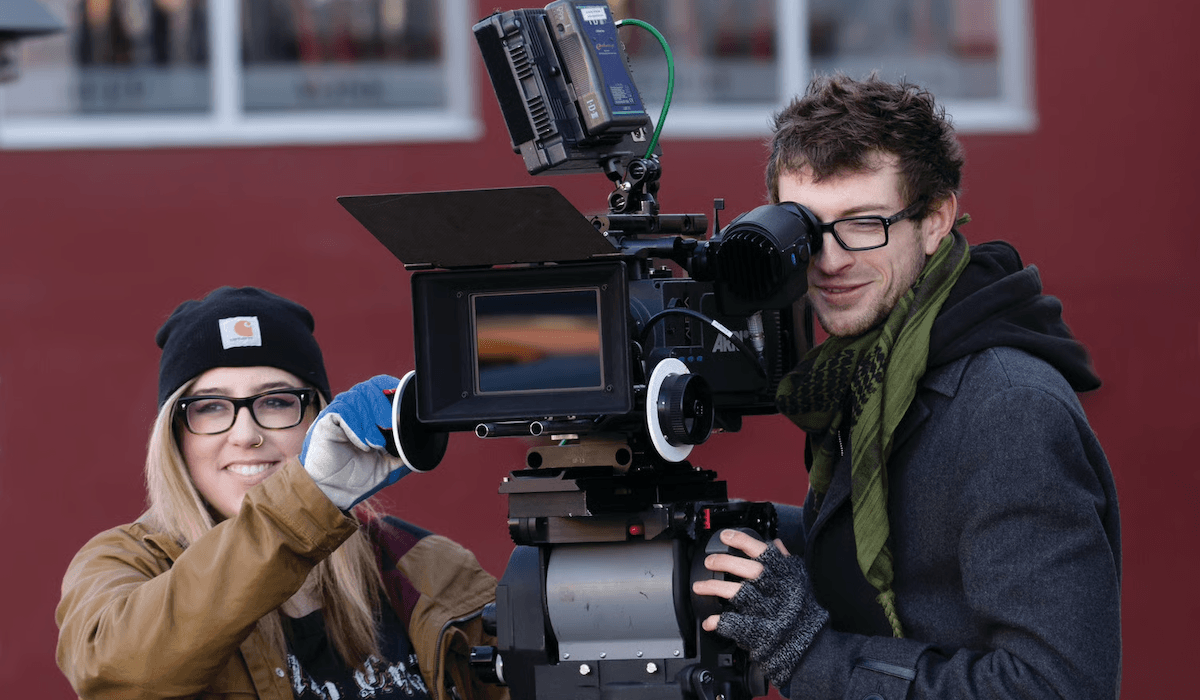
This two-year diploma trains you to develop scripts, plan productions, and create screen stories through directing, cinematography, lighting, sound, and editing, with intensive studio and project-based learning and an optional paid work term.
- Program length:
- 2 years
- Location:
- In person (Main Campus)
- Faculty:
- School for Advanced Digital Technology
- Certification type
-
Certificate
- Availability
- International Students Accepted Not PGWP eligible
This one-year certificate program will prepare you for creative digital roles by building core skills in camera, lighting, audio, editing, storytelling, project management, and client collaboration through hands-on studio and real-world projects.
- Program length:
- 1 year
- Location:
- In person (Main Campus)
- Faculty:
- School for Advanced Digital Technology

Subscribe for updates
Your journey starts here! Sign up to get important updates on:
- Graphic and media arts programs
- Application information
- Relevant news and events

Oki, Âba wathtech, Danit'ada, Tawnshi, Hello.
SAIT is located on the traditional territories of the Niitsitapi (Blackfoot) and the people of Treaty 7 which includes the Siksika, the Piikani, the Kainai, the Tsuut’ina and the Îyârhe Nakoda of Bearspaw, Chiniki and Goodstoney.
We are situated in an area the Blackfoot tribes traditionally called Moh’kinsstis, where the Bow River meets the Elbow River. We now call it the city of Calgary, which is also home to the Métis Nation of Alberta.