Delivering education and community for women in the skilled trades
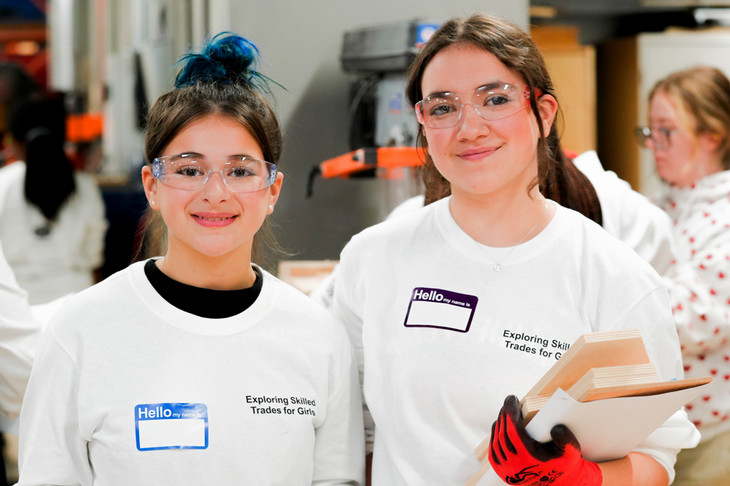
Our community-based approach to inspiring more women to consider careers in the skilled trades is a team effort at SAIT. From engaging youth through summer camps, workshops, and dual-credit programs to reducing financial barriers and providing mentorship opportunities, we’re building equity for women in the trades.
Add instructors who are experts in their craft and leadership who works closely with industry to foster inclusive workspaces, the possibilities are wide open. Meet some of the SAIT employees making it happen.
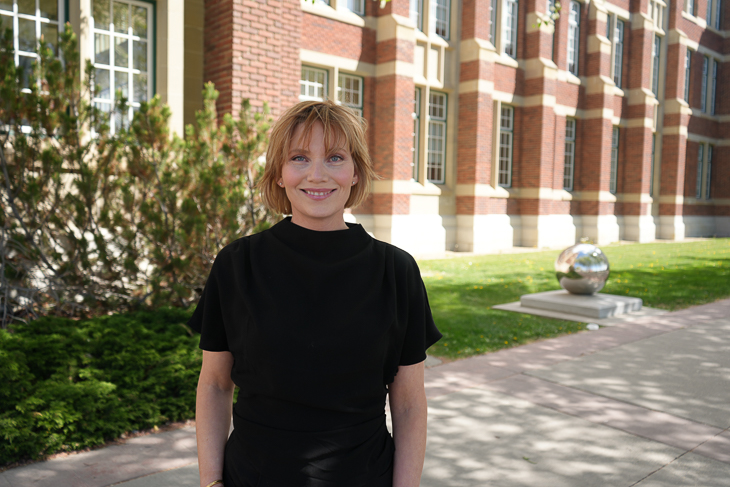
Chenoa Hansen is an Academic Chair inviting more women into the trades
The skilled trades were woven throughout Chenoa Hansen’s life before she ever began a career supporting them. Her father was a woodworker, crafting cabinetry and building furniture. Her husband, a SAIT alumnus, is a dual-ticketed electrician and heavy duty mechanic.
In her teens and early twenties she worked in the culinary trades, and she remembers the challenges that came with being the only woman in the kitchen.
Today, in her role as Academic Chair of automotive programs at SAIT, Chenoa is passionate about welcoming more women in male-dominated spaces. And you can see it in just about everything she does.
Her journey, her way
Chenoa’s route to Academic Chair wasn’t typical. For 10 years, she forged her own entrepreneurial path as a mortgage broker. When she was ready for a change, she found herself eyeing up a career at SAIT thanks to a friend who loved working there.
In 2018, she landed an Administrative Assistant role at the Point Trotter Campus, home to SAIT’s Crane, Rail, RV and Ironworker trades programming. One project management certificate and countless hours of mentorship later, she was promoted to Manager of Support Services in 2021.
The position marked Hansen’s first opportunity to lead with inclusion at the forefront. While managing and advocating for a large team of mostly women across three of SAIT’s trades schools, she also implemented more inclusive hiring practices to build a more diverse workforce that better reflected the learners they served.
In 2024, while working through her MBA, the Academic Chair role for automotive and motorcycle programs opened up. Unsure of her chances considering she didn’t come from the automotive industry, but confident in her proven leadership abilities, she went for it.
“I just swung for the fences,” says Chenoa.
To her surprise and delight, the big swing paid off — and she was ready to make her mark.
“The first few months took a lot of really hard work,” she says.
“I had a very different perspective on how to lead, how to manage and what I think is important in this role.”
Paving the way for more women in male-dominated spaces
As Academic Chair, she's prioritized bringing more women faculty and staff into the school’s automotive programming — no easy feat when women comprise less than 5% of automotive technicians in Alberta.
Leaning on her colleagues to help put forward female technicians they had worked with, she has successfully recruited additional team members and hopes to continue this trend.
“Experiencing the struggles I’ve had during my career progression in male-dominated sectors, I really believe in giving women a chance,” says Chenoa.
“Women bring significant innovation and creativity to work environments.”
Chenoa's commitment to inclusion goes beyond hiring practices. She sits on the steering committee for SAIT’s Women in Skilled Trades (WIST) Retention Program, designed to increase female representation in apprenticeship education through mentorship, barrier reduction and initiatives promoting cultural change. Her involvement includes co-emceeing mentorship events bringing together apprentices, industry leaders, faculty and mentors to explore the shared experience of women in trades.
As part of the Organizing Circle for a women employee resource group at SAIT called EMBRACE, Chenoa aids in planning events for development, connection and personal growth.
And sometimes her passion gets a little more hands on. On two occasions, she and her faculty members hosted a tire changing workshop — once for International Women’s Day and again for a SAIT employee appreciation event.
“We had 30 incredible women diving into trunks of cars, putting plastic smocks on, ripping out tires, showing no fear, with so much energy and excitement,” she says.
“Our team loved it.”
Importantly, Chenoa makes a point of spending time in automotive classrooms and labs, getting to know the women students and making sure they feel supported.
“I let them know they can always come to me if they have challenges or issues,” she says.
“It’s important they understand there are women faculty here that they can talk to.”
Behind the scenes, she empowers a safe and respectful learning and working environment. From carving out time for inclusion-focused micro-learnings in meetings to promoting discrimination and harassment response training, she ensures faculty members are informed and equipped to support students and one another.
She is an advocate for allyship amongst female faculty — women instructors leaning on one another when navigating their own challenges.
“It’s important for women to take care of each other and to do so with kindness and empathy. Quite often, we can lose sense of what our women peers are going through,” says Chenoa.
Collectively, these initiatives create a supportive culture from inside the organization out.
“If we role model the right way to treat women and everybody, then students become ambassadors as they enter industry. They will be the people that change culture in their work environments.”
Looking ahead, she sees tremendous opportunity. Chenoa is working to add inclusive messaging for women into program welcome letters for students, so they feel supported before their first day of class. She hopes to see more males attending events related to women in trades and taking allyship roles in the classroom and in industry. She aspires to one day embed equity, diversity and inclusion training in program curriculum. And she wants to continue making an impact in a role she doesn’t take lightly.
“When I see all these women students in our classrooms, knowing where they have come from and where they are going, I believe it’s good for them to see a woman in this type of role, so they know there’s more out there if they want it. There is always more.”
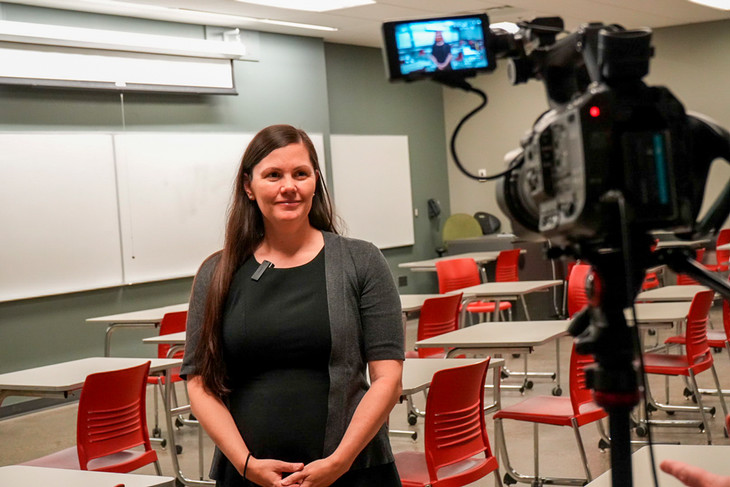
Sparking curiosity: How Rozlynn Wick is helping young girls explore the trades at SAIT
“I never even knew a career in the trades was an option,” says Rozlynn Wick (M.Ed., PMP), Associate Director, Strategic Youth Initiatives. “I could have been the best plumber in the world, but it was never presented as a program or career path to me. What if there are other girls out there who didn’t know this was a choice?”
Since starting at SAIT in 2012, Roz has been trying to make sure that youth know all their options for future careers. Her team collaborates with all SAIT Schools in the development of intentional pathways which introduce youth to careers and post-secondary programs. It’s a journey that can begin when elementary-aged kids are exploring their interests, all the way up through junior high and high school, when youth are making decisions for the future.
Some of SAIT’s youth programs are specifically designed for girls.
During Exploring Skilled Trades for Girls, female-identifying students in Grades 8 and 9 can come to SAIT’s main campus for workshops and activities related to careers in the trades. Girls who attend this event can try out a wide variety of different trades, from roofing to glazier, woodworking to refrigeration. The girls are supported throughout the day by female instructors as well as female mentors from industry.
If something catches their eye, they can get hands-on in weeklong summer camps like Carpentry: Tools and Foundations, STEAM Builders and Welding for Girls (beginner or intermediate).
While girls are welcome to sign up for whatever camp they’d like, the “For Girls” version of these camps give them a chance to build confidence in a female-only cohort if that’s how they feel most comfortable.
Roz recalls, “We were seeing junior high and high school girls sign up for our camps and, in a group of 12, they might be the only girl. That can be a tough environment as a young woman. You may be learning a new skill in a class of male campers, and that can be hard if you’re still building confidence in your skills and yourself.”
As youth continue to explore their interests, they can also begin to take steps toward post-secondary education. Youth can go as far as to earn credit or a SAIT credential through dual-credit programs, where youth in Grades 11 and 12 dive deeper into subjects and get a step ahead in their education. SAIT’s youth programs are created as a pathway, with multiple entry and exit points, allowing young people to engage early and often with different programs offered at SAIT.
“At the end of the day, we want girls to be informed about the many options they have before them and feel empowered to pursue whatever they’re interested in — even if, at the end of the day, they choose another path.”
Year-round Youth Initiatives programming
Throughout the year, Roz’s team works with all of SAIT Schools to welcome young people of all ages and gender identities to campus to take learning into their own hands. Several programs and events support exploratory opportunities for youth interested in the skilled trades:
- Our Skills Development Series, taking place in the evenings, SAIT welcomes junior high and high school students to explore their interests and develop skills related to welding, technology and culinary arts.
- Exploring Building Trades, in partnership with CBE and Mattamy Homes, supports high school students in learning about both restricted and unrestricted trades in a real-world residential building site.
- During Exploring Aviation Day, junior high students can participate in hands-on activities to explore career paths related to aviation, like maintenance, avionics and aircraft structures.
- On Exploring Energy Day, high school students can explore programs related to SAIT’s MacPhail School of Energy, focusing on electrical, petroleum, operations and sustainability.
- Throughout the summer, Indigenous youth from Maskwacis attend SAIT for a week-long summer camp experience where they can explore different program areas, including carpentry and welding.
- Through our Exploring Skilled Trades program, junior high students can learn more about the trades in a self-directed online program.
- The Calgary Skilled Trades and Technology Collegiate was created in collaboration with CBE, with a physical learning space scheduled to open in the fall.
Getting the word out through partnerships
Youth Initiatives programming is possible because of collaboration with our school board and industry partners. “We work closely with our school board partners to identify areas of student interest, trends related to labour market needs or possible gaps in program offerings. We then work to build our programming, which supports student interests and learning,” explains Roz.
“Much of our programming is available for a junior high audience because we know it’s important to start exposing young people to these options at an age where they can make informed decisions in Grade 9 about what they’ll take in high school — their math classes, their science classes — and to prepare them if they choose to participate in a dual-credit program in the trades.
“There are trades pathways that young people might be unfamiliar with, and part of our job is to open their eyes to the possibilities.”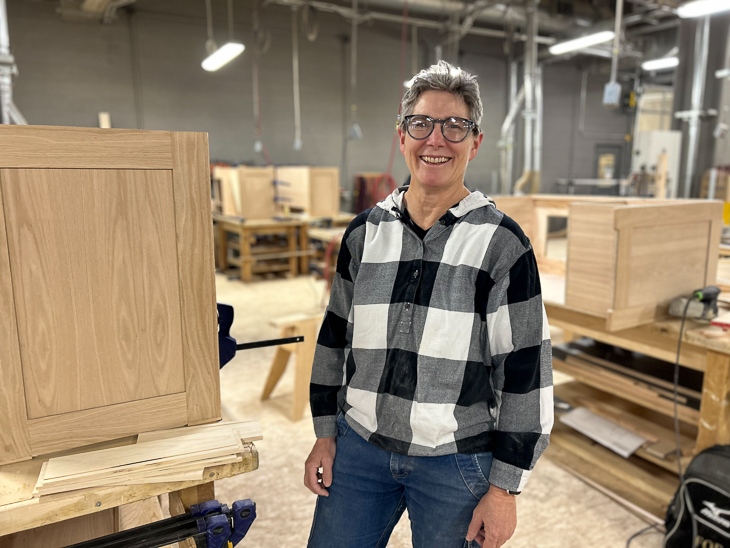
From building things to building confidence: Meet Jane Durango
“Can you imagine building this building?” says Jane Durango. She’s sitting on a stool at the front of a wood trades shop inside SAIT’s Thomas Riley building. “A designer, an architect, comes up with the idea. The engineer tells us it's possible. Then the carpenters have to build it. Carpentry is like a superhero job. It's amazing what we do every day.”
It’s instantly obvious Jane loves carpentry. She spent 25 years working construction onsite in the trades before joining SAIT as an instructor in the School of Construction.
“I loved getting a pile of wood, like a pile of sheets, and in two weeks, it would be something. I love that you can see what you did all day. I think that's why I'm a good teacher — because people can feel that I still love it.”
Jane’s journey from carpenter to carpentry instructor started when she found herself underemployed in her 20s. With aspirations to become a firefighter, she originally pursued the trades to be a stronger recruit. Carpentry was a good fit for the fire department, she says, since carpenters know about structure, how things are built — and how to break in.
“As soon as I tried carpentry, I knew I would be good at it,” she says. “Even though everyone told me I would fail.”
Succeeding at not failing
Thirty years ago, Jane was the only woman in her class #HereAtSAIT.
“Back then, women were typed, and I was the type that got along with the guys. That made class easy — not necessarily for me, but for everyone else.”
She was encouraged to move straight into teaching after finishing her training but wanted the professional experience of working outside and onsite.
Through her first job, she found a life-long mentor, John, who she quickly credits with helping her succeed.
“He didn’t know he was going to be my mentor but he took a chance on me. I know he hired me even when there was a dip in his work, so I think he was just willing to try. Not everybody was willing to take on a woman back then. And not everybody is now. John was amazing — he gave me everything, but I also gave him everything I had.”
Support means growing the number of women in construction
While the percentage of women making up the onsite trades workforce in construction has room to grow, Jane sees more women taking an interest in the skilled trades. Getting more women to enrol is a big step towards increasing future numbers. Through SAIT’s Women in Trades and Technology (WITT) group, Jane is focused on the present and supporting women who are here now.
“Women in the trades often don’t want to stand out, but they also don’t want to be alone,” she says. “These women are already determined — what they need is connections and support and rules that are enforced.”
WITT hosts monthly meetups to connect like-minded women and gender-diverse folks in a supportive space, where students, apprentices, faculty and staff can access on-campus resources, share experiences, build connections and celebrate one another.
“You’re building a network with WITT,” she says. “If you’re having a crappy day, you can reach out and these women will love you up — you’ll feel better, braver, and you know you can head back to work or class stronger. It feels good to be around each other — and the numbers give us power.
“I'm really glad WITT happened for me. I think it’s essential.”
Making the worksite better for everyone
Inside the classroom, Jane’s approach to teaching includes embracing her representation and her perspective as a woman in the skilled trades.
“I'm here, right? I'm respected by my department. Every woman in this class since I've been here knows they could be here too.”
But the real potential for impact lies with the men, she says.
“I have 16 fourth-year apprentices in this class — 15 are men,” she says. “How do I think we can change the culture on male-dominated worksites? One class at a time.
“This is a great group and they’ll be the leaders out there. So, we don’t just talk about carpentry, we talk a lot about how to be a good leader, how it feels when you work with a good one. We talk about how to be a better person.
“Each guy will have another 10 men under them. That’s 160. Helping them see that making the worksite better for women and all equity-deserving groups makes it better for everyone, that’s the job.”
Just four years into being an instructor, Jane describes carpentry and teaching as equally incredible.
“I'm better at it now than in my first year,” she says. “Now, I can anticipate mistakes and predict what they don’t understand. I can set them up for that amazing feeling when they figure it out.
“It’s kind of the same job as being a carpenter, but I’m helping build confidence in students instead of things.”


Oki, Âba wathtech, Danit'ada, Tawnshi, Hello.
SAIT is located on the traditional territories of the Niitsitapi (Blackfoot) and the people of Treaty 7 which includes the Siksika, the Piikani, the Kainai, the Tsuut’ina and the Îyârhe Nakoda of Bearspaw, Chiniki and Goodstoney.
We are situated in an area the Blackfoot tribes traditionally called Moh’kinsstis, where the Bow River meets the Elbow River. We now call it the city of Calgary, which is also home to the Métis Nation of Alberta.