Cadmus project promotes heavy equipment industry through EV go-kart challenge
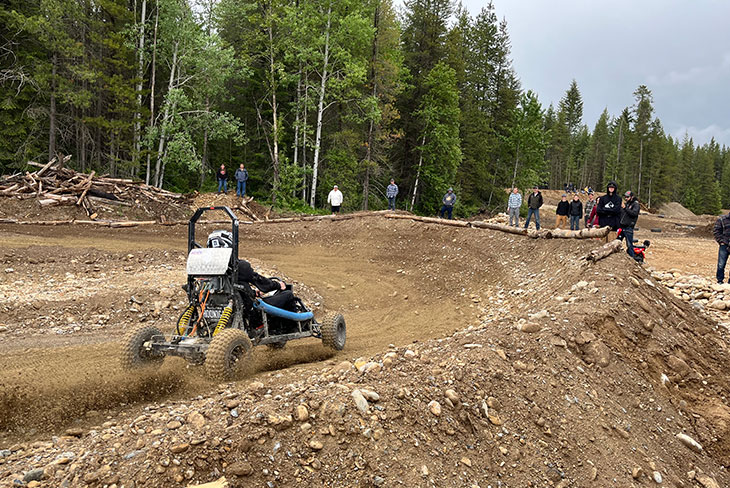
When you think of heavy-duty equipment, electric vehicles (EV) and hybrid systems might not be what first springs to mind.
But the connection makes perfect sense to Erik Sartison, Academic Chair for SAIT’s Heavy Equipment programs in the School of Transportation.
“Every automotive company has a battery hybrid or an EV now. But for those of us in heavy-duty, we’ve had hybrid vehicles since the early 1900s — every freight train out there is a hybrid vehicle.”
Last year, Sartison received the Cadmus Trades Teaching Chair award, which supports SAIT instructors to develop a project, idea or concept that enhances trades education. His winning pitch was a proposal to engage Calgary high schools in an EV go-kart challenge hosted by Edison Motors in B.C.
The challenge gives students a chance to design, build and race the vehicle, while providing some positive exposure to future career possibilities.
“It’s inspiring future heavy duty equipment techs, welders, mechanics, plus there’s the engineering aspect as well. There are kids out there who have realized through this competition they’re smart enough to figure this stuff out and they can do this as a career.”
Industry connection helps build Cadmus proposal
Sartison started at SAIT two years ago. He’s also an alum.
“As a heavy-duty equipment guy, I’ve been interested in Edison Motors for a while,” he says. “They’re building Canadian trucks in Canada — big log haulers and vocational trucks — and they're building them diesel-electric hybrid.”
Curious about the EV go-kart challenge, he noticed there were only a few teams on the competition list from Alberta. So, he went, checked it out, talked to some of the students and decided it could be a fit for young people closer to home.
“I thought there would be a lot of high schools here that would probably eat this up. When I started reaching out, the response was awesome.”
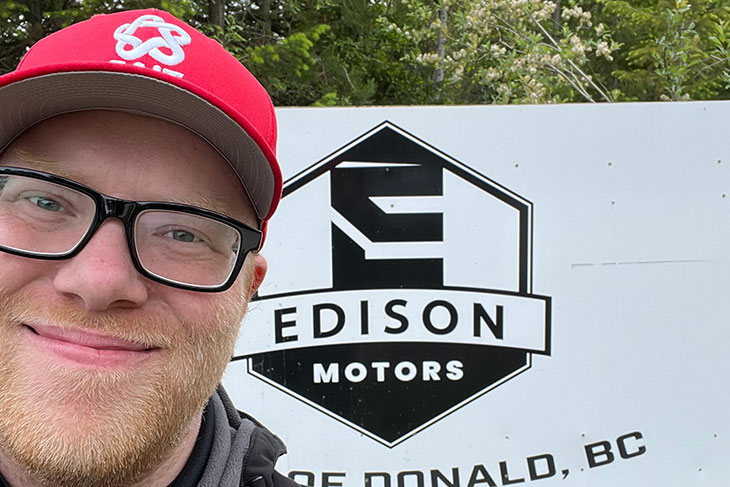
Sartison was an instructor in both the Transport and Heavy Equipment Technology diploma program and the Heavy Equipment Technician apprenticeship program when he received the 2025/26 Cadmus Chair award. The more he worked on the project, the more it built on itself.
In addition to talking to local high schools and hearing back from several who were interested in moving forward with a team, he also talked to Edison about creating some curriculum for the competition.
“I came up with a plan to design something they could share with a high school — like 10 slides, 10 minutes, this is hydraulic brakes, here’s how they work, here’s the theory and here are some applications.
“I built 13 modules based on that concept, covering hybrids, electrical, the internal combustion engine and how everything works. Now, Edison has it available and open as a resource for anyone who signs up for the competition.”
Bumps and bright spots mark Cadmus project path
While the curriculum part of the project moved ahead smoothly, Sartison hit a few major bumps in the road when it came to getting the Calgary teams to the competition. Restrictions on the use of high voltage vehicles in some of the high school shops, safety concerns and the province-wide teacher’s strike threw multiple wrenches in the works.
“It was so hard,” he says. “There were multiple interested teams and some great sponsors, which was really exciting, and then the teams just fell away one at a time.”
Despite not getting the teams to the actual competition, the overall project hit plenty of high notes.
“I completed the electric vehicle service course offered through SAIT, I was able to do a session on the risks and opportunities with EVs in high school automotive shops at Teachers’ Convention here at SAIT and the Cadmus funding allowed us to buy a Consulab EV trainer we can use in the high voltage part of our heavy equipment training.
“I also did a few sessions with the Calgary Board of Education, talking to some automotive teachers about the EV go-kart challenge and high voltage safety in the shop.”
Grab a quick glimpse of the EV go-kart challenge in action
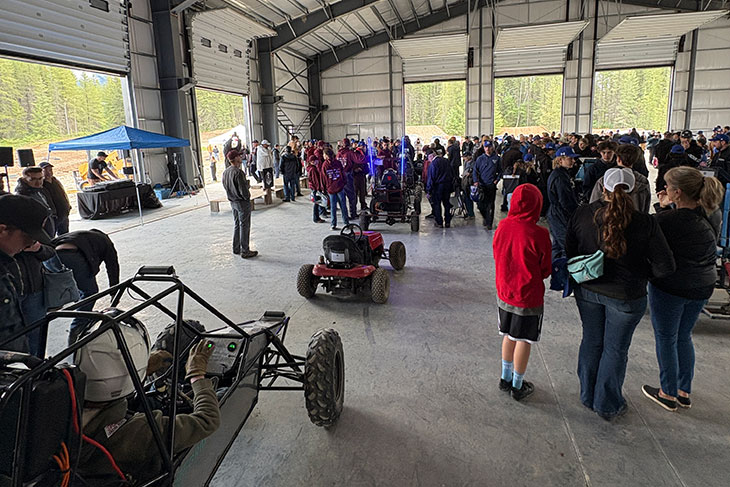
Plus, when Sartison attended the competition this spring, a teacher from one of the Calgary high schools brought along the kart his students completed, despite the setbacks. Although the students weren’t able to race, their kart still made an appearance on the track after another school experienced a kart failure.
“The EV challenge isn’t about who’s the best,” says Sartison. “There are a hundred kids out there, they’ve spent months building these karts and they’re just amazing. They’re getting better every year, so the inspiration is working.”
Cadmus a lesson in learning and a legacy for trades teaching
The Cadmus Chair award is designed to foster faculty excellence in skilled trades teaching. The first chair was awarded in 2005. Recipients receive $20,000 in funding and a four-month break from teaching to work on their project.
When asked if he would recommend applying for the Cadmus award to others, Sartison’s response is, absolutely.
“Whether it’s professional or personal development, I think it’s really valuable to have the opportunity and support to take some time and learn something new.
“I wanted to do something for my Cadmus project that would benefit some kids out there, inspire them, maybe to come to SAIT, and get a great job they enjoy. I had so much help, lots from previous Cadmus Chairs. They are so motivated to help out whoever is doing the next one.”
Despite being relatively new to SAIT, Sartison wasn’t a stranger to the award. His first exposure to Cadmus was through his dad, who worked at SAIT for 25 years.
“I remember him telling me to go to Mick McGowan’s wood-working showcase and me walking in and seeing all these incredible things.
“Here we are, 10 years later and I’m wrapping up my own Cadmus project and I got to sit at the table and listen to Mathew Romeike’s 2026/27 proposal. I just hope this continues and I get to watch other people and their successes. If we can get more faculty inspired to do these kinds of projects, it would be amazing.”
Applications for the 2027/28 Cadmus Trades Teaching Chair are now open! Learn more and apply before Feb. 26, 2027.

Oki, Âba wathtech, Danit'ada, Tawnshi, Hello.
SAIT is located on the traditional territories of the Niitsitapi (Blackfoot) and the people of Treaty 7 which includes the Siksika, the Piikani, the Kainai, the Tsuut’ina and the Îyârhe Nakoda of Bearspaw, Chiniki and Goodstoney.
We are situated in an area the Blackfoot tribes traditionally called Moh’kinsstis, where the Bow River meets the Elbow River. We now call it the city of Calgary, which is also home to the Métis Nation of Alberta.