Important
This NDT course is delivered in person and is subject to minimum enrollment.
If you’re travelling from outside the Calgary area to attend and need to make travel or accommodation arrangements, please contact ConEdAdvising@sait.ca at least 14 calendar days before the start date to confirm your section's status.
Overview
Liquid Penetrant Inspection (LPI), also referred to as Dye Penetrant Testing, is a sensitive, inexpensive and very portable Non-Destructive Testing (NDT) method that is capable of detecting and locating discontinuities that are surface breaking. This method is an enhancement of visual inspection. Liquid Penetrant Levels I and II covers basic principles of liquid penetrant inspection and processing, advantages and disadvantages of various processes, system controls, test equipment and accessories, and inspection procedures and standards.
To be eligible to take this course, you must be at least 18 years old and have completed CODE 118 Materials and Process for NDT. If you have completed this requirement at a institution other than SAIT, please email your proof of completion documents to ConEdAdvising@sait.ca at least one week prior to the course start.
To be successful in this course, we recommend that you have:
- a minimum 50% in Math 10-C course; if you haven’t taken this course or would like to refresh consider taking an Academic Upgrading course equivalent.
- three months of field experience in liquid penetrant inspection.
Upcoming dates
Select an available section and add it to your cart. When you're ready, proceed to check out to sign into your student account and complete your registration.
Don't have a student account? Let's set one up!
Registration closes seven days before the start date for on-campus, online scheduled, and blended courses, and one day before the start date for online self-paced courses.
After you've completed this course
Upon successful completion of this course, you'll be able to self-print a proof of completion document from your Continuing Education student account.
Costs
Textbook and reading list
Included in the purchase of this course, you’ll receive course content accessible online in Brightspace (D2L).
Technology
To be successful in this course, you’ll need:
- Access to your own computer or laptop with standard hardware/software requirements
- Internet access
Additional supplies
You'll need the following items starting the first day of class:
- Calculator
- Geometry set
- Steel-toe safety boots
- Clear-lens safety glasses with UV protection
Financial support
Financial opportunities are available to help pay for your course fees. Learn more about how to reduce your education or training costs with available awards, bursaries, loans and grants, including the Canada Alberta Productivity Grant.
Related courses you may like
- Certification type
-
 Course

Train your team
Interested in group training opportunities for this course? Tell us about your organization's needs, and one of our training consultants will contact you within one business day.
Stories and news
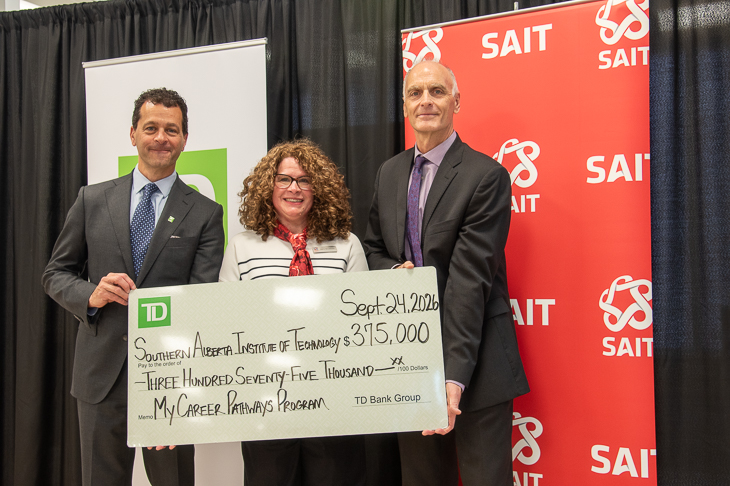
TD investment strengthens skills development and career exploration at SAIT
MEDIA RELEASE - The Southern Alberta Institute of Technology (SAIT) has received a second $375,000 commitment, over three years, from TD Bank Group (TD). This renewed investment aims to support My Career Pathways.

New SAIT and Mastercard partnership targets cybersecurity gaps facing Canada’s small businesses and non-profits
MEDIA RELEASE - SAIT and Mastercard collaborate to expand access to cybersecurity learning and help organizations in Western Canada strengthen their digital resilience.
Oki, Âba wathtech, Danit'ada, Tawnshi, Hello.
SAIT is located on the traditional territories of the Niitsitapi (Blackfoot) and the people of Treaty 7 which includes the Siksika, the Piikani, the Kainai, the Tsuut’ina and the Îyârhe Nakoda of Bearspaw, Chiniki and Goodstoney.
We are situated in an area the Blackfoot tribes traditionally called Moh’kinsstis, where the Bow River meets the Elbow River. We now call it the city of Calgary, which is also home to the Métis Nation of Alberta.