Overview
Intermediate Live Sound Engineering focuses on digital data processors in live sound environments while comparing digital and analog signal processing.
Through in-class coursework, assessments, and a group project, you'll develop the advanced skills needed to configure and operate digital mixers and corresponding routing networks for the distribution of data. By the end of this micro-credential course, you’ll have the fundamental working knowledge of digital mixing systems and their applications in a live sound environment.
You must complete AUDI 012 Intro to Live Sound Engineering before registering for this course.
Upon successful completion of this course, you'll be able to:
- discuss the basics of a digital processing environment
- describe the process of using digital filters and equalization
- assess various types of microphones and their characteristics
- identify various types of loudspeaker systems and their characteristics
- demonstrate the basic operation of a digital mixing console
- illustrate the use of digital dynamics and effects processors
- explain how to setup and operate a portable intercom system
- demonstrate proper operation of a sound system with digital control.
To request a course outline, contact ConEdAdvising@sait.ca.
Upcoming dates
Select an available section and add it to your cart. When you're ready, proceed to check out to sign into your student account and complete your registration.
Don't have a student account? Let's set one up!
Registration closes seven days before the start date for on-campus, online scheduled, and blended courses, and one day before the start date for online self-paced courses.
After you've completed this course
Upon successful completion of this course, you'll be able to self-print a proof of completion document from your Continuing Education student account.
Micro-credential
SAIT Micro-credentials develop practical skills aligned to current industry standards and include competency-based testing. Earning a SAIT Technical Skills Micro-credential demonstrates to employers that you have the required competencies — combining knowledge, skills and abilities — to get the job done. Learn more.
Students who complete this course with a final grade of A- (80%) or higher will earn the Micro-credential and receive a shareable digital badge that validates their achievement.
Costs
Textbook and reading list
Included in the purchase of this course, you'll receive learning materials/handouts distributed in class.
Technology
During this course, you'll get access to a professional recording studio and mixing room on SAIT campus.
Additional supplies
You'll need to bring the following items to the first day of class:
- USB stick (minimum 32 GB capacity)
- a pair of closed-back, plug-in headphones (1/8-inch/3.5mm jack)
- notebook and pen to take notes.
Financial support
Financial opportunities are available to help pay for your course fees. Learn more about how to reduce your education or training costs with available awards, bursaries, loans and grants, including the Canada Alberta Productivity Grant.
Applicable certificates
This course applies to the following certificate programs:
- Certification type
-
 Certificate of Achievement
- Certification type
-
Certificate of Achievement

Train your team
Interested in group training opportunities for this course? Tell us about your organization's needs, and one of our training consultants will contact you within one business day.
Stories and news

New SAIT and Mastercard partnership targets cybersecurity gaps facing Canada’s small businesses and non-profits
MEDIA RELEASE - SAIT and Mastercard collaborate to expand access to cybersecurity learning and help organizations in Western Canada strengthen their digital resilience.
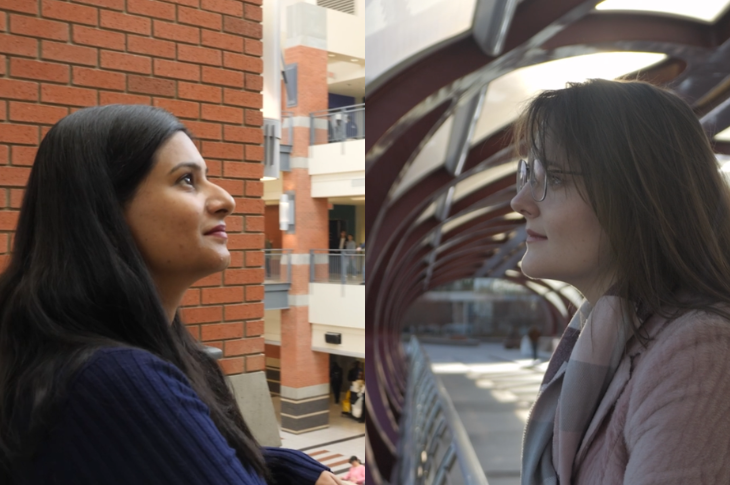
From landing in Canada to landing dream jobs: Newcomers upskill with SAIT’s professional programs
Kanika from India and Lydia from Ukraine gained experience and confidence to take their careers to the next level

Oki, Âba wathtech, Danit'ada, Tawnshi, Hello.
SAIT is located on the traditional territories of the Niitsitapi (Blackfoot) and the people of Treaty 7 which includes the Siksika, the Piikani, the Kainai, the Tsuut’ina and the Îyârhe Nakoda of Bearspaw, Chiniki and Goodstoney.
We are situated in an area the Blackfoot tribes traditionally called Moh’kinsstis, where the Bow River meets the Elbow River. We now call it the city of Calgary, which is also home to the Métis Nation of Alberta.