Overview
Effective emergency response relies on what you know, what you can do, and how you think under pressure. Emergency Medical Response: Core to Advanced develops those competencies in a practical, supportive learning environment.
As one of two required courses in SAIT’s Emergency Medical Responder (EMR) certificate program, this intensive eight-week course builds the essential knowledge, physical skills, and professional judgment you need to respond safely and effectively in prehospital environments. You’ll learn how the emergency medical services system works, how to communicate clearly with patients and other responders, and how to assess and manage a wide range of trauma, medical, environmental, and special-population emergencies. You’ll be guided by licensed EMR instructors who bring extensive real-world experience to your learning. You’ll also develop personal wellness and resilience strategies that support the demands of this profession.
Your learning combines online modules, hands-on lab sessions, and applied practice that moves you from understanding core concepts to performing real skills. You’ll work with equipment used in the field, practice critical thinking through realistic scenarios, and learn how to document care accurately and professionally. Throughout the course, you’ll grow your confidence in decision-making, patient interaction, and the safe performance of physical tasks such as lifting, moving, and airway management. Successful completion of this course prepares you for the next requirement in the certificate program, EMRG 102 ITLS Basic Provider, where you further strengthen your trauma assessment and intervention abilities.
After completing both required courses, you are eligible to take the program’s practicum requirement, where you support EMS professionals in real prehospital settings. This allows you to demonstrate professionalism in the field through patient engagement and observe how the skills you’ve learned are used in practice.
This course is ideal if you:
- are beginning your pathway into emergency medical services and want a strong, practical foundation
- are preparing for roles where calm, accurate assessment and decision-making are essential
- prefer learning through a blend of online study, hands-on practice, and real-world application
- value a course that supports teamwork, professionalism, and personal wellness.
To be eligible to take this course, you must be at least 18 years of age and:
- provide proof that you’ve completed the following required high school-level courses:
- at least 50% in English Language Arts 30-1 or English Language Arts 30-2; and
- at least 50% in Math 10C or Pure Math 10 or Math 20-1 or Math 20-2 or Applied Math 20; and
- at least 50% Biology 30 or Science 30 (or SAIT’s Open Studies course, ANPH 209 Anatomy and Physiology); and
- have a Basic Life Support (BLS) Provider certificate issued by the Heart and Stroke Foundation of Canada within the past six months; and
- demonstrate English language proficiency (English Language Arts 30-1 or 30-2 accepted as proof).
Contact us for more clarification on high school prerequisites and equivalencies and how Academic Upgrading and Open Studies can help you fill any gaps for admission into the EMR certificate program.
Note: If you are a firefighter, nurse, or other first responder who is not intending to complete the EMR certificate program, but would like to register for EMRG 102 ITLS Basic Provider, contact ConEdAdvising@sait.ca.
Upon successful completion of this course, you'll be able to:
Part 1: Foundations of Practice
- describe EMS roles, responsibilities, and professional standards
- build resilience with strategies for mental and physical wellness
- communicate effectively with patients, colleagues, and other health providers
- apply safe work practices and use correct medical terminology
- perform patient assessments, airway management, and safe lifting techniques
Part 2: Trauma, Medical, Exposure Response
- respond confidently to traumatic injuries and medical emergencies
- manage overdoses, poisonings, and administer Naloxone safely
- care for patients in extreme environments and special populations
Part 3: Integrating Skills and Professional Practice
- operate EMS equipment and vehicles safely
- respond to mass-casualty and hazardous incidents using proper protocols
- apply infection control and PPE practices
- uphold ethical, legal, and documentation standards
- demonstrate professional competence in real-world prehospital settings.
To request a course outline, contact ConEdAdvising@sait.ca.
To work as a designated EMR professional in Alberta, you must register with the Alberta College of Paramedics and hold an active practice permit. This requires submitting a registration application and successfully passing the COPR (Canadian Organization of Paramedic Regulators) examination within one year of finishing your SAIT certificate program.
Upcoming dates
Select an available section and add it to your cart. When you're ready, proceed to check out to sign into your student account and complete your registration.
Don't have a student account? Let's set one up!
Register early!
- We recommend registering at least three weeks before the course section start date to support course planning and help ensure a smooth start to your course.
- Course sections require minimum enrollment and may be rescheduled or cancelled two weeks before the start date.
- Registration closes seven days before the start date for on-campus, online scheduled and blended courses, and three days before the start date for online self-paced courses.
After you've completed this course
Upon successful completion of this course, you'll be able to self-print a proof of completion document from your Continuing Education student account.
Costs
Textbook and reading list
Included in the purchase of this course, you’ll receive:
- Access to online course content in in Brightspace (D2L)
- Additional course materials/supplies distributed in class
You are required to purchase the following textbook from the SAIT Bookstore website:
- Navigate 2 Advantage Access for Emergency Medical Responder (Canadian ed.). Jones & Bartlett Learning
Technology
To be successful in this course, you’ll need:
- Access to your own computer or laptop with standard hardware/software requirements
- Internet access
Note: Bringing a laptop to class or the labs is not required.
Additional supplies
You'll need to bring the following personal items starting the first day of class:
- CSA-approved safety glasses
- Stethoscope
Note: For the practicum training component (taken after you've completed EMRG 007 and EMRG 102):
- If you take your practicum with a SAIT pre-approved partner provider, you’ll need:
- An EMR uniform or an EMS T-shirt with tactical pants
- A physical SAIT Student ID card
- If you arrange your own practicum with an approved preceptor, the EMR uniform may not be required.
You don't need to purchase or wear the uniform during EMRG 007 or EMRG 102, though you’re welcome to wear it during lab days if you choose.
Financial support
Financial opportunities are available to help pay for your course fees. Learn more about how to reduce your education or training costs with available awards, bursaries, loans and grants, including the Canada Alberta Productivity Grant.
Applicable certificates
This course applies to the following certificate programs:
- Certification type
-
 Certificate of Achievement

Train your team
Interested in group training opportunities for this course? Tell us about your organization's needs, and one of our training consultants will contact you within one business day.
Stories and news
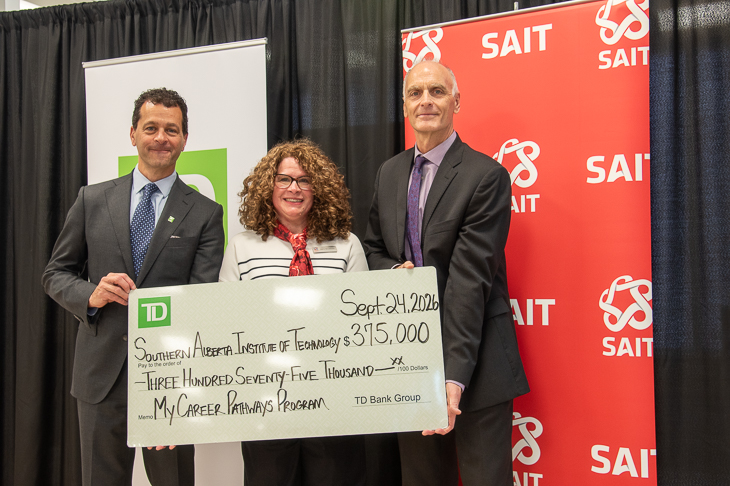
TD investment strengthens skills development and career exploration at SAIT
MEDIA RELEASE - The Southern Alberta Institute of Technology (SAIT) has received a second $375,000 commitment, over three years, from TD Bank Group (TD). This renewed investment aims to support My Career Pathways.

New SAIT and Mastercard partnership targets cybersecurity gaps facing Canada’s small businesses and non-profits
MEDIA RELEASE - SAIT and Mastercard collaborate to expand access to cybersecurity learning and help organizations in Western Canada strengthen their digital resilience.

Oki, Âba wathtech, Danit'ada, Tawnshi, Hello.
SAIT is located on the traditional territories of the Niitsitapi (Blackfoot) and the people of Treaty 7 which includes the Siksika, the Piikani, the Kainai, the Tsuut’ina and the Îyârhe Nakoda of Bearspaw, Chiniki and Goodstoney.
We are situated in an area the Blackfoot tribes traditionally called Moh’kinsstis, where the Bow River meets the Elbow River. We now call it the city of Calgary, which is also home to the Métis Nation of Alberta.