Overview
Carbon dioxide (CO₂) transportation infrastructure is a critical part of the carbon capture and storage (CCS) value chain, and pipeline design must balance technical performance, safety, reliability, and cost constraints. Designing effective carbon gathering and transmission systems is essential to the safe and efficient movement of captured CO₂.
In Design of Carbon Transportation Infrastructure, you’ll develop an understanding of CO₂ pipeline transportation conceptualization and the considerations that shape techno‑economic objectives, constraints, and processes. You’ll explore pipeline components and constraints for liquid and gaseous CO₂, design and routing considerations, mechanical design principles, electrical and instrumentation (E&I) design requirements, and life cycle assessment (LCA) for carbon pipeline and marine transportation.
The course is delivered online in a self‑paced format, with access to instructor guidance throughout. You’ll work through structured content, applied assignments, and quizzes that focus on pipeline conceptualization, design and routing, mechanical design, E&I design, and LCA, using realistic carbon transportation contexts.
By the end of this course, you’ll be prepared to apply engineering design principles and standards to CO₂ transportation infrastructure. You’ll be able to define design objectives and constraints, evaluate routing and design factors that influence safety, reliability, and cost, and describe key mechanical and E&I considerations. You’ll also be able to explain how life cycle assessment can be used to inform and improve carbon transportation infrastructure design.
This course is ideal if you:
- want to apply engineering or technical principles to the design of CO₂ transportation infrastructure
- work in or alongside energy or industrial projects that involve pipeline or infrastructure planning
- are interested in the technical, safety, and cost considerations that shape carbon pipeline design
- need applied context for routing, mechanical design, electrical and instrumentation systems, or life cycle assessment in CCS projects.
Completion of ENVS 011 Introduction to Carbon Capture and Storage is required before taking this course. Learners should be comfortable engaging with technical concepts and applying structured problem‑solving to engineering and infrastructure design considerations.
Upon successful completion of this course, you’ll be able to:
- describe the components, objectives, and constraints associated with liquid and gaseous carbon dioxide (CO2) pipeline transportation and demonstrate an understanding of how to simulate and validate CO2 pipeline design
- demonstrate an understanding of key considerations for designing a CO2 pipeline, including routing and factors impacting equipment and materials choice to achieve reliability, safety, and cost specifications
- demonstrate an understanding of the key considerations for mechanical design of CO2 pipelines.
- demonstrate an understanding of electrical and instrumentation design requirements for CO2 pipelines
- demonstrate an understanding of how to conduct life cycle assessment (LCA) for carbon pipeline and marine transportation and use outputs of LCA to inform and improve carbon transportation infrastructure design.
To request a course outline, contact ConEdAdvising@sait.ca.

Unlocking Careers in Carbon Future Careers
Upcoming dates
Select an available section and add it to your cart. When you're ready, proceed to check out to sign into your student account and complete your registration.
Don't have a student account? Let's set one up!
Register early!
- We recommend registering at least three weeks before the course section start date to support course planning and help ensure a smooth start to your course.
- Course sections require minimum enrollment and may be rescheduled or cancelled two weeks before the start date.
- Registration closes seven days before the start date for on-campus, online scheduled and blended courses, and three days before the start date for online self-paced courses.
After you've completed this course
Upon successful completion of this course, you'll be able to self-print a proof of completion document from your Continuing Education student account.
Micro-credential
SAIT Micro-credentials develop future-ready skills aligned to emerging technologies and industries and include competency-based testing. Earning the SAIT Future-Forward Skills Micro-credential demonstrates to employers that you have the required competencies — combining knowledge, skills and abilities — to stay ahead in a rapidly changing workplace. Learn more.
Students who complete this course with a final grade of A- (80%) or higher will earn the Micro-credential and receive a shareable digital badge that validates their achievement.
Costs
Textbook and reading list
Included in the purchase of this course, you'll receive course content accessible online in Brightspace (D2L).
Technology
To be successful in this course, you'll need:
- Access to your own computer or laptop with standard hardware/software requirements
- Internet access.
Financial support
Financial opportunities are available to help pay for your course fees. Learn more about how to reduce your education or training costs with available awards, bursaries, loans and grants, including the Canada Alberta Productivity Grant.
Applicable certificates
This course applies to the following certificate programs:
- Certification type
-
 Certificate of Completion

Train your team
Interested in group training opportunities for this course? Tell us about your organization's needs, and one of our training consultants will contact you within one business day.
Stories and news
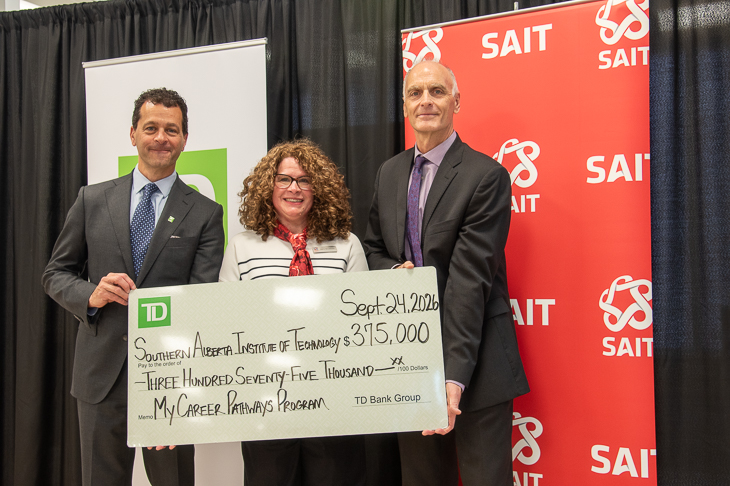
TD investment strengthens skills development and career exploration at SAIT
MEDIA RELEASE - The Southern Alberta Institute of Technology (SAIT) has received a second $375,000 commitment, over three years, from TD Bank Group (TD). This renewed investment aims to support My Career Pathways.

New SAIT and Mastercard partnership targets cybersecurity gaps facing Canada’s small businesses and non-profits
MEDIA RELEASE - SAIT and Mastercard collaborate to expand access to cybersecurity learning and help organizations in Western Canada strengthen their digital resilience.

Oki, Âba wathtech, Danit'ada, Tawnshi, Hello.
SAIT is located on the traditional territories of the Niitsitapi (Blackfoot) and the people of Treaty 7 which includes the Siksika, the Piikani, the Kainai, the Tsuut’ina and the Îyârhe Nakoda of Bearspaw, Chiniki and Goodstoney.
We are situated in an area the Blackfoot tribes traditionally called Moh’kinsstis, where the Bow River meets the Elbow River. We now call it the city of Calgary, which is also home to the Métis Nation of Alberta.