
Overview
Carbon capture and storage (CCS) is playing a growing role in reducing industrial emissions and supporting the transition to a lower‑carbon energy system across energy and industrial sectors. As CCS projects move from concept to deployment, organizations need professionals who understand how CCS technologies, infrastructure, and regulatory considerations come together in real‑world applications.
The Carbon Capture and Storage (CCS) program is designed to help you build practical, job‑relevant knowledge of the CCS value chain used across Canada and the United States. Through a curated set of short, focused courses, you’ll explore the key components of carbon capture and storage—including capture technologies, CO₂ transportation, underground storage, measurement, monitoring and verification (MMV), and infrastructure design—and how they function together in practice.
You’ll begin with a core course that introduces CCS fundamentals, Canada’s CCS landscape, and key technical, regulatory, and socio‑economic considerations. You’ll then select electives that allow you to deepen your knowledge in areas aligned with your role or interests, such as carbon capture technologies, transportation systems, MMV, or infrastructure design. All courses are delivered online in a self‑paced format with instructor support, allowing you to balance learning with work and personal commitments.
By completing the core course and electives that align with your role, you’ll develop a practical, systems‑level understanding of carbon capture and storage as it is applied across real projects. You’ll be prepared to analyze CCS technologies, navigate regulatory and socio‑economic considerations, and apply technical concepts related to capture, transportation, storage, monitoring, and infrastructure in workplace and industry contexts where CCS is being planned, developed, or deployed.
Good to know: This program focuses on carbon capture and storage (CCS), a key component of carbon capture, utilization, and storage (CCUS). Carbon utilization is introduced conceptually but is not covered in depth.
This program is ideal if you:
- work in the energy or industrial sector and want to expand your CCS knowledge
- are an engineer, technologist, operator, trades professional, or geoscience professional seeking upskilling
- want a flexible, online learning option with industry relevant content
- need a structured way to build CCS expertise across the value chain.
There are no formal prerequisites for this program. The courses are designed for learners with experience or interest in the energy or industrial sector who want to build or expand their understanding of carbon capture and storage technologies and systems.
Upon successful completion of this program, you’ll be able to:
- apply systems‑level thinking to explain how carbon capture and storage (CCS) technologies, transportation, storage, monitoring, and infrastructure design function together in projects
- analyze CCS technologies and infrastructure options using technical, regulatory, economic, and operational considerations relevant to real‑world applications
- interpret Canadian and U.S. regulatory, monitoring, and verification requirements to support compliant CCS planning and operations
- evaluate storage, transportation, and monitoring risks and constraints to inform safe and effective CCS deployment
- contribute informed technical input to CCS project discussions, planning, design, or operations within energy and industrial contexts.

Podcast: From Oil Rigs to Sustainability
Program outline
To earn this certificate, you must complete core course ENVS 011 Introduction to Carbon Capture and Storage first, plus at least one elective from the list below, for a minimum total of two courses.
Required courses & electives
How to register for this certificate
Once you have registered for any course offered in this certificate, you will be automatically eligible to complete the certificate. You will have up to three years to complete this program. You may track your progression by signing in to your Continuing Education student account.
Certifications and professional designations
Upon successful completion of all the required courses in this certificate program, you’ll receive an electronically issued SAIT Certificate of Completion and transcript. For each SAIT Micro-credential earned, you'll also receive a shareable digital badge.
Costs
This program consists of a minimum of two courses (one core course and one elective) with varying fees. Please review the individual course pages for this certificate to determine costs and to learn more about additional learning materials, including textbooks.
Financial support
Financial opportunities are available to help pay for your course fees. Learn more about how to reduce your education or training costs with available awards, bursaries, loans and grants, including the Canada Alberta Productivity Grant.
Careers and opportunities
Skills gained in this program can help you apply your existing technical or operational experience to carbon capture and storage projects. You’ll be prepared to contribute to CCS‑related activities such as project planning, operations, monitoring, infrastructure design, or regulatory compliance.
Related certificates you may like
- Certification type
-
 Certificate of Achievement
This certificate program covers technical knowledge, underlying concepts, essential background and plant safety required for gas plant operations.

- Certification type
-
Certificate of Achievement
This certificate covers technical knowledge about LNG operations and maintenance, LNG plant process operations, plant equipment, auxiliary equipment/instrumentation and more.

Stories and news
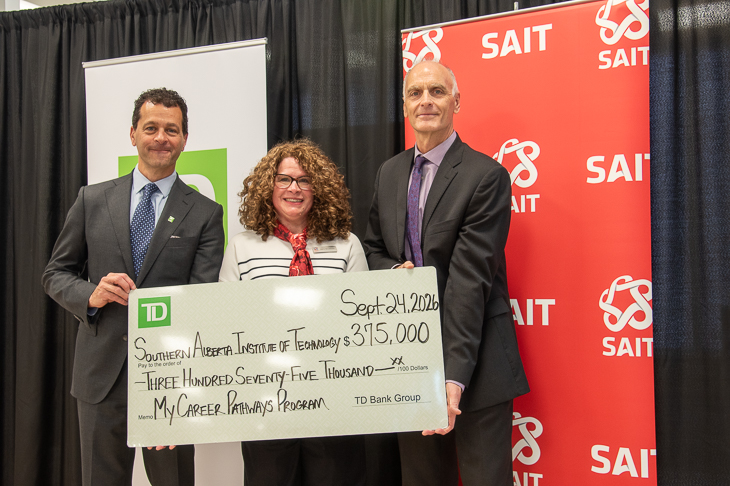
TD investment strengthens skills development and career exploration at SAIT
MEDIA RELEASE - The Southern Alberta Institute of Technology (SAIT) has received a second $375,000 commitment, over three years, from TD Bank Group (TD). This renewed investment aims to support My Career Pathways.

New SAIT and Mastercard partnership targets cybersecurity gaps facing Canada’s small businesses and non-profits
MEDIA RELEASE - SAIT and Mastercard collaborate to expand access to cybersecurity learning and help organizations in Western Canada strengthen their digital resilience.

Oki, Âba wathtech, Danit'ada, Tawnshi, Hello.
SAIT is located on the traditional territories of the Niitsitapi (Blackfoot) and the people of Treaty 7 which includes the Siksika, the Piikani, the Kainai, the Tsuut’ina and the Îyârhe Nakoda of Bearspaw, Chiniki and Goodstoney.
We are situated in an area the Blackfoot tribes traditionally called Moh’kinsstis, where the Bow River meets the Elbow River. We now call it the city of Calgary, which is also home to the Métis Nation of Alberta.