Overview
Third Class Power Engineers are expected to understand the design, operation, and integration of turbines, engines, compressors, refrigeration systems, and other major plant equipment used in industrial power and heating facilities.
Third Class Power Engineering B2 supports preparation for the Alberta Boilers Safety Association (ABSA) Third Class B2 theory certification exam and is also suited to industry professionals seeking to strengthen or refresh Third Class–level technical knowledge related to plant equipment and auxiliary systems. In this course, you’ll study steam turbine principles and auxiliaries, turbine condenser systems, gas turbine design and operation, internal combustion engines, cogeneration systems, compressor theory and auxiliaries, refrigeration principles and systems, heat exchangers and cooling towers, fired heaters, wastewater treatment processes, and plant maintenance and administration.
You’ll complete this course through flexible, part-time online study with instructor support. Your learning experience combines textbook study with interactive online chapter assessments that reinforce key concepts, while instructor consultation supports your understanding of the material. The course concludes with a final proctored online exam taken at a physical testing centre of your choice.
This course is ideal if you:
- are preparing to write the ABSA Third Class Power Engineering B2 theory exam
- want to deepen your understanding of turbines, compressors, refrigeration, and plant systems
- work in an industrial or plant environment and need stronger technical knowledge of major equipment and auxiliaries
- need flexible, part-time online learning that fits your schedule.
There are no mandatory prerequisites or eligibility requirements to enroll in this course.
To be successful in this course, we recommend you have a minimum 50% in Grade 11 Math, English, Physics. If you haven’t completed these courses, consider taking Academic Upgrading courses first.
Learners will benefit from having Fourth Class–level theory knowledge, or equivalent education or industry experience, before beginning Third Class theory training. Completion of Fourth Class Power Engineering theory courses is recommended.
Upon successful completion of this course, you'll be able to:
- describe the design, components and operating principles of steam turbines
- describe steam turbine auxiliary equipment, controls and operation
- explain design, components, and operation of steam condensers
- explain design, components, and operation of gas turbines
- describe gas turbine auxiliary equipment, controls, operation and maintenance
- explain design, components, and operation of internal combustion engines
- explain cogeneration and describe common configurations and applications
- explain the classification, design, and operation of compressors
- explain the controls, auxiliaries and operation of air compressors
- explain the classification and properties of refrigeration systems
- explain controls, safety devices, equipment and procedures for refrigeration systems
- describe the design, application, operation of heat exchangers and cooling towers
- describe the application, design, components and operation of fired heaters
- explain the purpose, designs, processes used for wastewater treatment
- explain industrial maintenance and administration programs.
To request a course outline, contact ConEdAdvising@sait.ca.
Upon successful completion of this course, you will be issued an official result letter which you can submit with your ABSA Third Class B2 exam application. SAIT's passing grade is 50%, while the ABSA Certificate of Competency exams require 65%.
To receive the ABSA Third Class Certificate of Competency, proof of work experience is also required. If you complete all four third class power engineering courses and work in an eligible role at a qualifying power plant as defined by ABSA, you may receive six months' credit toward the 12-month operating or steam time experience requirement. Contact ABSA for more information to determine your needs based on your unique situation.
Power engineering certification requirements and transfer provisions vary by province and territory across Canada. Check with the regulatory authority in your desired work location for details.
Upcoming dates
Select an available section and add it to your cart. When you're ready, proceed to check out to sign into your student account and complete your registration.
Don't have a student account? Let's set one up!
Registration closes seven days before the start date for on-campus, online scheduled, and blended courses, and one day before the start date for online self-paced courses.
After you've completed this course
Upon successful completion of this course, SAIT will issue you an official result letter for you to submit with your ABSA Third Class certification exam application.
Costs
Textbook and reading list
Included in the purchase of this course, you'll receive access to online course content in Brightspace (D2L).
The following book is required and available for purchase at checkout when you register online for this course:
- Power Engineering Third Class Parts B1 & B2 Textbook, Ed. 3.0
It is optional to purchase:
- 2018 ASME Academic Extract (Vol. 1)
Note: If you choose to purchase the books from SAIT after you have registered for the course, contact ConEdAdvising@sait.ca for assistance.
Technology
To be successful in this course, you’ll need:
- Access to your own computer or laptop with standard hardware/software requirements
- Internet access.
Additional information
An additional proctoring fee applies to write the final exam at your chosen testing centre.
Financial support
Financial opportunities are available to help pay for your course fees. Learn more about how to reduce your education or training costs with available awards, bursaries, loans and grants, including the Canada Alberta Productivity Grant.
Applicable certificates
This course applies to the following certificate programs:
- Certification type
-
 Certificate of Achievement

Train your team
Interested in group training opportunities for this course? Tell us about your organization's needs, and one of our training consultants will contact you within one business day.
Stories and news
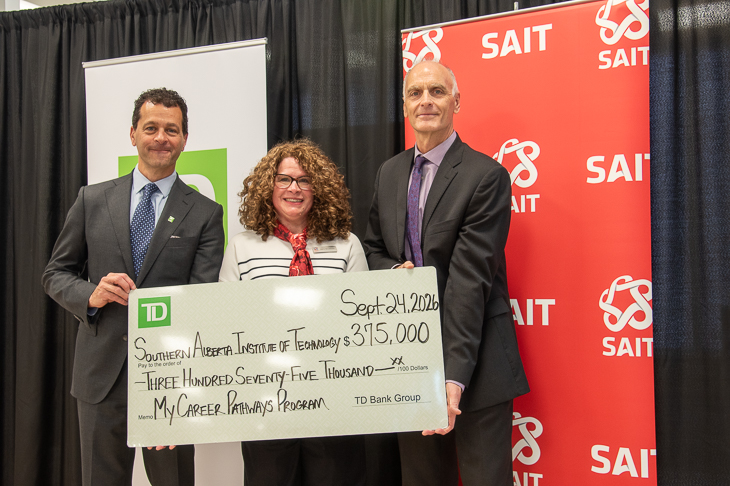
TD investment strengthens skills development and career exploration at SAIT
MEDIA RELEASE - The Southern Alberta Institute of Technology (SAIT) has received a second $375,000 commitment, over three years, from TD Bank Group (TD). This renewed investment aims to support My Career Pathways.

New SAIT and Mastercard partnership targets cybersecurity gaps facing Canada’s small businesses and non-profits
MEDIA RELEASE - SAIT and Mastercard collaborate to expand access to cybersecurity learning and help organizations in Western Canada strengthen their digital resilience.

Oki, Âba wathtech, Danit'ada, Tawnshi, Hello.
SAIT is located on the traditional territories of the Niitsitapi (Blackfoot) and the people of Treaty 7 which includes the Siksika, the Piikani, the Kainai, the Tsuut’ina and the Îyârhe Nakoda of Bearspaw, Chiniki and Goodstoney.
We are situated in an area the Blackfoot tribes traditionally called Moh’kinsstis, where the Bow River meets the Elbow River. We now call it the city of Calgary, which is also home to the Métis Nation of Alberta.