Overview
Transportation decisions affect cost, service, risk, and the reliable movement of goods through a supply chain. If your work involves shipping, logistics, or distribution, you need practical knowledge of transportation costs, services, documentation, and responsibilities.
In this course, you’ll compare road, rail, air, water, pipeline, and intermodal transportation. You’ll also examine freight rates, load and route planning, documentation, logistics service providers, special handling, cargo insurance, Incoterms 2020, and cross-border shipping between Canada and the United States.
Through instructor-led, live online classes, you’ll take part in discussions and applied exercises. You’ll calculate chargeable weight, compare freight rates, and work through load planning, routing, documentation, and transportation service-provider decisions.
By the end of the course, you’ll be prepared to assess transportation options, plan for shipment requirements, and support the movement of goods across modes and borders. Successful completion also counts toward Supply Chain Canada’s Supply Management Training (SMT) Diploma.
This course is ideal if you:
- want a practical foundation in transportation management
- make or support decisions involving freight, shipping, routing, or logistics service providers
- want experience calculating chargeable weight and comparing transportation rates
- need to balance cost, service, risk, documentation, and cross-border requirements.
There are no prerequisites for this course.
Upon successful completion of this course, you'll be able to:
- explain the importance of transportation in a supply chain
- demonstrate the basic calculation for chargeable weight
- identify the key objectives for load planning and route planning in a variety of business situations
- describe the purpose of basic documentation used in road and rail
- describe the purpose of basic documentation used in air and water
- identify the benefits and challenges of intermodal transportation
- identify the factors affecting freight rates and their impact to the supply chain
- describe the value of Logistics Service Providers (LSP) and the process to contract an LSP
- describe the impact of various Incoterms on transportation functions
- identify the programs impacting the flow of goods at the Canada-US border.
To request a course outline, contact ConEdAdvising@sait.ca.
Supply Chain Canada
To qualify for the Supply Management Training (SMT) diploma offered by Supply Chain Canada, you must:
- successfully complete all ten required SMT courses
- achieve a final grade of at least 60% in each course
- meet any additional course assessment requirements
- apply to Supply Chain Canada (SMT Coordinator) for the Diploma.
SCMT 114 assessment requirement: You must also achieve at least 60% on the final exam for this course to count toward the SMT diploma.
Interested in pursuing the Supply Chain Management Professional (SCMP™) designation?
Learn how the SMT diploma and eligible SMT courses may support SCMP admission and recognition of prior learning through Supply Chain Canada’s pathways and application process.
Upcoming dates
Select an available section and add it to your cart. When you're ready, proceed to check out to sign into your student account and complete your registration.
Don't have a student account? Let's set one up!
Register early!
- We recommend registering at least three weeks before the course section start date to support course planning and help ensure a smooth start to your course.
- Course sections require minimum enrollment and may be rescheduled or cancelled two weeks before the start date.
- Registration closes seven days before the start date for on-campus, online scheduled and blended courses, and three days before the start date for online self-paced courses.
After you've completed this course
Upon successful completion of this course, you'll be able to self-print a proof of completion document from your Continuing Education student account.
Costs
Textbook and reading list
Included in the purchase of this course, you'll receive access to online course content in Brightspace (D2L).
Technology
To be successful in this course, you’ll need:
- Your own computer or laptop with standard hardware/software requirements to use D2L
- Functional webcam and microphone
- Internet access.
Financial support
Financial opportunities are available to help pay for your course fees. Learn more about how to reduce your education or training costs with available awards, bursaries, loans and grants, including the Canada Alberta Productivity Grant.
Applicable certificates
This course applies to the following training program:
- Certification type
-
 certificate

Train your team
Interested in group training opportunities for this course? Tell us about your organization's needs, and one of our training consultants will contact you within one business day.
Stories and news
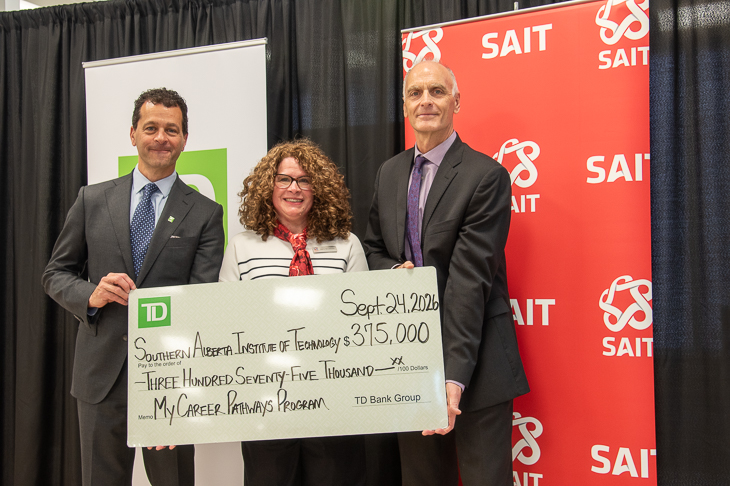
TD investment strengthens skills development and career exploration at SAIT
MEDIA RELEASE - The Southern Alberta Institute of Technology (SAIT) has received a second $375,000 commitment, over three years, from TD Bank Group (TD). This renewed investment aims to support My Career Pathways.

New SAIT and Mastercard partnership targets cybersecurity gaps facing Canada’s small businesses and non-profits
MEDIA RELEASE - SAIT and Mastercard collaborate to expand access to cybersecurity learning and help organizations in Western Canada strengthen their digital resilience.

Oki, Âba wathtech, Danit'ada, Tawnshi, Hello.
SAIT is located on the traditional territories of the Niitsitapi (Blackfoot) and the people of Treaty 7 which includes the Siksika, the Piikani, the Kainai, the Tsuut’ina and the Îyârhe Nakoda of Bearspaw, Chiniki and Goodstoney.
We are situated in an area the Blackfoot tribes traditionally called Moh’kinsstis, where the Bow River meets the Elbow River. We now call it the city of Calgary, which is also home to the Métis Nation of Alberta.