Overview
Negotiations shape costs, supplier relationships, agreements, and business outcomes across supply chain management. If your role involves suppliers, stakeholders, or internal teams, a structured approach helps you prepare, respond to interests, and build relationships beyond the deal.
In this course, you’ll explore planning, persuasion, goal setting, your best alternative to a negotiated agreement (BATNA), reservation points, and assessments of the other party. You’ll also examine distributive and integrative negotiation, negotiation styles, power imbalances, ethics, trust, multi-party negotiations, culture, stakeholder engagement, and buyer-supplier challenges.
Through instructor-led, in-person classes, you’ll take part in simulations, role-playing exercises, and discussions. You’ll practice preparing for two-party and multi-party negotiations, evaluating interests and power, responding to objections, and adapting your approach to different situations.
By the end of the course, you’ll be prepared to plan and participate in negotiations, apply strategies, and support constructive agreements and longer-term relationships. Successful completion also counts toward Supply Chain Canada’s Supply Management Training (SMT) Diploma.
This course is ideal if you:
- want a practical framework for preparing and conducting negotiations
- negotiate or influence decisions involving suppliers, stakeholders, or internal teams
- want experience practicing negotiation through simulations and role-playing
- need to manage competing interests, power dynamics, ethics, and relationships.
There are no prerequisites for this course.
Upon successful completion of this course, you'll be able to:
- understand and develop the primary negotiation skills
- develop your BATNA, and estimate your reservation point in preparation for negotiation
- apply tools for negotiation preparation – including self-assessment and assessment of the other party
- apply the tools of distributive negotiation
- apply the tools of integrative (“win-win”) negotiation
- identify obstacles to integrative negotiation in the buyer-supplier (supply chain) context
- describe the three broad dimensions of negotiation style, along with alternative styles or approaches under each dimension
- explain the complexity of multi-party negotiations, and apply strategies for effective negotiation in the multi-party context
- describe challenges and strategies for dealing with coalitions, agents, constituents and teams in negotiation
- understand the importance of trust and relationships in negotiation
- recognize and apply sources of power in negotiation
- practice ethical negotiation practices – and recognize unethical practices.
To request a course outline, contact ConEdAdvising@sait.ca.
Supply Chain Canada
To qualify for the Supply Management Training (SMT) diploma, offered by Supply Chain Canada you must:
- successfully complete all ten required SMT courses
- achieve a final grade of at least 60% in each course
- meet any additional course assessment requirements
- apply to Supply Chain Canada (SMT Coordinator) for the diploma.
Interested in pursuing the Supply Chain Management Professional (SCMP™) designation?
Learn how the SMT diploma and eligible SMT courses may support SCMP admission and recognition of prior learning through Supply Chain Canada’s pathways and application process.
Blue Seal Certificate
This course includes business‑related learning that may align with some business competencies for the Alberta Apprenticeship and Industry Training (AIT) Blue Seal Certificate. Learn more about earning the Blue Seal using SAIT Continuing Education courses.
Upcoming dates
Select an available section and add it to your cart. When you're ready, proceed to check out to sign into your student account and complete your registration.
Don't have a student account? Let's set one up!
Register early!
- We recommend registering at least three weeks before the course section start date to support course planning and help ensure a smooth start to your course.
- Course sections require minimum enrollment and may be rescheduled or cancelled two weeks before the start date.
- Registration closes seven days before the start date for on-campus, online scheduled and blended courses, and three days before the start date for online self-paced courses.
After you've completed this course
Upon successful completion of this course, you'll be able to self-print a proof of completion document from your Continuing Education student account.
Costs
Textbook and reading list
Included in the purchase of this course, you'll receive:
- Learning materials/hand-outs distributed in class
- Access to online course content in Brightspace (D2L).
Technology
For any coursework completed outside of classroom time, you’ll need:
- Your own computer or laptop with standard hardware/software requirements to use D2L
- Internet access.
Financial support
Financial opportunities are available to help pay for your course fees. Learn more about how to reduce your education or training costs with available awards, bursaries, loans and grants, including the Canada Alberta Productivity Grant.
Applicable certificates
This course applies to the following training program:
- Certification type
-
 certificate

Train your team
Interested in group training opportunities for this course? Tell us about your organization's needs, and one of our training consultants will contact you within one business day.
Stories and news
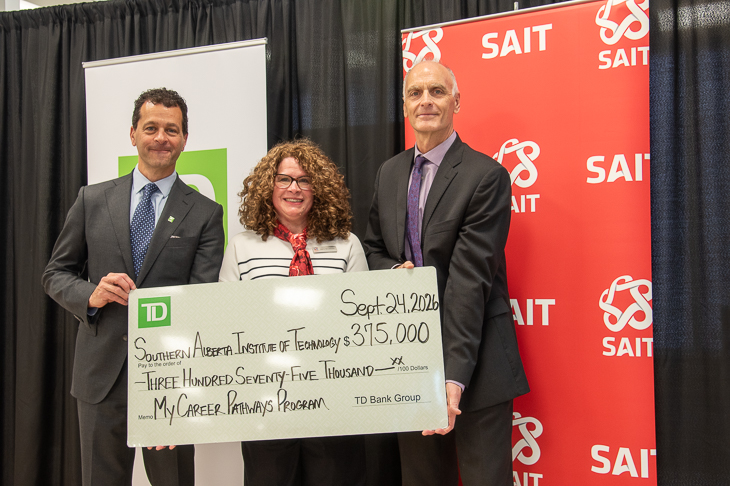
TD investment strengthens skills development and career exploration at SAIT
MEDIA RELEASE - The Southern Alberta Institute of Technology (SAIT) has received a second $375,000 commitment, over three years, from TD Bank Group (TD). This renewed investment aims to support My Career Pathways.

New SAIT and Mastercard partnership targets cybersecurity gaps facing Canada’s small businesses and non-profits
MEDIA RELEASE - SAIT and Mastercard collaborate to expand access to cybersecurity learning and help organizations in Western Canada strengthen their digital resilience.

Oki, Âba wathtech, Danit'ada, Tawnshi, Hello.
SAIT is located on the traditional territories of the Niitsitapi (Blackfoot) and the people of Treaty 7 which includes the Siksika, the Piikani, the Kainai, the Tsuut’ina and the Îyârhe Nakoda of Bearspaw, Chiniki and Goodstoney.
We are situated in an area the Blackfoot tribes traditionally called Moh’kinsstis, where the Bow River meets the Elbow River. We now call it the city of Calgary, which is also home to the Métis Nation of Alberta.