Evaluation shows whether learning is effective and whether it achieves the intended outcomes. One of the most widely used frameworks for evaluating training and education is the Kirkpatrick Model, developed by Donald Kirkpatrick in the 1950s and later expanded by James and Wendy Kirkpatrick. It provides four levels of evaluation that help instructors examine immediate student reactions, demonstrated learning, applied behaviours, and long-term results.
The model provides a structured way to measure not only if students learned something, but also if they can use it. It helps instructors connect classroom activities to larger program and institutional goals. Evaluating across all four levels can:
- Provide evidence of effectiveness for stakeholders.
- Guide course improvements based on student response and performance.
- Show how learning translates into skills and behaviours in real contexts.
- Demonstrate long-term impact on program success.
Four levels of evaluation
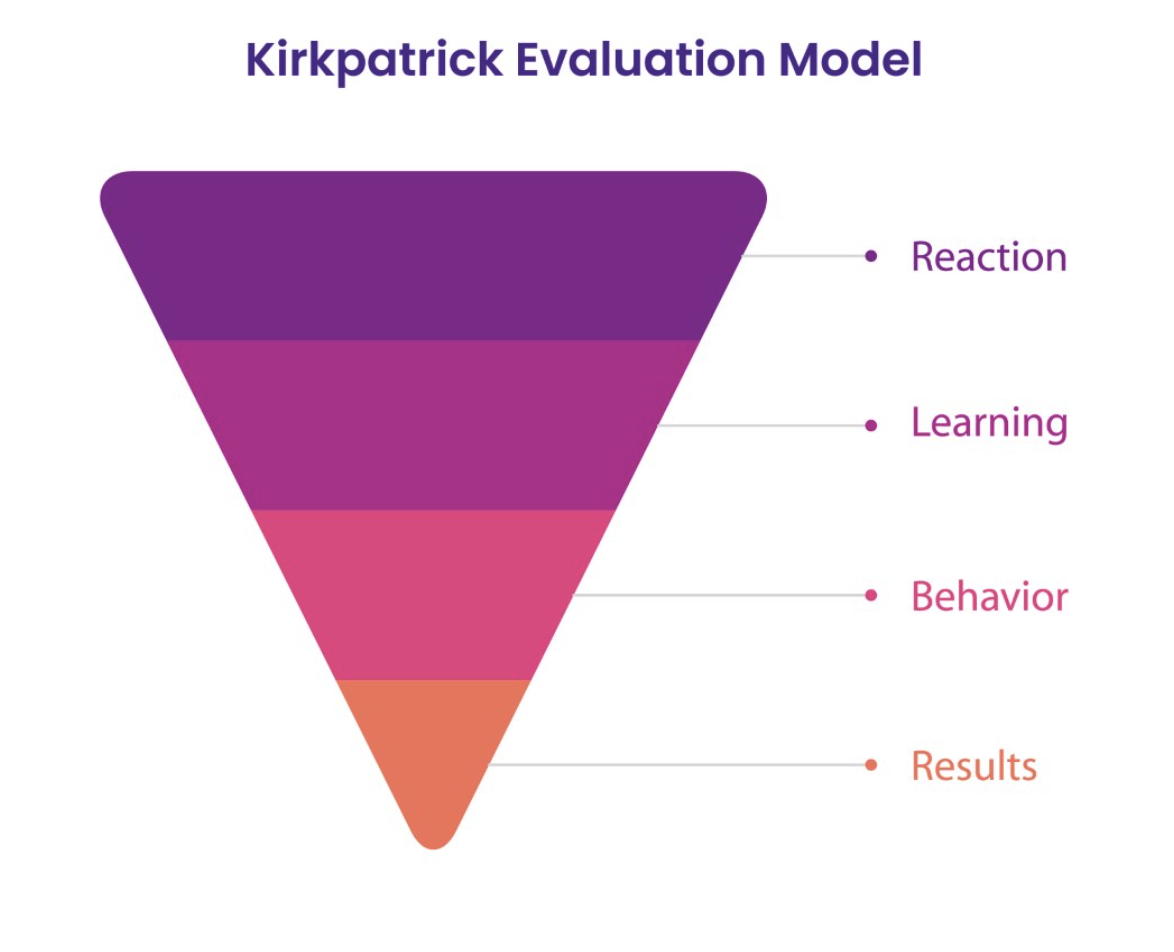
The Kirkpatrick Model breaks evaluation into four levels, moving from immediate reactions to long-term impact. Each level builds on the last, helping you see not just whether students enjoyed a course, but whether they learned, applied, and benefited in ways that last beyond the classroom.
Reaction: How did students respond to the learning experience?
Collect feedback through surveys, exit tickets, or quick polls. Focus on perceived relevance, clarity, and engagement.
For example, at the end of a lab, students complete a short survey on whether the instructions were clear and the activity felt useful.
Learning: What did students actually learn?
Measure changes in knowledge, skills, or attitudes using tests, assignments, or demonstrations.
For example, after a workshop on data visualization, students submit a graph using a dataset and explain why their design choices communicate effectively.
Behaviour: Are students applying what they learned?
Look for evidence of transfer into new settings: practicum placements, projects, or later courses.
For example, in a capstone project, students integrate research methods learned earlier in the program to design a study for a real client.
Results: What are the long-term outcomes?
Evaluate impact at the program or institutional level.
For example, tracking whether graduates from a program successfully earn industry certifications or demonstrate key competencies in workplace settings.
Limitations of the Kirkpatrick Model
Based on Cahapay (2021), three main themes emerged regarding how the Kirkpatrick Model may fall short when used in higher education:
1. Tendency to use only the lower levels
Many evaluations focus primarily on Levels 1 and 2 (Reaction and Learning) while Levels 3 (Behaviour) and 4 (Results) often get neglected. Tracking behavioural or long-term outcomes is harder and resource-intensive.
2. Rigidity and lack of contextual flexibility
The model’s fixed four-level structure does not easily include other factors important in educational settings, such as institutional context, learner diversity, or program-specific goals.
3. Weak evidence of casual links between levels
There’s limited proof that achieving success at one level (e.g., Learning) reliably leads to outcome success at higher levels (Behaviour and Results). The model assumes a linear cause-and-effect relationship that often isn’t empirically verified in higher education.
Final thoughts
The four levels, when used together, can give you a layered picture of success. Reaction data shows you how students experience the course, while learning data shows mastery of concepts and skills. Behaviour and results extend the view into applied practice and long-term outcomes. Together, these levels guide continuous improvement and provide evidence that learning makes a difference.
References
- Kirkpatrick, D. L., & Kirkpatrick, J. D. (2006). Evaluating training programs: The four levels. Berrett-Koehler.
- The Kirkpatrick model.
- Cahapay, M. B. (2021). Kirkpatrick model: Its limitations as used in higher education evaluation. International Journal of Assessment Tools in Education.
How can we help?
Every teaching context is different. Let's start with a conversation about your goals, your learners, and your ideas.

Oki, Âba wathtech, Danit'ada, Tawnshi, Hello.
SAIT is located on the traditional territories of the Niitsitapi (Blackfoot) and the people of Treaty 7 which includes the Siksika, the Piikani, the Kainai, the Tsuut’ina and the Îyârhe Nakoda of Bearspaw, Chiniki and Goodstoney.
We are situated in an area the Blackfoot tribes traditionally called Moh’kinsstis, where the Bow River meets the Elbow River. We now call it the city of Calgary, which is also home to the Métis Nation of Alberta.