Bloom’s revised cognitive domain taxonomy presents a two-dimensional framework for designing learning tasks. The two dimensions are:
- The Cognitive Process Dimension describes the “how” of learning: remember, understand, apply, analyze, evaluate, and create.
- The Knowledge Dimension, which describes the “what” of learning: factual, conceptual, procedural, and metacognitive.
These dimensions intersect in a grid that illustrates (see figure 1) how learning tasks vary in complexity. As you move from concrete factual knowledge paired with simple recall to abstract metacognitive knowledge combined with creative thinking, the tasks generally become more complex.
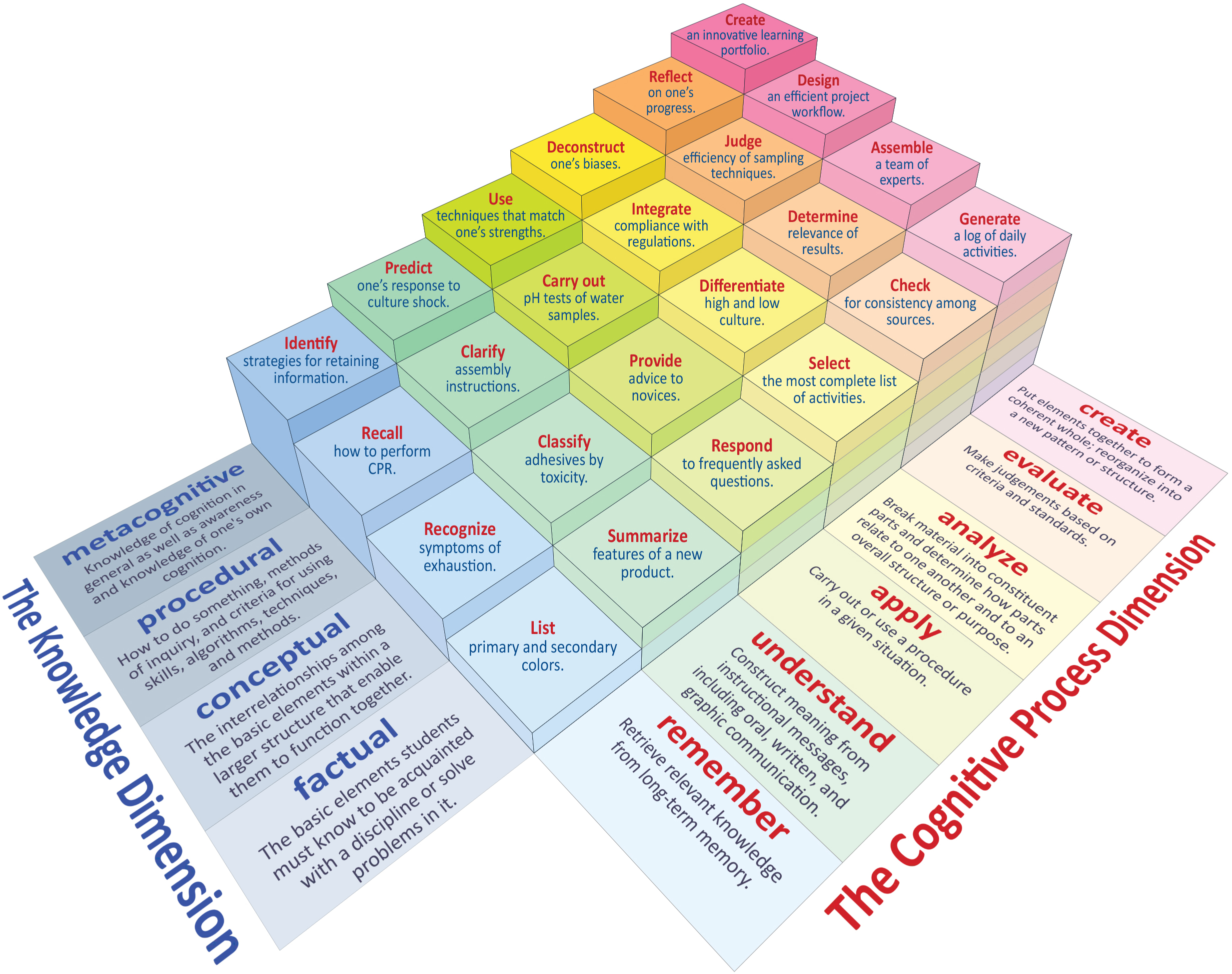
Understanding the dimensions
Cognitive process dimension
From lower to higher order thinking.
Remember
Recall facts and basic concepts.
Understand
Explain ideas or concepts.
Apply
Use information in new situations.
Analyze
Draw connections among ideas.
Evaluate
Justify a decision or course of action.
Create
Produce new or original work.
Knowledge dimension
Factual
Basic elements students must know (for example, terminology, musical symbols, specific details).
Conceptual
Interrelationships among basic elements (for example, principles, theories).
Procedural
How to do something (for example, methods, techniques).
Metacognitive
Awareness of one’s own cognition (for example, strategies for learning, self-assessment).
| The Cognitive process dimension | The knowledge dimension | |||
|---|---|---|---|---|
| Factual | Conceptual | Procedural | Metacognitive | |
| Remember | ||||
| Understand | ||||
| Apply | ||||
| Analyze | ||||
| Evaluate | ||||
| Create | ||||
How to use both dimensions to create learning outcomes
When writing learning outcomes, combine a cognitive verb (from Bloom’s taxonomy) with a knowledge type.
Template
Learners will be able to [Cognitive Verb] [Knowledge Type] to [Purpose/Context].
Examples
| Factual + Remember | Conceptual + Understand | Procedural + Apply | Metacognitive + Evaluate | |
| Learning outcome | "Learners will be able to list the key components of a reinforced concrete structure." | "Learners will be able to explain the relationship between soil types and foundation design." | "Learners will be able to apply the steps of the concrete curing process to ensure structural integrity." | "Learners will be able to evaluate their approach to project scheduling and adjust timelines based on site constraints." |
| Cognitive verb | List (remember) | Explain (understand) | Apply (apply) | Evaluate (evaluate) |
| Knowledge type | Factual (basic elements) | Conceptual (interrelationships) | Procedural (methods and techniques) | Metacognitive (self-awareness and strategy) |
| Purpose/context | Foundational knowledge for site work or design. | Understanding how site conditions affect structural choices. | Performing tasks correctly on-site. | Improving planning and decision-making in real-world scenarios. |
Designing assessments based on the dimensions
Align assessments with both the cognitive level and knowledge type of your outcomes:
| The cognitive process dimension | The knowledge dimension | |||
|---|---|---|---|---|
| Factual | Conceptual | Procedural | Metacognitive | |
| Remember | MCQs, Fill-in-the-blanks | Concept maps | Identify steps | Reflective checklist |
| Understand | Short answers | Explain relationships | Describe processes | Journal entry |
| Apply | Case studies | Apply theory | Perform task | Strategy application |
| Analyze | Compare/contrast | Analyze frameworks0 | Troubleshoot process | Self-analysis |
| Evaluate | Critique | Judge relevance | Assess method | Evaluate own learning |
| Create | Build glossary | Design model | Develop procedure | |
Bloom's and generative AI
Integrating Bloom’s Taxonomy with Generative AI opens up possibilities for designing learning experiences that are more personalized, creative, and adaptive.
The table below illustrates how Generative AI capabilities align with human skills, AI-supported learning activities, and assessment strategies—mapped to the revised Bloom’s cognitive dimensions and knowledge types.
This framework is adapted from Oregon State University Ecampus’s resource Advancing Meaningful Learning in the Age of AI, and insights from Zhongrui Yao’s 2023 work, AI-Supported Learning Activities and Assignments Based on Bloom’s Taxonomy.
| Cognitive level | Knowledge type | Distinctive human skills | AI capabilities | AI-supported activities and assessments |
|---|---|---|---|---|
| Create | Conceptual/procedural | Generating, planning, producing, and reorganizing elements into new patterns | Suggest alternatives, describe real-world cases | Drafting research proposals or treatment plans using AI; Generating design ideas or project outlines |
| Evaluate | Metacognitive | Judging based on criteria, critiquing, and ethical reflection | Make rough judgments, identify pros/cons, and develop rubrics | Peer review using AI-generated feedback; Critiquing AI-generated responses; Ethical analysis of AI decisions |
| Analyze | Conceptual | Differentiating, organizing, attributing; identifying relationships | Compare/contrast, infer trends, predict outcomes | Case study analysis with AI support; Data interpretation using AI tools |
| Apply | Procedural | Executing or implementing procedures | Follow models/methods to solve problems | AI-assisted problem-solving in quizzes; Simulations of construction procedures using AI |
| Understand | Conceptual | Interpreting, summarizing, explaining, classifying | Translate concepts, recognize examples | AI-generated summaries or explanations; Concept translation using AI tools |
| Remember | Factual | Recalling facts, listing, defining, constructing chronologies | Retrieve and recall factual info | AI-generated flashcards or quizzes; Auto-generated definitions and timelines |
References
- Lynne, Patricia. (2024), Reading and Writing Successfully in College: A Guide for Students [Revised Edition], licensed under a Creative Commons Attribution-ShareAlike 4.0 International License.
- Oregon State University Ecampus. Advancing Meaningful Learning in the Age of AI.
- Heer, Rex. (2012), A Model of Learning Objectives, based on A Taxonomy for Learning, Teaching, and Assessing: A Revision of Bloom’s Taxonomy of Educational Objectives. Center for Excellence in Learning and Teaching, Iowa State University. Licensed under a Creative Commons Attribution- NonCommercial-ShareAlike 3.0 Unsupported License.
- Zhongrui Yao, 2023, AI Supported Learning Activities and Assignments Based on Bloom’s Taxonomy
How can we help?
Every teaching context is different. Let's start with a conversation about your goals, your learners, and your ideas.

Oki, Âba wathtech, Danit'ada, Tawnshi, Hello.
SAIT is located on the traditional territories of the Niitsitapi (Blackfoot) and the people of Treaty 7 which includes the Siksika, the Piikani, the Kainai, the Tsuut’ina and the Îyârhe Nakoda of Bearspaw, Chiniki and Goodstoney.
We are situated in an area the Blackfoot tribes traditionally called Moh’kinsstis, where the Bow River meets the Elbow River. We now call it the city of Calgary, which is also home to the Métis Nation of Alberta.