Feature photo by Jacek Syzmanski
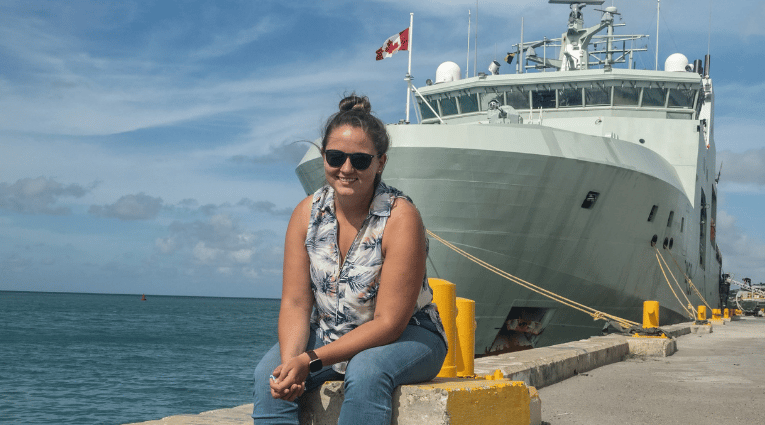
Sarah Jensen had only seen the ocean a few times before walking into a Canadian Armed Forces recruiting centre to explore a career in the Navy.
That was in 2016, when an economic recession meant limited upward mobility at the downtown Calgary hotel where she worked. Armed with a love of travel, her SAIT Hospitality Management diploma and a bachelor’s degree from the University of Calgary, a few years of hospitality experience and the encouragement of her brother (a naval logistics officer at the time), Jensen decided to set herself on a different course.
It didn’t take long for the Alberta-born, third-generation SAIT graduate to discover just how well her hospitality background would translate to life at sea.
Today she serves as a Lieutenant-Commander and Logistics Officer (Log O for short) with the Royal Canadian Navy. As Jensen puts it, “If you think of a ship as a floating hotel, it makes perfect sense.”
You pursued hospitality — and the military — because you love to travel. Yet on your first deployment, you didn’t leave the ship. Why not?
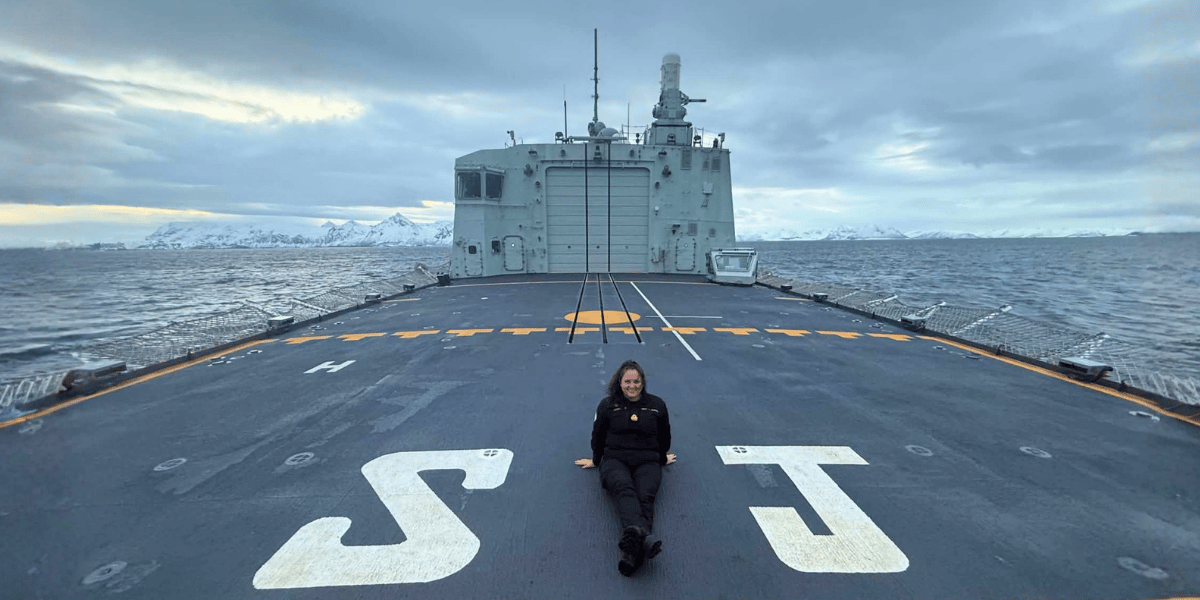
I started my assistant logistics officer tour on HMCS Toronto in July 2020 as part of Operation REASSURANCE. It was the beginning of the pandemic, so we spent seven months confined to the ship. It wasn’t what I had expected, but that was when I truly started to understand just how well my hospitality background would serve me.
I’m a bit of a unicorn in the military. I’ve never met any other Log O with my training. But when you think about it, the structure of a hotel is quite similar to a ship. A hotel’s general manager is equivalent to a ship’s captain, and the logistics trades (cooks, supply technicians, financial services and human resources) are 100% in the realm of hospitality management. Menus, accounting, hosting — even making Canadian wine lists and folding napkins for formal events — can all be part of this job.
You’ve crossed the Atlantic four times now. What does a typical day look like when you’re deployed?
The best part of working in the Navy is that every day can be completely different. As a Log O I’m a day worker, so, unlike most of the ship’s company, I get to sleep at night. I wake up around 7 a.m. and, if my team is on scullery, we set up for breakfast. Then I meet the executive officer and other department heads and bring our orders for the day to the four sections that report to me.
Some of the busiest days are when we’re coming alongside in a foreign port. I’m running around on the jetty coordinating the port services, storage for the food we’re picking up, and taking on fuel.
My second deployment, Operation CARIBBE, was completely different. I was on forward logistics site — a team of people that travel ahead of the ships. We spent a week at each port conducting reconnaissance, taking photos, making purchases and preparing so the ship had everything it would need when coming alongside. I got to do that in San Diego, Mexico, Panama and Jamaica. It was definitely a highlight.
You’ve travelled to 26 countries. Is there a port of call that stands out?
My fourth deployment was a return to Operation REASSURANCE and another stop in Lisbon. It was a full-circle moment for me. My first time in Lisbon, we weren’t able to get off the ship because of the pandemic. When we returned in 2025, I finally got to explore, and Lisbon was just as incredible as I’d hoped. It was very beautiful, the people were nice and the food was great.
You're now helping plan the supply needs of Canada's future naval ships. What does serving Canada in this way mean to you?
In a 25-year career, a logistics officer might spend 20 years in jobs away from ships. In April 2026, I was posted to Ottawa as Supply Integration Manager in the project management office for the River-class destroyer, a new class of warships that will replace the current fleet.
My job involves figuring out what parts and supplies the ships need to carry to stay at sea for an extended period. I’m very proud to be able to make an impact on the future of the Navy.
Do your long-term plans involve the sea?
The Navy has given me so many amazing opportunities and taken me to incredible places. When I retire in 2042, I’d love to buy a bed-and-breakfast in Latin America. I first caught the travel bug on a family trip to Costa Rica when I was 16. My military career is providing me with the savings and pension – and a few cool experiences along the way to take me back there.

Oki, Âba wathtech, Danit'ada, Tawnshi, Hello.
SAIT is located on the traditional territories of the Niitsitapi (Blackfoot) and the people of Treaty 7 which includes the Siksika, the Piikani, the Kainai, the Tsuut’ina and the Îyârhe Nakoda of Bearspaw, Chiniki and Goodstoney.
We are situated in an area the Blackfoot tribes traditionally called Moh’kinsstis, where the Bow River meets the Elbow River. We now call it the city of Calgary, which is also home to the Métis Nation of Alberta.