Photo courtesy of SAIT Archives
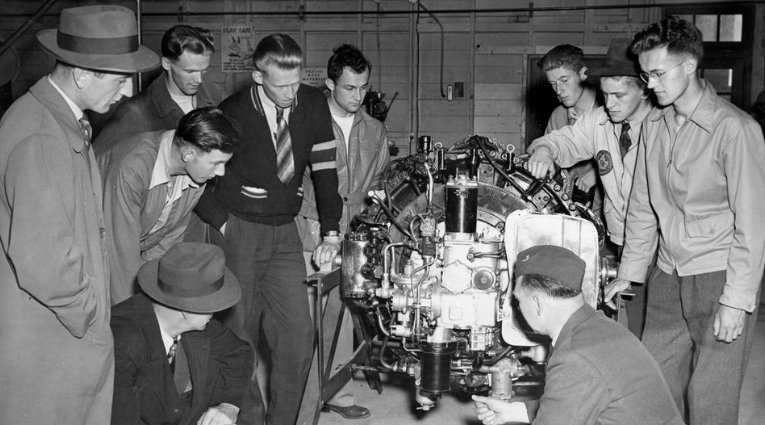
By the end of the 1940s, the Provincial Institute of Technology and Art (as SAIT was known until 1960) could boast that its Department of Aeronautics was Canada’s only school of aviation to be recognized as an Authorized Enterprise for the rebuilding, repair and overhaul of commercial aircraft and engines.
Students could choose from a two-year Air Engineering course — designed to provide the technical knowledge needed to complete the Department of Transportation’s “A” and “C” Air Engineer’s Certificates — or the three-year Aeronautical Engineering course, which combined the Air Engineering course with an additional year of advanced work that would prepare students to pass examinations for the Associate Fellowship of the Royal Aeronautical Society.
In this photo, Aeronautics Department students are on a field trip to the Royal Canadian Air Force’s #10 Repair Depot. Created during the Second World War to overhaul and repair all aircraft being used for training in western Canada, the depot remained active after the war as part of RCAF Station Lincoln Park (located where ATCO Park is today).
For many, these PITA programs were an opportunity to build on skills gained during the war. George Ryning (back row, standing second from the left) enlisted in the RCAF in 1942, serving as an airframe mechanic in Nova Scotia and Newfoundland. In 1946, Ryning enrolled in the Aeronautical Engineering program and, after graduating in 1949, worked in the aircraft industry. In 1955, he became a PITA instructor and was the Aeronautics program supervisor when he retired in 1984.
The sweater Ryning is wearing is now preserved in the SAIT Archives, and you can read more about him in this issue’s Contributor Spotlight
Oki, Âba wathtech, Danit'ada, Tawnshi, Hello.
SAIT is located on the traditional territories of the Niitsitapi (Blackfoot) and the people of Treaty 7 which includes the Siksika, the Piikani, the Kainai, the Tsuut’ina and the Îyârhe Nakoda of Bearspaw, Chiniki and Goodstoney.
We are situated in an area the Blackfoot tribes traditionally called Moh’kinsstis, where the Bow River meets the Elbow River. We now call it the city of Calgary, which is also home to the Métis Nation of Alberta.