Painting the town SAIT
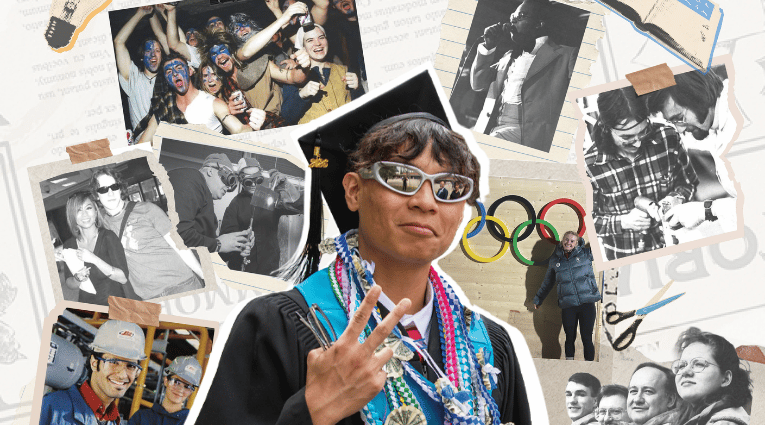
On Nov. 18, SAIT recognized Murdoch Maclean (Fitness and Wellness Management '26) as its 300,000th graduate during the convocation ceremony at the Southern Alberta Jubilee Auditorium. LINK asked MacLean to reflect on their favourite moments and make a few predictions for the future.
Memories and milestones
Every SAIT graduating class has its own decisive moments, distinctive traits and defining trends — impossible to fully capture, but deeply woven into our history.
As our alumni community celebrates a major 300,000-graduate milestone, LINK is irresistibly drawn to revisiting how students have learned, worked and created here at SAIT over the past 110 years.
Through nearly a dozen historic and world-altering decades — each with their own groundbreaking innovations, shifting soundtracks and cultural touchstones —SAIT’s heritage holds more than a century of shared optimism and drive.
As skylines and styles on campus have changed, so too have the academic studies, cutting-edge technologies and day-to-day experiences of hundreds of thousands of SAIT graduates.
Among alumni, no two recollections — perhaps faded but boisterously retold — are ever quite the same. The past will always be a space for continual re-examination and interpretation. And those memories are a living archive of who was here and who they have become.
Join us for this progression through SAIT’s eras, revealed in snapshots and stories from an ever-growing community that has learned, shared and changed together.
2020s | A world re-shaped
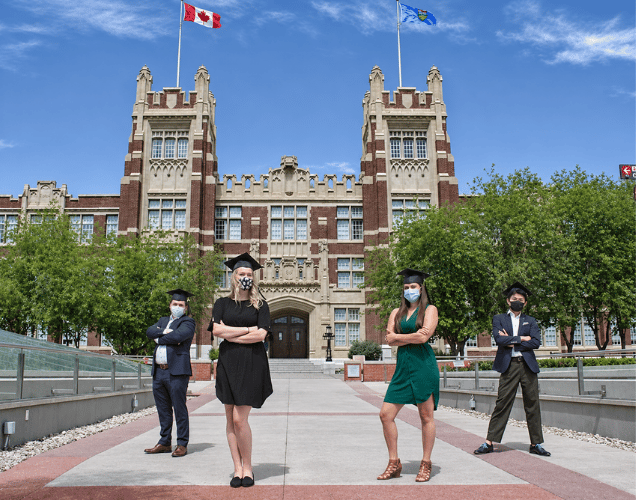
Our current era starts with SAIT reaching 250,000 alumni in November 2020 — only the second Canadian polytechnic to pass this milestone. It happens during SAIT's virtual convocation ceremony, held online after the COVID-19 pandemic leads to the cancellation of all in-person classes and events.
So much has happened since then, including new cyber security programs, a rising profile for the skilled trades and launching the future of autonomous aviation.
Everyone's been talking about
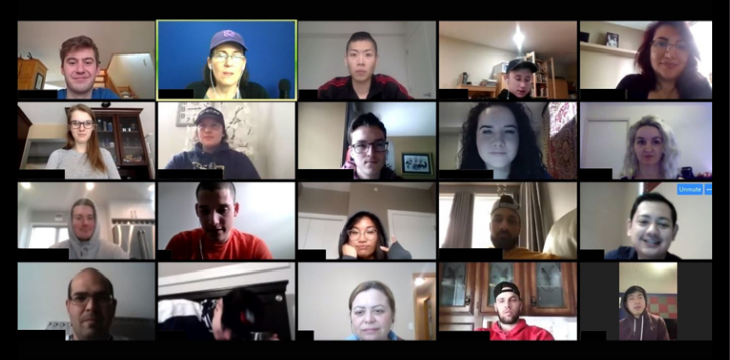
Zoom taking over: Video calls, live chats and screen sharing become defining communication tools as work, school and social life move online. Artificial Intelligences arrives: Large language models bring AI into everyday learning and work, accelerating conversations about safety, ethics and future-ready skills Fads and fashion: Quiet luxury • Heated Rivalry • NFTs • Fermented foods Era extras: The School for Advanced Digital Technology opens (2020) • The Last of Us films on campus (2022) • SAIT holds its first Every Child Matters March (2023) • The Real Futures fundraising campaign launches to change how, who and what SAIT teaches (2025) |
2000s and 2010s | On the global stage
In this era, Calgary and SAIT welcome competitors from around the world by hosting WorldSkills 2009. Then, in 2012, SAIT's brand-new Trades and Technology Centre is recognized as one of the world's most innovative urban architecture projects by the KPMG Infrastructure 100: World Cities Edition.
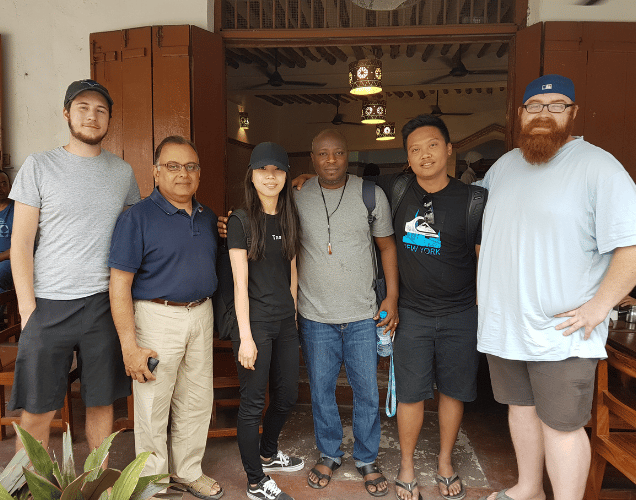
And SAIT doesn't only bring the world to Calgary: Through the long-standing Study Abroad program, more than 200 students see the world from a new perspective during the 2017/2018 academic year alone — including these students and instructors from the School of Business. They've travelled to Zanzibar (an archipelago off the coast of Africa) to mentor youth in entrepreneurship.
Everyone's been talking about
Smartphones changing the screen: The first-generation iPhone helps shift mobile phones from physical keyboards to touch screens. Instagram changing the frame: The photo-sharing platform reshapes digital photography, short-form video and self-expression.
Fads and fashion: Flash mobs • Gangnam Style • Man buns • Slow food Era extras: Y2K (2000) • SAIT's 200,000th graduate crosses the stage (2013) • "Selfie" is the Oxford Dictionary's Word of the Year (2013) • SAIT celebrates it's centennial (2016) |
1980s and 1990s | Technology takes centre stage
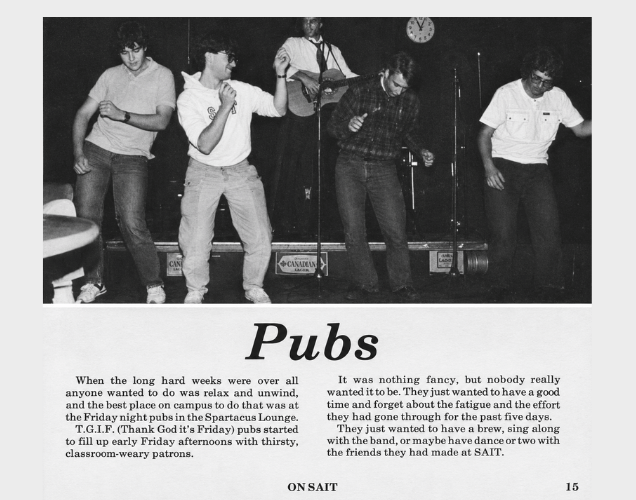
Tough times, turn-arounds and technology: these two decades run the gamut from recession to recovery; from iconic fashions and music trends to SAIT welcoming the world as part of the 1988 Calgary Winter Olympics.
Student social life enters a new era with the opening of the Campus Centre 1981, including the Spartacus Lounge (aka Sparty's) plus a bowling alley, pinball machines and athletics infrastructure that helps propel Trojans teams to new heights.
Major leaps in technology allow tools to become toys, video games and pagers. Curated mix-tapes played on a Walkman give way to the rise of the digital MP3 and peer-to-peer digital music sharing through Napster.
Everyone's been talking about
Canadarm reaching space: The first Canadarm launches aboard a NASA space shuttle, putting Canadian robotics and engineering on an interstellar stage. A Canadian soundtrack: Alanis Morissette's Jagged Little Pill becomes one of the defining albums of the 1990s. Fads and fashion: Rubik's cube • MuchMusic • Jelly shoes • The Macarena • Grunge Era extras: Terry Fox's Marathon of Hope (1980) • The Alberta College of Art and Design gains autonomy from SAIT (1984) • SAIT's Library replaces its card catalogue with computerized catalogue system (1990) • A new Business Technology centre opens on campus |
|
1960s and 1970s | Challenging the status quo
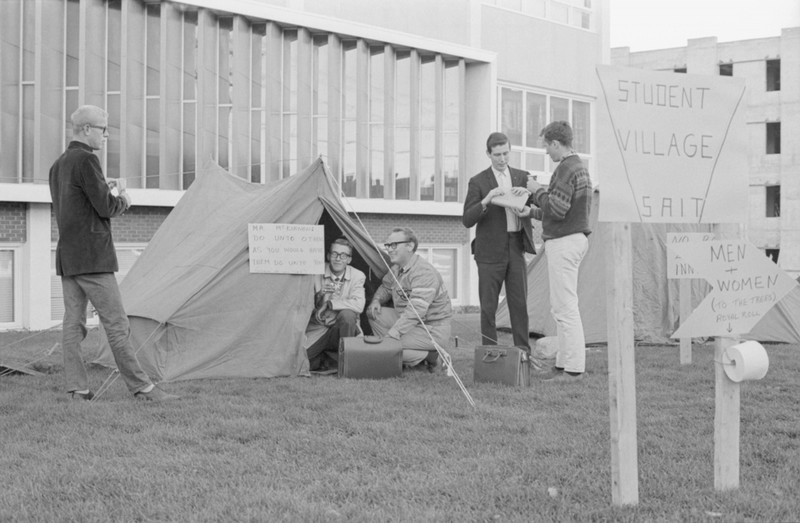
These turbulent decades see wide-spread political protest across Canada — including SAIT. To draw attention to the lack of any on-campus housing, students in 1966 hold a "sleep-in" in the Student Activity Building (today's E.H. Crandell building) followed by a "camp-out" (shown here) on the East Block lawn (in front of today's John Ware building). Their campaign is successful, but it takes until 1972 for the Owasina Hall residence to open.
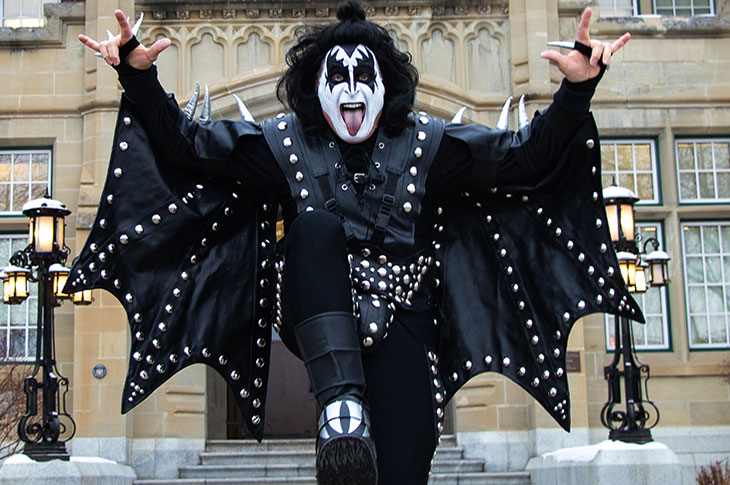
Everyone's been talking aboutPersonal computing: Advances in semiconductor chips allow Altair to launch the first mass-produced personal computer for small businesses and consumers. Arena rock makes an entrance: Popular music in North America shifts from club performances which — along with advances in high-powered sound systems — allows bands to create large-scale theatrical productions in sports arenas seating thousands of fans. On Feb. 6, 1974, KISS makes the second stop of their first-ever North American tour, playing in the SAIT gymnasium. To celebrate the 50-year KISS-versary, SAIT's campus radio station re-brands to KISS 103 for the day. "The Demon," aka Gene Simmons, aka SAIT alumni and instructor Richard Stroobant, was spotted at Heritage Hall ready to rock and roll.
Fads and fashion: Bean bag chairs • The Easy-Bake Oven • Bell bottoms and platform shoes • Punk and disco Era extras: PITA changes its name to the Southern Alberta Institute of Technology (1960) • The Highlander Hotel (aka H Block) opens (1961) • Canada's Centennial (1967) • The Students' Association re-brands as Saitsa (1974) • The first Star Wars movie is released (1977) |
1916 to the 1950s | Leading the way
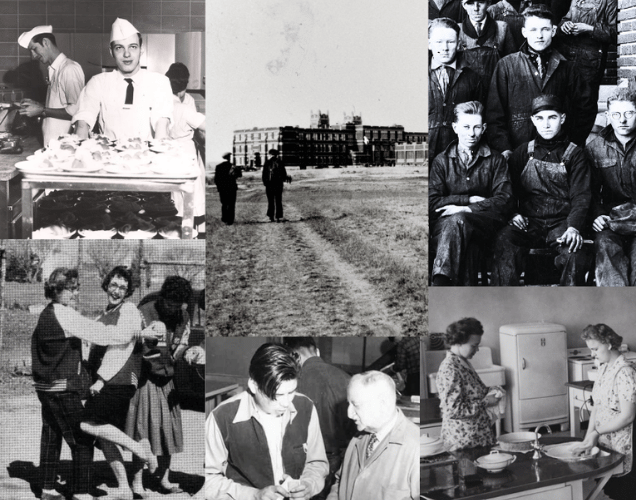
SAIT's origin story stretches back more than a century to when, on Oct. 16, 1916, the Provincial Institute of Technology and Art (PITA) opens its doors to re-train veterans returning from the First World War.
Our first decades are times of profound social change and fast-evolving technologies and our alumni dedicate their trades, technology and business skills to building this province.
As SAIT reaches the 300,000 alumni mark, we celebrate the touchstones that bring students together, bolster a world-wide community of proud alumni and shape new eras of alumni experiences still to come.
Everyone's been talking aboutUnprecedented technological change: Steam engines and automobiles; mass media and air condition; electricity and commercial air travel — these and other new technologies transform daily life at rates never seen before. Social progress and staying the course: In the 1920s, wages are high; Canadians foster a new national identity; women make great strides in obtaining equal rights; modern conveniences improve life. But the 1930s and '40s demand resilience and perseverance with The Great Depression, extensive drought and the Second World War. Peace and plenty: Post-war recovery and the Leduc oil discovery bring increasing demand for skilled workers, resulting in record numbers of students enrolling throughout the 1950s. Fads and fashion: The Jazz Age • The Dionne Quintuplets • Scrabble and Monopoly • buzz cuts and bouffants Era extras: Spanish Flue pandemic (1918) • The Main Building (how Heritage Hall) open its doors (1922) • PITA offers free courses for the unemployed (1930s) • Classes are relocated as PITA relinquishes its campus for war-time military training (1942-1946) • With more than 1,400 apprentices training at PITA, parking on campus becomes a challenge (1955) |
Like what you are reading?
Find more stories from past, present and upcoming issues of LINK magazine!

Oki, Âba wathtech, Danit'ada, Tawnshi, Hello.
SAIT is located on the traditional territories of the Niitsitapi (Blackfoot) and the people of Treaty 7 which includes the Siksika, the Piikani, the Kainai, the Tsuut’ina and the Îyârhe Nakoda of Bearspaw, Chiniki and Goodstoney.
We are situated in an area the Blackfoot tribes traditionally called Moh’kinsstis, where the Bow River meets the Elbow River. We now call it the city of Calgary, which is also home to the Métis Nation of Alberta.