How a surprise discovery high up on Castle Mountain lets us glimpse a group of SAIT apprentice students from more than 60 years ago.
Photo by Nicole Larson
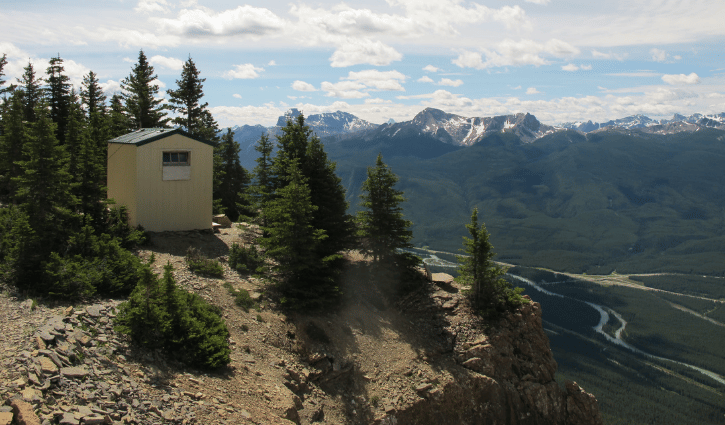
Castle Mountain is a picturesque spectacle: imposing, sometimes golden, and undeniably regal along the north side of the Trans-Canada Highway between Banff and Lake Louise.
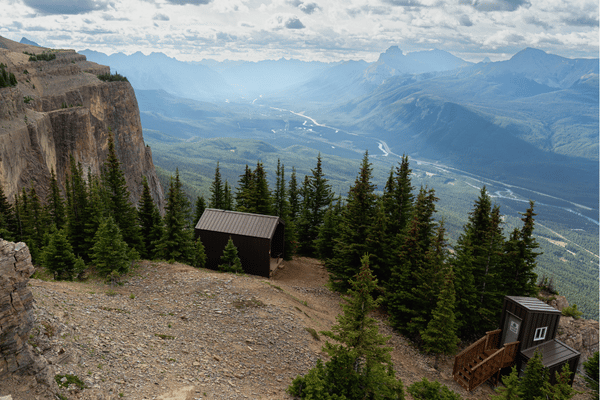
Unbeknownst to most travellers below, a little mountain hut sits about halfway up the south face, on a wide ledge between the lower and upper cliffs.
You have to relinquish the mountain’s iconic profile to pinpoint the exact location, but there’s been a hut up there — in one form or another — for nearly six decades, providing temporary shelter to members of the climbing community.
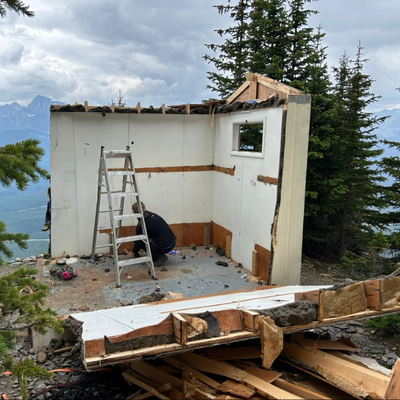
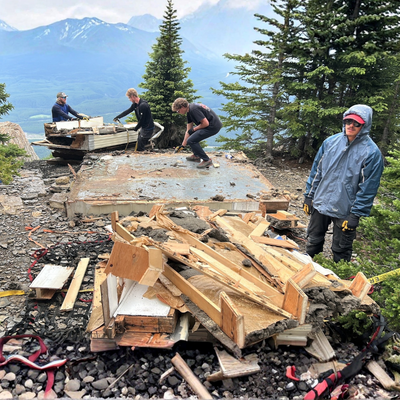
In 2024, the original Castle Mountain Hut was decommissioned by the Alpine Club of Canada (ACC). Their Capital Project Manager, Tom Fransham (pictured), remembers the day the old hut was taken apart on-site and sectioned out by helicopter.
He had left the site early and was in the staging area in a parking lot below, where he was helping transfer huge chunks of the dismantled hut’s walls from the chopper’s cargo netting to a trailer.
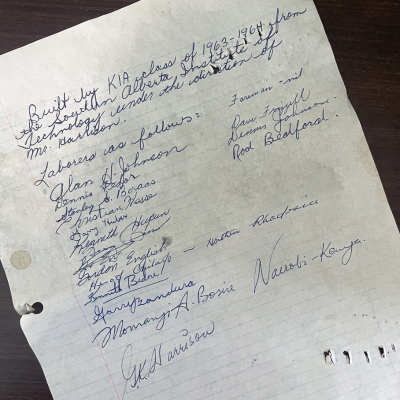
“As we shifted this one segment, a piece of paper fell out. I picked it up and read it,” says Fransham. It was a handwritten note signed by 15 carpenter apprentice students and their instructor, part of the Construction class who built the hut at SAIT during the 1963/64 academic year.
“This note was from the year before I was born,” says Fransham. “I was super thankful for the team who had thought to leave this piece of history and that, somehow, it hadn’t blown away during the helicopter ride down the mountain.”
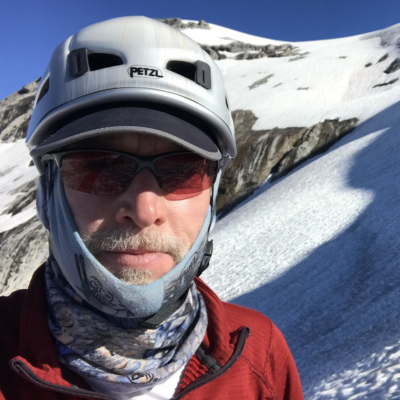
Capital Project Manager, ACC
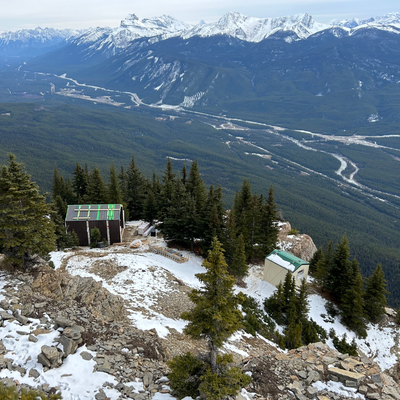
It’s funny how things can work out. And how the very end of a thing can take us all the way back to its beginning.
“It’s a bit of a time capsule to recognize the people involved, isn’t it,” said Fransham. “These days, the trades I work with as Project Manager are finishing buildings on a daily basis, so it’s no longer standard practise to leave this kind of thing behind. But it definitely makes sense for unique construction projects in unusual places.
“I’m kind of kicking myself for not having thought of that for the new construction [Castle Mountain (Currie) Cabin].”
Putting faces to the names
Clearly torn from a student's binder, this signed sheet of loose-leaf paper managed to survive nearly 60 years hidden inside a wall of the old Castle Mountain Hut with little more damage than a few stains and punctures.
Yet it gives us a portal to look back through time, enabling us to connect both faces and names with the students who built the hut and their instructor, G.K. Harrison.
It also shows how (even in the early 1960s) SAIT students came to Calgary and beyond; across Canada and around the world — from the village of Clyde, Alberta to Marmora, Ontario; from Nairobi, Kenya to two locations in Northern Rhodesia (now part of Zambia).
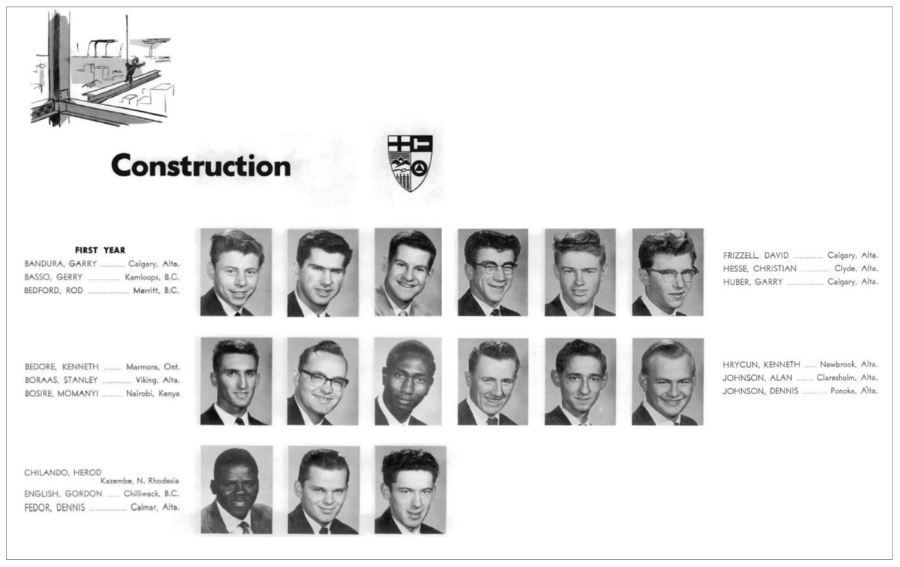
Pictured below is a composite image of pages from the SAIT Yearbook 1964, with the photos of the students who signed the note found in the hut.
The SAIT Archives collects, preserves and shares the Institute’s historical records — including the Tech-Art Record for 1964. It’s available to explore online, but here are the pages showing the K1A Class of 1963/64.
According to SAIT’s Academic Calendar for 1963/64, the key used to identify Carpenter Apprentice courses was KA, and the people who signed were students from the first year.
The SAIT connection
Back in 1956, Dick Lofthouse (1932 – 2016) arrived at SAIT to teach Chemistry, a position he held for the next 30 years.
As an avid mountain climber, a skilled mountain rescue leader, a founding member of the Association of Canadian Mountain Guides and an active member of the Calgary Mountain Club (CMC), he realized in the early 1960s that the Club’s plan to build a shelter was a potential project for students in the Architectural Technology and Construction Technology programs.
The resulting structure, while sturdy, was a simple design created by students with direction from the Club. Plans for building one prefabricated hut morphed into building two huts, ensuring ample student work throughout the Winter term.
One hut was installed above Moraine Lake and, when the Club secured a location on Castle Mountain for the second hut three years later, Dick Lofthouse was there to help with the installation.
His son Ian Lofthouse (Computer Technology ’85), an outdoor enthusiast himself, remembers his dad’s description of the experience.
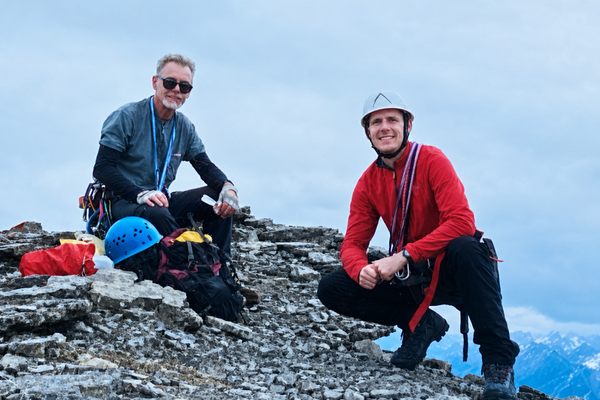
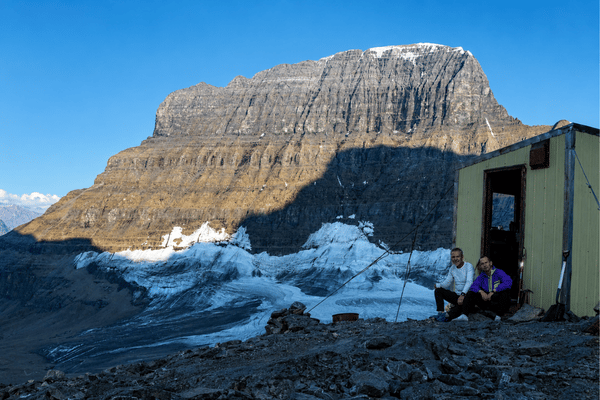
“The hut was about half the size of an ATCO trailer. That’s an easy thing to throw on a flat-deck truck, but not so easy to fly up a mountainside, while it’s hanging from a helicopter, in the wind.
“They had to knock it right down to the panels to transport it, which was no easy task,” Ian says. The construction class had built this hut to last. “These things had been glued and screwed.”
The challenge of dismantling a hut that was never meant to come apart was made worse by the fact that Dick’s CMC crew did not have the proper tools. “Dad’s team had hammers and that’s all. They had to take this thing apart forcefully, ripping out screws and the like.”
Putting the hut back together on the mountainside would prove no less violent. A screwdriver or two would have been most helpful, but they had none. “They basically had to knock out screws with their piton hammers and then bash them back into the wood like nails.”
Not ideal.
“My understanding is the hut was a bit leaky for the first little while until the Club managed to get a crew up there to properly screw it together and do some waterproofing,” says Ian.
But despite this difficult beginning, the delicate sheet of signatures stayed safe, hidden in the insulation where the students had stashed it. And although it may have acquired some battle scars, this original Castle Mountain Hut went on to provide shelter to climbers for 57 years.
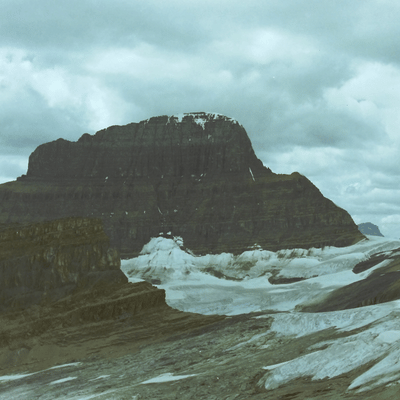
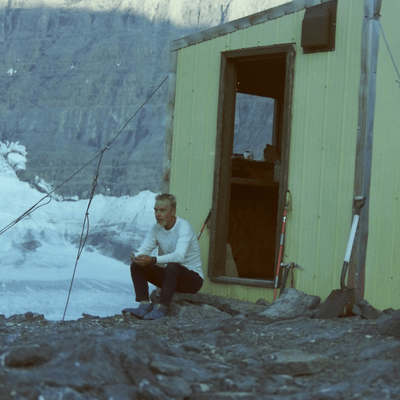
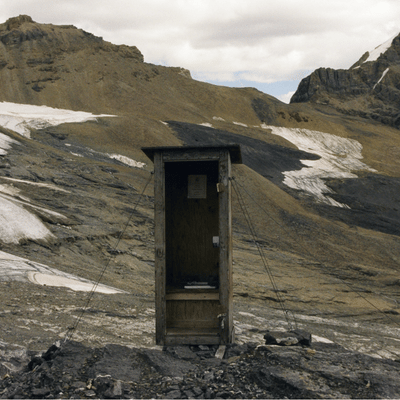
Photos of the Alberta Mountain Hut courtesy of the Lofthouse Collection.
“I stayed up there with my dad a couple of times,” says Ian. “The hut itself was pretty austere, but as a climber, you’re glad to have it when the weather turns.”
And, he says, the value-add of these mountain huts extends far beyond shelter.
“These places enable adventure — and adventurers. They serve as a jumping-off point for the next climb. They make it possible for people to do some really cool things.
“With these huts proving a safe place to stay or to stow your gear, you can travel light. You’ve got more energy to explore more. To push yourself further. To go harder.”
October 1963
- SAIT Chemistry instructor Dick Lofthouse, a founding member of the Association of Canadian Mountain Guides and life-long member of the Calgary Mountain Club (CMC), suggests student apprentices in SAIT’s Construction Department could help the club fulfill its plans to build a low-cost shelter for high-altitude climbers.
January 1964
- As a class project, SAIT Architectural Technology students draw up designs for a small, prefabricated hut designed to withstand high winds and harsh conditions.
- The plans are approved by the CMC and finalized in conjunction with a SAIT Construction Technology instructor.
- Because building just one hut isn’t a large enough project to fill the Winter term, it is decided to build two.
- Carpenter apprentice students build both huts. Constructed with plywood, insulated with fibre glass and covered with aluminum sheeting, each can accommodate six people and up to eight if necessary.
- The first hut is earmarked for a location above Moraine Lake, but there are no plans for the second hut.
June 1964
- Both huts are completed.
- The first hut is transported to a parking lot near Lake Louise using a borrowed grain truck. From there, a helicopter takes it to a site in the Valley of the Ten Peaks. It is named the Graham Cooper Hut.
- There are still no plans for the second hut. For the next three years, it is stored at an acreage southeast of Calgary.
June 1967
- A location is finally selected for the second hut. Halfway up the south-west face of Castle Mountain, the setting provides access to prime rock-climbing routes and spectacular views.
- The hut is airlifted to the mountain's Goat Plateau. Assembled on the 100th anniversary of Canada’s Confederation, the hut sits at an elevation of 2,393 metres and is named the Castle Mountain Hut.
1983
- The Graham Cooper Hut reaches the end of its lifespan and is dismantled; it is replaced by the Neil Colgan Hut. Some parts of the Graham Cooper Hut (the door and some plywood panels) are incorporated into the Mount Alberta Hut near Jasper, Alta.
2024
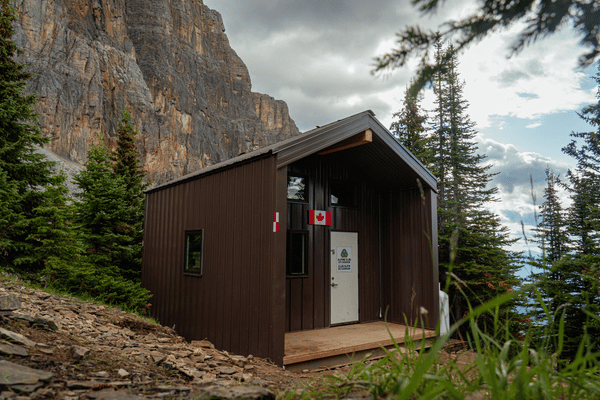
- As the Castle Mountain Hut reaches the end of its lifespan, the Alpine Club of Canada begins construction of a new cabin nearby.
August 2024
- The new Castle Mountain (Currie) Cabin opens to climbers. The original hut is disassembled and removed — yielding both its place on the mountain and the delicate piece of paper hidden by students who built it more than sixty years before.
Then and now
Alberta’s mountain huts are much-loved amenities in the world of climbing. Keith Haberl, Strategic Impact Director for the Alpine Club of Canada (ACC), has first-hand experience with many of the mountain huts and, in 1994, wrote the seminal guidebook to huts managed by the ACC.
“Some of them are grand, some are historic, and some are just wonderful pieces of architecture,” says Haberl. “The original Castle Mountain Hut was none of that!
“I’ve been there a number of times, albeit years ago,” he recalls. “It wasn’t fantastic in any normal way. It was small. It was beaten up. The door was kind of eaten away by porcupines or some such critters. It was weathered and had seen its day for sure.
“But it was loved because of the place that it was and what people went up there to do.”
To access the hut, climbers undertake a strenuous three- to four-hour uphill hike before arriving at the large plateau at the top of the lower cliff.
The mountain hut up on that lower plateau represents an opportunity for a comfortable night’s rest with an early start from there the next day to reach the best climbing routes on the rock walls above.
And a spectacular view. Not just the up-and-down that a 914-metre cliff affords, but also the expansive 180-degree perspective of the Bow Valley panning left to right from Banff to Lake Louise.
That view hasn’t changed over the years, but the accommodations certainly have.
The replacement hut, called the Castle Mountain (Currie) Cabin, opened in 2025 and offers improved capacity (sleeps eight), comfort (well insulated), safety and functionality. It also has solar powered lighting, charging stations for mobile devices (intended to improve navigation and access to real time weather forecasts), and a fully enclosed barrel toilet. A throne with a view.
“This is our DNA”
While Jim Szautner, Dean of SAIT’s School of Construction, finds the story of the 1964 Castle Mountain Hut construction project interesting, he doesn’t think it all that remarkable.
To him, the idea of a SAIT faculty member identifying an industry need and turning it into a teaching opportunity, of two programs collaborating for a shared purpose, and a class of students leaving their mark on something they proudly created with their own hands — it’s all just part of what SAIT does.
“This is our DNA,” says Szautner. “It's always been about applied learning. It’s always been about Calgary and surrounding area. Right from the day we opened our doors in 1916, through the 60s and still today, it’s who we are and what we do.”
As Szautner points out, it echoed SAIT’s long-standing emphasis on aligning form, function and materials to support practical and enduring solutions that live in the real world — beyond the confines of a laboratory.
“In this case that just happened to be a mountainside 3,000 feet up.
“Don’t get me wrong,” continues Szautner. “I think it’s great that they did that. That they applied their learned skills to build the thing properly, with the proper materials and the proper building techniques in order to ensure what they did and what they put their name behind would be there for many years to come.”
He points to current construction of the Taylor Family Campus Centre (scheduled to open in 2027) as a perfect modern-day example of the kind of cool things SAIT students are involved in, the pride of that involvement, and the lasting impact it has.
Student apprentices are on-site learning. Folks who have completed their apprenticeships are now journeypeople working on site and mentoring SAIT students.
“Two-time SAIT grad, Moses Maina (Bachelor of Science — Construction Project Management ’16 and Civil Engineering Technology ’14) is leading the project. Two other grads, Project Coordinator Nikita Fradkin (Architectural Technologies ’23) and General Foreman Shaun Leitch (Carpenter ’17) just toured me through the site,” Szautner says.
“I describe the Taylor Family Campus Centre as a love letter from current SAIT students and alumni to those of the future.”
It’s both a love letter and a legacy — just like the secret note hidden for so many years in a tiny mountainside hut.
Like what you are reading?
Find more stories from past, present and upcoming issues of LINK magazine!
Oki, Âba wathtech, Danit'ada, Tawnshi, Hello.
SAIT is located on the traditional territories of the Niitsitapi (Blackfoot) and the people of Treaty 7 which includes the Siksika, the Piikani, the Kainai, the Tsuut’ina and the Îyârhe Nakoda of Bearspaw, Chiniki and Goodstoney.
We are situated in an area the Blackfoot tribes traditionally called Moh’kinsstis, where the Bow River meets the Elbow River. We now call it the city of Calgary, which is also home to the Métis Nation of Alberta.