Photography by JChu Photography
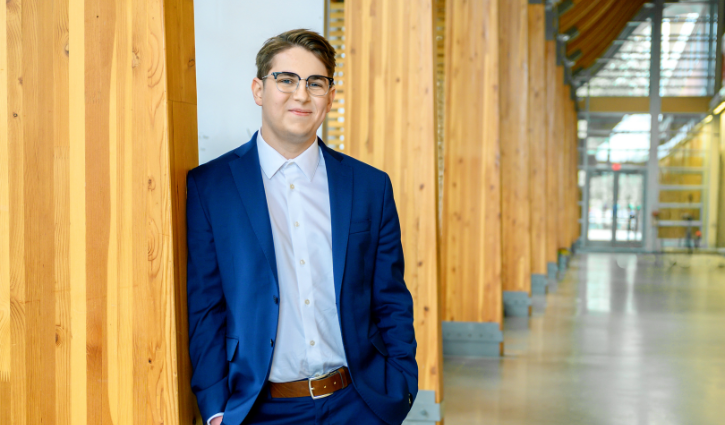
Abe Armagan (Bachelor of Science Construction Project Management ’26) was still in high school when he flew nearly 9,000 kilometres from Calgary. His parents sent him to Mauritania in West Africa to gain experience with charitable work, and to learn about the local history, language and culture. There, he lived in a remote village without access to running water or electricity.
Looking back, Armagan recognizes he was also in Mauritania to “learn a lesson.” His eight-month visit turned into two years when the COVID-19 pandemic shut down the roads and airports, preventing his return. With no certainty he would ever make it back to Canada, he began imagining what a future in Mauritania could look like while reflecting on what he took for granted at home.
“This experience made me recognize that privilege is not just about having more. It’s also about having the chance to do more. I swore to myself that if I could ever return home, I’d make the most of every opportunity,” he says.
When Armagan returned to Calgary, he completed Grade 12 at Discovering Choices, where the self-directed structure allowed him to complete 95 credits in 1 year, and where his academic performance earned him the Governor General’s Academic Medal — the most prestigious award that students in Canadian schools can receive.
At the time, he met off-campus learning coordinator Rahim Sajan, who became a mentor who guided him toward SAIT’s Bachelor of Science Construction Project Management program and imparted many hours of wisdom. This encouraged Armagan to step outside of his comfort zone and make the most of extracurriculars during his time at SAIT.
“He introduced a concept called Ikigai to me,” Armagan shares. “It translates to ‘a reason for being’ and it’s shaped everything I've done since then. Going to SAIT for this degree was perfectly in the centre of my Ikigai.”
Armagan, then a self-proclaimed introvert, took Sajan’s advice to heart. He became the President of the Construction Project Management Students’ Association (CPMSA). While balancing a 4.0 GPA and part-time employment, he rebuilt the club’s internal structure, onboarded and trained a growing executive team, doubled fundraising to nearly $50,000 and led more than 20 events in a single academic year.
The momentum extended across and beyond campus. CPMSA was awarded both the SAIT Students’ Association’s Club of the Year Award and SAIT’s President’s Student Leadership Award. In addition, Armagan was elected president of the SAIT Students’ Association and appointed to SAIT’s Board of Governors, representing more than 30,000 students in high-level decisions on policy, programming and strategic planning. He brought his work to Ottawa, meeting with members of the Prime Minister’s Office, federal ministers, and regional directors to discuss support for trades and technology students.
In his final year, Armagan founded Rotaract SAIT and served as its chartering President, bringing a worldwide community of 1.4 million people dedicated to “service above self” to SAIT.
“Service brought me to SAIT. It seems quite fitting to end my time here by creating a community dedicated to it,” he says.
Asked what’s been pivotal to creating an impact in his endeavours, Armagan says it’s ultimately the people.
“None of these accomplishments have been achieved alone, and I’ve had the honour and privilege to work with such extraordinary people: Trinity Tratch, Sophie Delaquis, Adam Krol, Moeez Saleem, Brandon Dechambre, Matthew Johnston, Ali Abou Ahmad, Youssef Khalil and countless others,” he says. “I appreciate the award and its recognition, but in fairness, it’s also deserved by the hundreds who have been so generous with their time and energy toward my journey these past four years. I’m indebted to all the kindness I’ve received, and I’m committed to paying it forward.”
Armagan hopes to one day return to Mauritania and use his SAIT education to spearhead lasting infrastructure projects to aid those living in poverty.
Oki, Âba wathtech, Danit'ada, Tawnshi, Hello.
SAIT is located on the traditional territories of the Niitsitapi (Blackfoot) and the people of Treaty 7 which includes the Siksika, the Piikani, the Kainai, the Tsuut’ina and the Îyârhe Nakoda of Bearspaw, Chiniki and Goodstoney.
We are situated in an area the Blackfoot tribes traditionally called Moh’kinsstis, where the Bow River meets the Elbow River. We now call it the city of Calgary, which is also home to the Métis Nation of Alberta.